 Support

Here is the uncomfortable truth underneath most data governance programmes: the catalog is written by the few and read by the few.
Stewards spend months documenting domains, glossary terms, lineage and quality rules. The work is genuinely good. Then adoption flattens out, because using the catalog means leaving whatever tool you are in, learning someone else's navigation model and already knowing the right word to search for. For an analyst with a deadline, asking a colleague is simply cheaper.
A catalog agent inverts that. The catalog comes to the user, inside a tool they already use, and accepts the question in the words they would use with a human. The proposition is simple: it turns a reference system into an answering system.
The weakest version of this business case is "we need an AI agent for our catalog" . It starts with the tool. The strongest version starts with work that is slow, repetitive, or unnecessarily dependent on three people who are always in meetings.
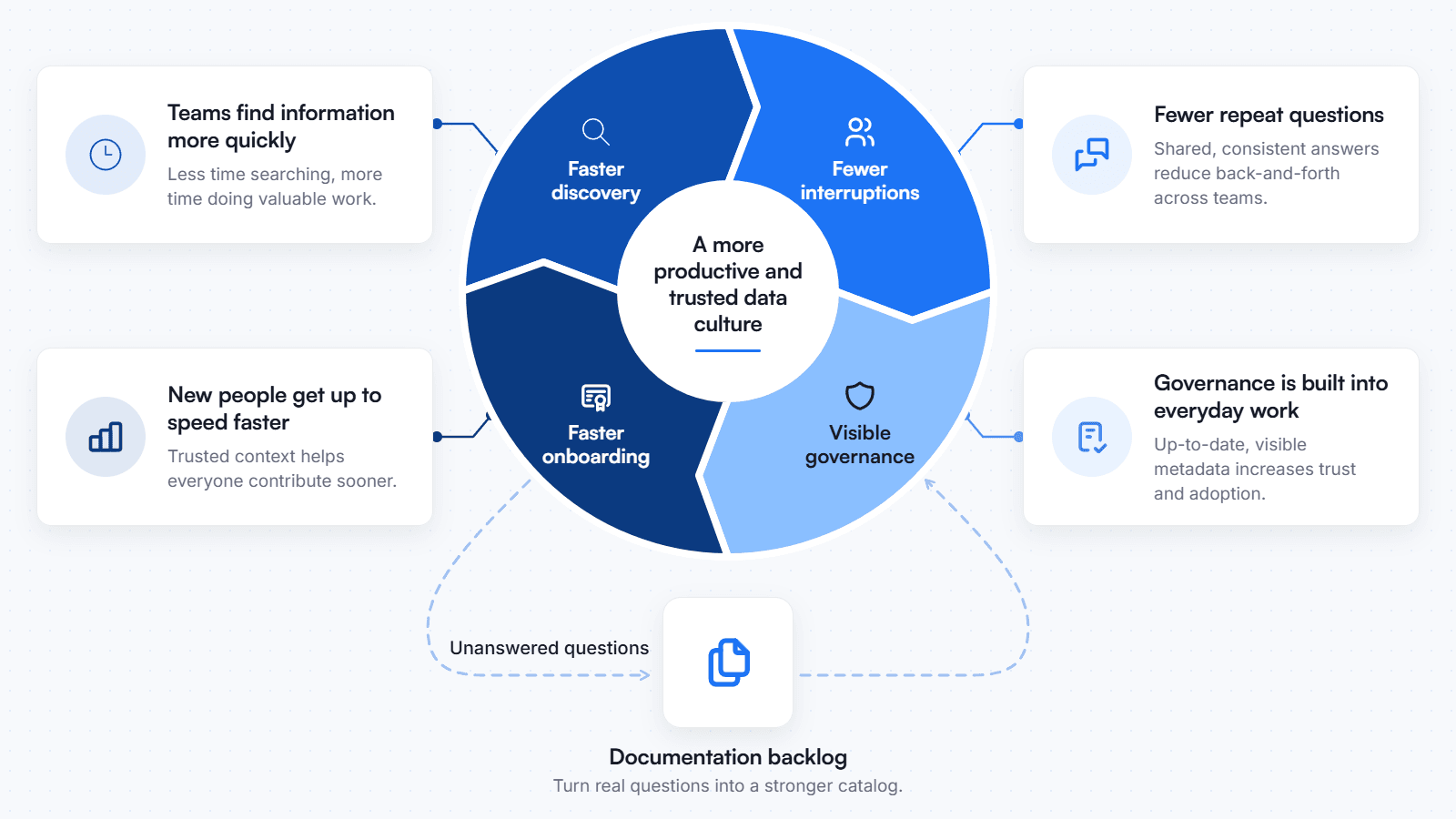
1. Time recovered from “where is it, and can I trust it?”
The expensive version of this question is not the one typed into the catalog. It is the one posted in any of communication channels like Teams or Slack, which interrupts a steward, who answers from memory, and the answer is never recorded anywhere. Six weeks later, somebody else asks the same thing. The cost is distributed and therefore invisible: a few minutes for the asker, a broken context switch for the steward, and a permanent failure to accumulate institutional memory. The agent intercepts that loop at the point of the question. The asker gets an answer faster, the steward avoids another interruption, and the answer is more consistent because it comes from the same governed source each time.
2. Guardrails on an AI habit you already have
This value driver lands hardest with risk-aware executives. Employees are already asking AI assistants about enterprise data. They are doing it today, without any connection to your catalog, and receiving answers assembled from assumptions. Without organisation-specific context, the model fills gaps with assumptions and can produce answers that sound authoritative but are partly invented.
Connecting the catalog does not introduce AI into your data estate. t puts guardrails around AI use that already exists. That reframe changes the conversation from "should we do this?" to "should we keep doing the ungoverned version?", which is a much easier question to answer.
3. Governance work becomes visibly useful
Documentation quality is hard to justify because the payoff is diffuse and arrives late. A missing description costs nothing today. It costs somebody two hours eighteen months from now, and nobody attributes that cost correctly. An agent makes the payoff immediate and legible. A well-documented domain produces useful answers. A poorly documented one produces "that is not documented in the catalog" in front of a named user, with a timestamp, in a channel their manager can see.
That gives stewards a feedback loop they have wanted for years. Missing descriptions and ownership stop being abstract completeness percentages and become real questions that real users could not answer. The backlog becomes demand-driven. It is a far better argument for funding stewardship than any maturity model.
4. Faster onboarding and absorbing change without adding headcount
New analysts, acquisitions and platform migrations generate the same burst of questions: what is this, where did it come from and who owns it? A catalog agent with lineage access absorbs part of that demand without adding headcount.
For M&A integration and multi-entity consolidation, this can be the strongest argument. The catalog records the shape of the acquired estate. The agent gives the wider organisation access to that understanding without another meeting.
Where the value lands, by role
Dataedo's governance model assigns responsibility for objects to named people, with Owner available as a role by default and further roles such as Data Custodian configurable alongside it. That matters here for a specific reason: the roles already in your catalog are the roles the agent should be designed for.
| Role | The friction today | What changes | Signal to measure |
|---|---|---|---|
| Data Owner | Cannot see the state of their domain without asking someone to pull it | On-demand view of what exists, what is undocumented and who is assigned | Owner-initiated queries per month |
| Data Steward | Interrupted constantly with questions that are already documented | Routine questions deflected; failed queries reveal genuine gaps | Reduction in ad-hoc questions |
| Data Custodian / Engineer | Impact analysis means manual lineage tracing before a change | Upstream and downstream lookup before touching a pipeline | Time to complete an impact assessment |
| Analyst / Business consumer | Does not know which of five similar tables is the right one | Finds the asset, its meaning and its owner in one exchange | Self-service resolution rate |
| Governance / Compliance lead | Evidence gathering for an audit takes days | Rapid location, classification and accountability lookup | Time to answer an audit request |
| Enterprise / Data architect | No single tool gives the cross-system view | Dependency and duplication questions that span sources | Share of queries crossing sources |
This table is also a design brief. The agent you build for a Data Owner should behave differently from the one you build for an engineer: different emphasis, different default answer shape, sometimes a different tool scope.
A value model that survives a CFO
Resist the forty-row benefits spreadsheet. For an internal pitch, one honest model lands better than ten optimistic ones. Use your own numbers and keep them conservative.
Annual time value
  =  people who ask data questions
  ×  questions per person per month
  ×  minutes saved per question
  ×  12
  ÷  60
  ×  loaded hourly cost
Then add the things that do not monetise cleanly but matter more in the room:
- Risk reduction. Fewer decisions taken on invented metadata.
- Steward capacity released. Interruption time returned to documentation work.
- Catalog investment defended. Governance work that is already paid for finally gets consumed.
- Platform leverage. One metadata investment serving several AI experiences rather than three separate integrations.
And be explicit about what the model does not cover. The agent answers questions about metadata. It will not tell you last quarter's revenue; it will tell you which table holds it, what the definition is and who owns it.
The cost side
The service is cheap. Having something worth asking is not.
| Item | Realistic scale | Who owns it |
|---|---|---|
| MCP service hosting | One small container behind HTTPS | Platform engineering |
| Initial setup | Hours for the service, not weeks | Platform engineering |
| AI platform consumption | Usually the dominant line item | AI platform owner |
| Ongoing operations | Version pinning, patching, monitoring an endpoint | Platform engineering |
| Documentation effort | The real investment — and already on your roadmap | Data governance |
That last row deserves to be said out loud in the pitch rather than discovered in month two. The service is cheap. Having something worth asking is not. If your coverage is thin today, the honest sequence is: pilot on your best-documented domain, demonstrate value there, and use that demonstration to fund the documentation of the next one.
What success looks like
| Measure | Definition | What a bad number is telling you |
|---|---|---|
| Reach | Unique users asking at least one question per month | The agent is not where the work happens |
| Answerable rate | Share of questions answered from catalog evidence | Documentation coverage, not agent quality |
| Gap discovery | Documentation gaps found via failed queries, then closed | Nobody owns the backlog the agent is generating |
| Role spread | Share of use from outside the core data team | You have built a faster catalog, not a governance channel |
| Accuracy | Steward-verified correctness on a sample | Grounding or tool scope needs work before you widen access |
| Platform leverage | Number of approved AI experiences on the same service | You built an integration, not a knowledge layer |
Gap discovery is diagnostic, not a target to maximise. A low answerable rate usually means thin documentation rather than a broken agent, and the questions it could not answer are a prioritised, demand-ranked documentation backlog you did not have to guess at.
Next up → Part 3 Securing it end to end (coming soon)
A credible value case gets sponsorship, but it does not replace a security model. Before choosing a platform or publishing an agent, the next article separates identity, transport, authorization, metadata sensitivity and client governance.


