


Microsoft just announced the retirement of Purview Data Governance, raising a critical question: where will your business glossary, data ownership, lineage, data quality rules, and stewardship processes live after 12 November 2027? While Microsoft is shifting governance into Fabric’s OneLake catalog, that isn't your only option, especially if your data spans non-Fabric systems. Depending on your current setup, we propose three practical transition paths to consider.
Microsoft is moving its data governance strategy into Microsoft Fabric, with the OneLake catalog positioned as the foundation for governing data across the enterprise. Microsoft Purview itself is not going away. Its data security and compliance capabilities, including classification, sensitivity labels and data loss prevention, remain part of Microsoft's strategy.
For organizations whose data and analytics already live mostly in Fabric, the OneLake catalog may cover much of what they need. For organizations running Fabric alongside SQL Server, Oracle, Snowflake, Databricks, Power BI, Tableau and on-premises applications, the answer is more nuanced.
In many cases, the most practical target architecture looks like this:
- Microsoft Purview protects sensitive data through classification, sensitivity labels, DLP and compliance controls.
- The OneLake catalog gives Fabric users a native place to discover and endorse Fabric items.
- Dataedo provides business context, ownership, documentation, data quality and end-to-end lineage across Fabric and non-Fabric systems.
Use the next twelve months to decide what your governance architecture should become, rather than rushing into a last-minute product swap.
What Microsoft announced
On 12 November 2026, Microsoft announced that Purview Data Governance will be retired, with support ending on 12 November 2027. Microsoft Learn now states that new accounts can no longer be created and that existing capabilities remain in maintenance mode until that date.
The announcement contains five important changes:
1. Purview Data Governance is being retired. Organizations have one year to move their governance workloads. Microsoft has published transition guidance and asks regulated customers and those with contractual obligations to contact their account team early.
2. Governance moves into Microsoft Fabric. The OneLake catalog becomes Microsoft's governance product. Microsoft's reasoning: when the catalog is not a part of the data platform, every policy, label and lineage update has to bridge two systems.
3. Purview continues as a security and compliance platform. It keeps classifying, labelling and protecting sensitive data, preventing data loss and supporting compliance. There is no need to remove Purview completely just because its governance product is retiring.
4. Governance cost moves into Fabric capacity. Microsoft says governance will be included in Fabric capacity rather than billed through separate meters. That simplifies licensing for Fabric-committed organizations, but it also ties governance to your wider Fabric capacity strategy.
5. Non-Fabric data is reached through Fabric. The OneLake catalog will govern Azure and third-party data through shortcuts, mirroring and supported connectors, without copying it. The architectural question is not only whether data has to move. It is whether you want Fabric to be the control point through which your whole estate is governed.
What is actually at risk?
The end-of-support date is not mainly a metadata-scanning problem. Scanning another database is easy. The real risk is losing the governance knowledge, processes and adoption built up around the current platform.
Depending on how deeply you use Purview Data Governance, that may include:
- business glossary terms and their relationships;
- governance domains and data products;
- ownership and stewardship assignments;
- critical data elements;
- data quality rules;
- technical and business lineage;
- classifications and managed attributes;
- review and approval processes;
- evidence used for audit, regulatory or internal control purposes.
Reconstructing years of business definitions, ownership decisions and stewardship activity is hard. That is why the transition should start first with an inventory of governance content before you start evaluating replacement products.
Three possible transition paths
There is no single right destination for every Purview customer. It depends on the shape of your data estate and the maturity of your governance program.
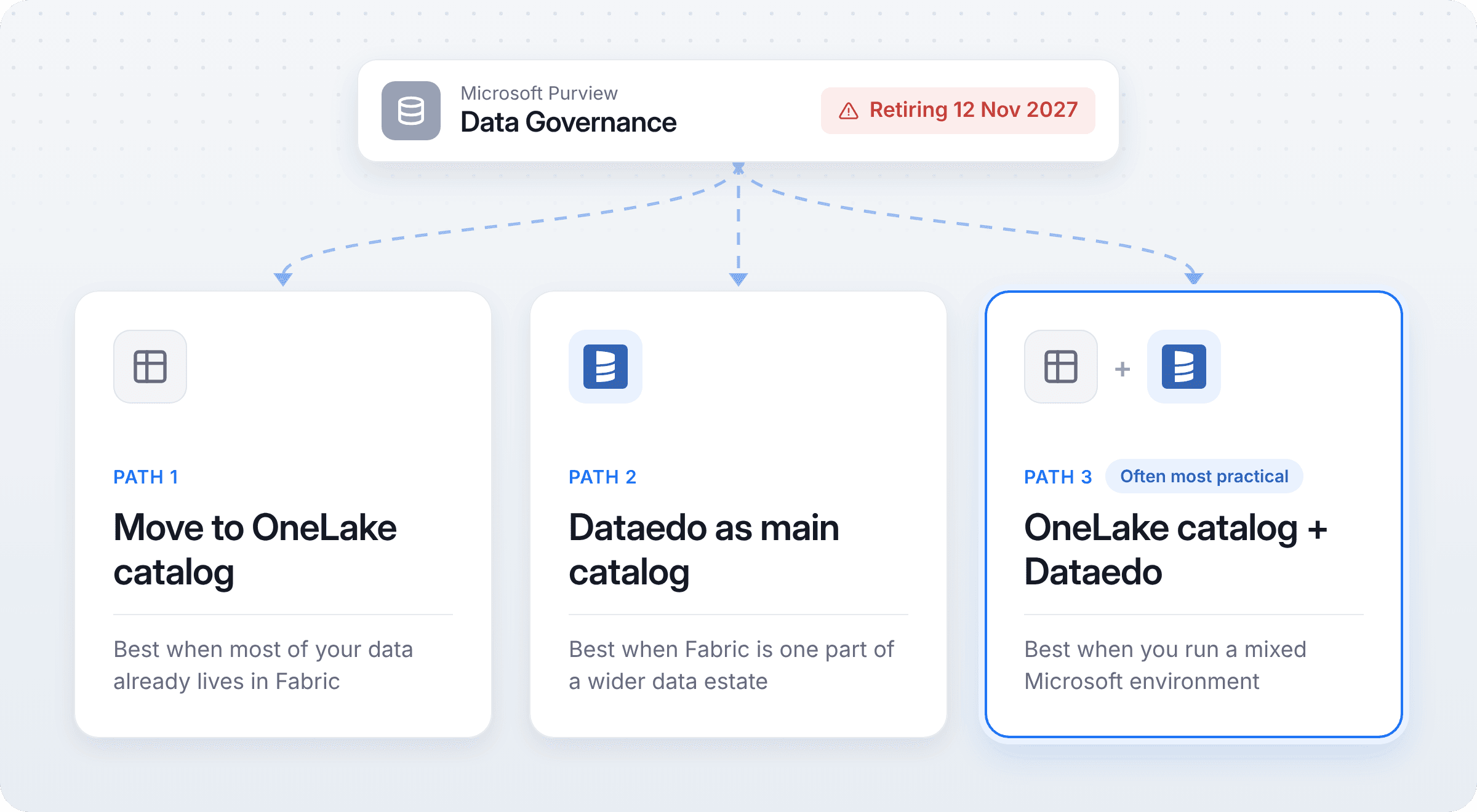
Path 1: Move primarily to the OneLake catalog
This will work only when:
- your most important data and analytics workloads already run in Fabric;
- Fabric is the strategic destination for the rest of the estate;
- users mainly need discovery, endorsement, item-level lineage and admin governance views;
- you are comfortable linking governance to Fabric capacity;
- what OneLake offers meets your glossary, stewardship, lineage and data quality needs.
It is the most natural Microsoft-native path. Fabric is evolving quickly, so check your requirements against what is generally available at the time you decide.
Path 2: Use Dataedo as the main governance catalog
Dataedo makes sense when:
- Fabric is only one part of your data landscape;
- important data stays in on-premises or non-Microsoft platforms;
- people need one glossary, one ownership model and one lineage view across the estate;
- you need detailed technical documentation or column-level lineage now;
- data quality should be managed next to metadata;
- self-hosting or deployment control matters;
- governance should not depend on where data is stored or processed.
Path 3: Use the OneLake catalog and Dataedo together
For mixed Microsoft environments, this is often the most practical model. Fabric users keep discovering and endorsing Fabric items in the OneLake catalog. Purview keeps applying security and compliance controls. Dataedo holds the shared business definitions, ownership, documentation, data quality and cross-platform lineage.
This is not duplication, as long as each platform has a deliberate role. Problems start only when two catalogs try to own the same glossary and stewardship workflow without a clear system of record.
A practical target architecture
For most Microsoft-centric organizations, the target state has three layers.
Layer 1: Protect with Microsoft Purview. Sensitivity labels, DLP, information protection, sensitive information classification and compliance across Microsoft 365, Azure and Fabric. Dataedo is not designed to replace any of this.
Layer 2: Discover Fabric items in the OneLake catalog. Finding and endorsing Fabric items, Fabric lineage and admin views, with governance signals kept close to Fabric users and workloads.
Layer 3: Govern the wider estate with Dataedo. A shared business glossary, ownership and stewardship, domains and data products, technical and business documentation, cross-platform and column-level lineage, profiling and data quality, schema change tracking, and Steward Hub workflows, across Fabric and non-Fabric sources alike.
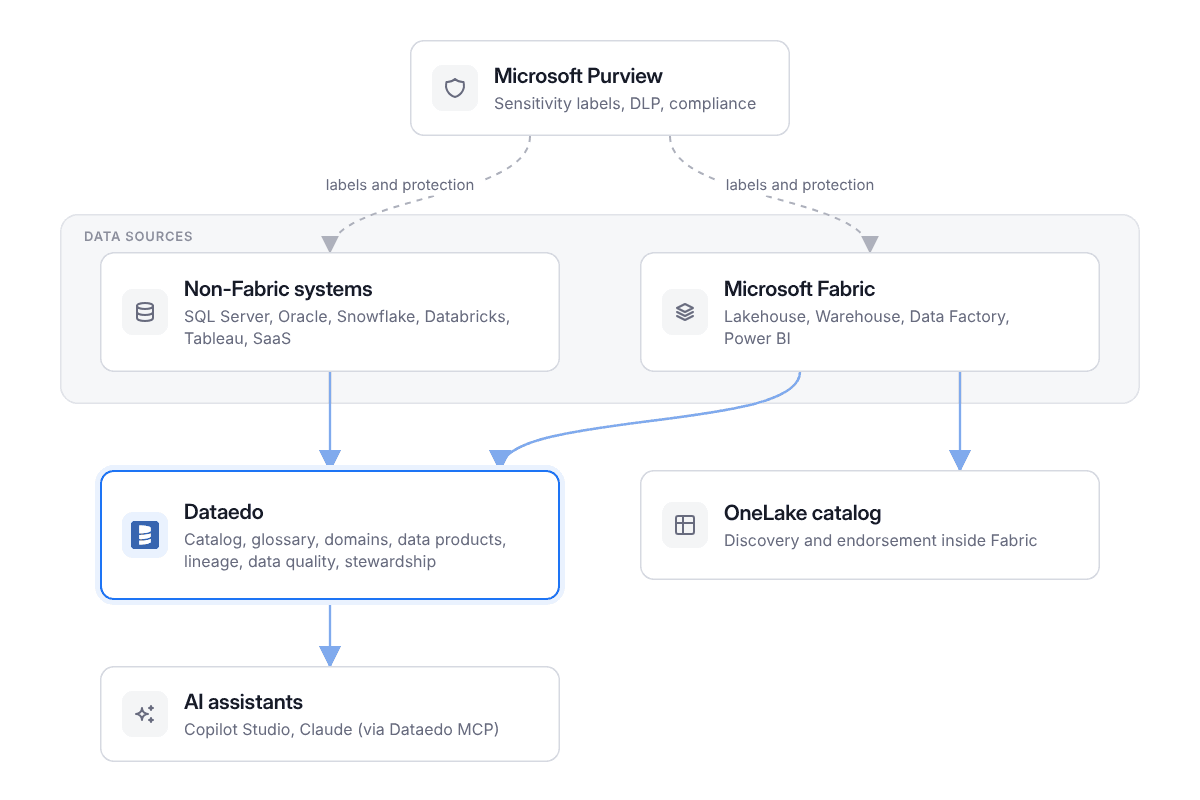
Purview protects the data. OneLake serves the Fabric experience. Dataedo connects governance across the wider estate.
Microsoft Purview, OneLake catalog and Dataedo compared
These platforms are not direct substitutes. Each covers a different part of the target architecture. The comparison reflects capabilities as of November 2026. We advise that you validate critical requirements in a proof of concept.
Role, Fit & Licensing
| Aspect | Microsoft Purview | OneLake catalog | Dataedo |
|---|---|---|---|
| Primary role | Data security, information protection, DLP and compliance | Native discovery and governance for Fabric | Cross-platform catalog, documentation and governance |
| Role after November 2027 | Keep for security and compliance | Native catalog for Fabric users | Governance layer across Fabric and non-Fabric systems |
| Best fit | Microsoft-native protection and compliance | Estates centred on Fabric | Mixed estates needing shared definitions, stewardship, quality and lineage |
| Commercial model | Security and compliance licensing continues | Included in Fabric capacity | Separately licensed, with published pricing |
Governance & Platform Features
| Feature | Microsoft Purview | OneLake catalog | Dataedo |
|---|---|---|---|
| Business glossary | Part of the retiring governance product | Check current availability against your needs | Glossary with term relationships, linked to technical assets |
| Domains and data products | Part of the retiring governance product | Fabric domains | Nested domains and data products linked to ownership and lineage |
| Ownership and stewardship | Governance stewardship must move | Fabric-oriented roles and admin views | Owners, stewards, Steward Hub and workflows |
| Lineage | Existing governance lineage is affected | Fabric lineage, depth varies by workload | Cross-platform lineage, column-level for supported sources, plus manual lineage |
| Data quality | Governance-side quality needs a new home | Check current native capabilities | Profiling, rules, thresholds, scheduled checks, dashboards |
| Schema change tracking | Depends on what is migrated | Check against your audit scenario | Schema change tracking and history of changes |
| Sensitivity labels and DLP | Core capability, enforced here | Shows and uses Purview labels | Not in scope: stays in Purview |
| Non-Fabric data | Depends on Microsoft services and connectors | Through shortcuts, mirroring and supported connectors | Direct connectors to databases, warehouses, ETL and BI tools |
| Power BI | Protection and scanning depend on configuration | Native | Workspaces, semantic models, reports, pages, visuals, dataflows, lineage |
| AI and agent access | Security and compliance context for Microsoft AI | Native AI access to governed Fabric metadata | AI autodocumentation; read-only, permission-aware MCP server (beta) |
| Deployment | Microsoft cloud service | Part of Microsoft Fabric | Self-hosted on-premises or in a public cloud, or hosted by Dataedo |
Organisations whose estate sits almost entirely in Fabric may find the OneLake catalog sufficient. Organisations with mixed estates should test whether it gives them the coverage they need without making Fabric the mandatory route for every important source.
What Dataedo brings to the transition
1. Keep the work you have already done
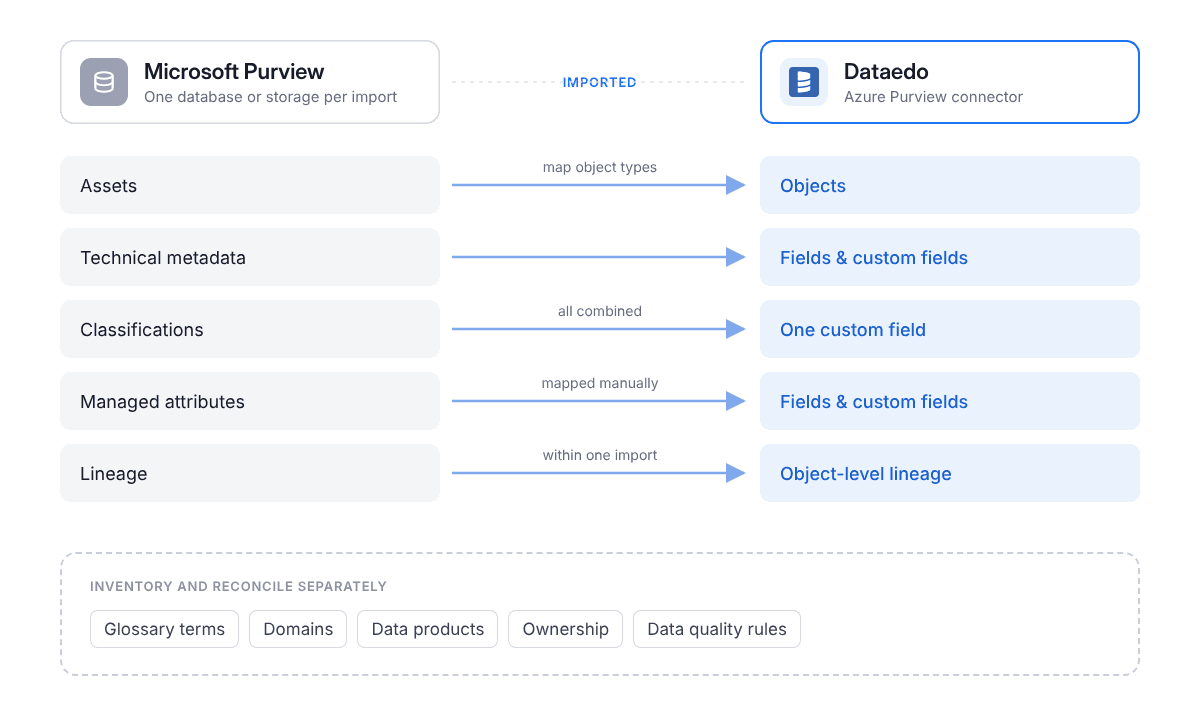
You should not have to start with a blank catalog. Dataedo's Azure Purview connector imports Purview assets as objects and maps technical metadata, classifications and managed attributes to Dataedo fields and custom fields.
Treat this as a technical starting point, not a one-click migration. The connector imports one database or storage at a time, requires mapping Purview object types to Dataedo object types, and builds object-level lineage within a single import. Glossary terms, domains, data products, ownership and quality rules should be inventoried and reconciled separately. The goal is not just to copy metadata, but to preserve the governance meaning attached to it.
2. Govern data where it already lives
The OneLake catalog reaches external data through Fabric mechanisms. Dataedo connects to each source directly, which helps when you have operational SQL Server databases, on-premises Oracle applications, Snowflake or Databricks, Power BI and other BI tools, legacy warehouses, or ETL platforms spread across several clouds. You can document an on-premises ERP database and a Fabric warehouse in the same catalog, with the same glossary and lineage.
3. Add a business layer people actually use
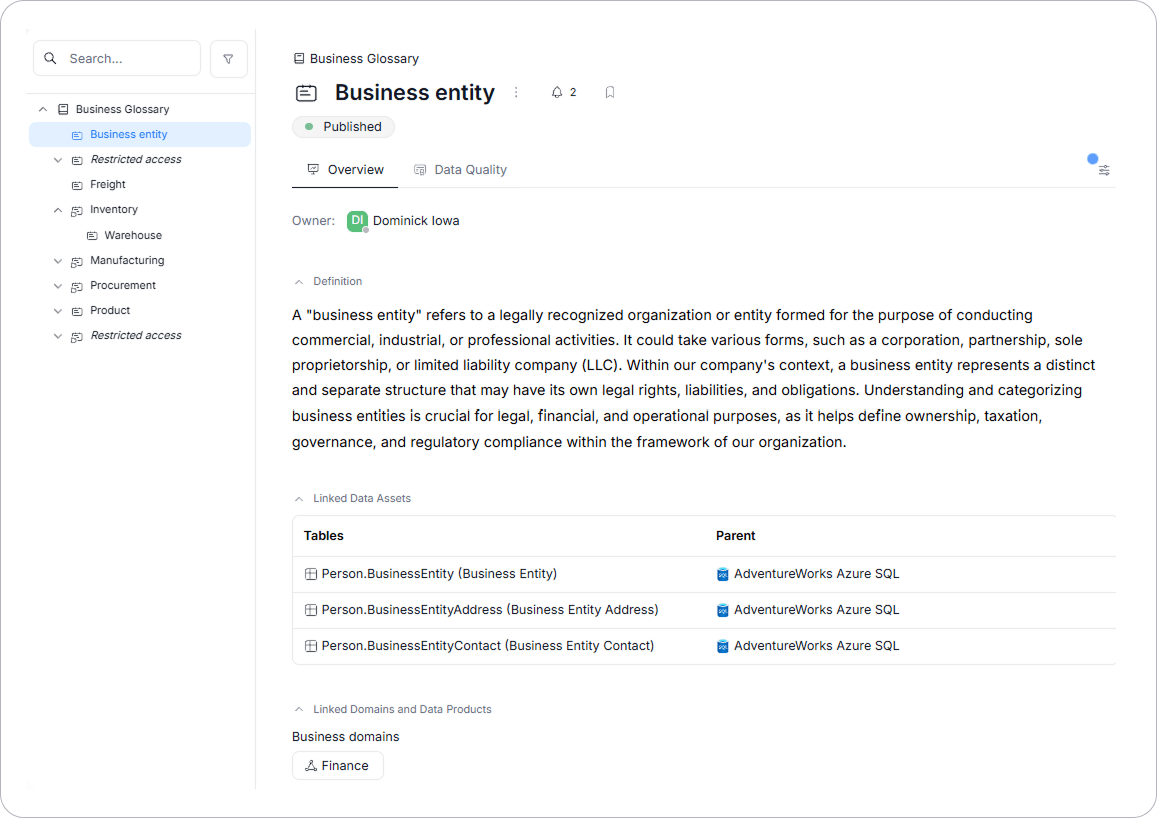
A catalog earns its place when it helps people understand data, not when it simply lists objects. Dataedo links:
- business terms to tables, columns and reports;
- owners and stewards to assets; data products to their sources;
- and quality rules to the data they measure.
A finance analyst can then go beyond where is the revenue table? and answer: What does recognised revenue mean? Which report uses the approved definition? Who owns it? Where does it come from? Has its quality been tested? What breaks if the source changes?
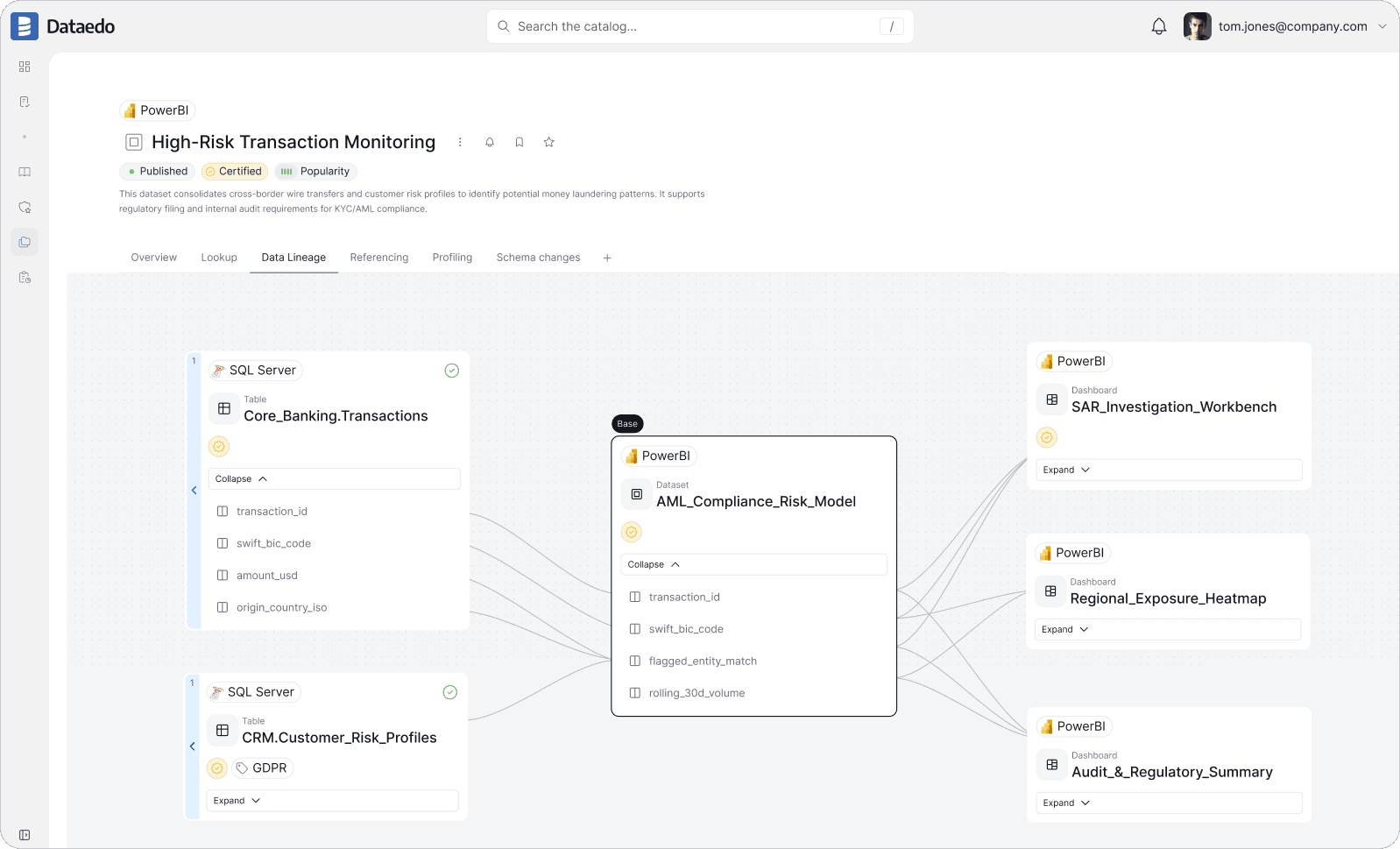
4. Follow lineage across platforms
A typical reporting flow runs from an operational database, through a pipeline, into a Fabric Lakehouse or Warehouse, into a Power BI semantic model and its DAX measures, and finally into a management report. A platform-specific catalog shows only the part inside that platform.
Dataedo combines automatically extracted lineage with manually documented processes where automation can't see the link. Its Microsoft Fabric connector currently covers Power BI, Data Warehouse, Data Lakehouse and Data Factory, with Real-Time Analytics under development. For Fabric Data Factory it imports pipelines, activities, sources and destinations.
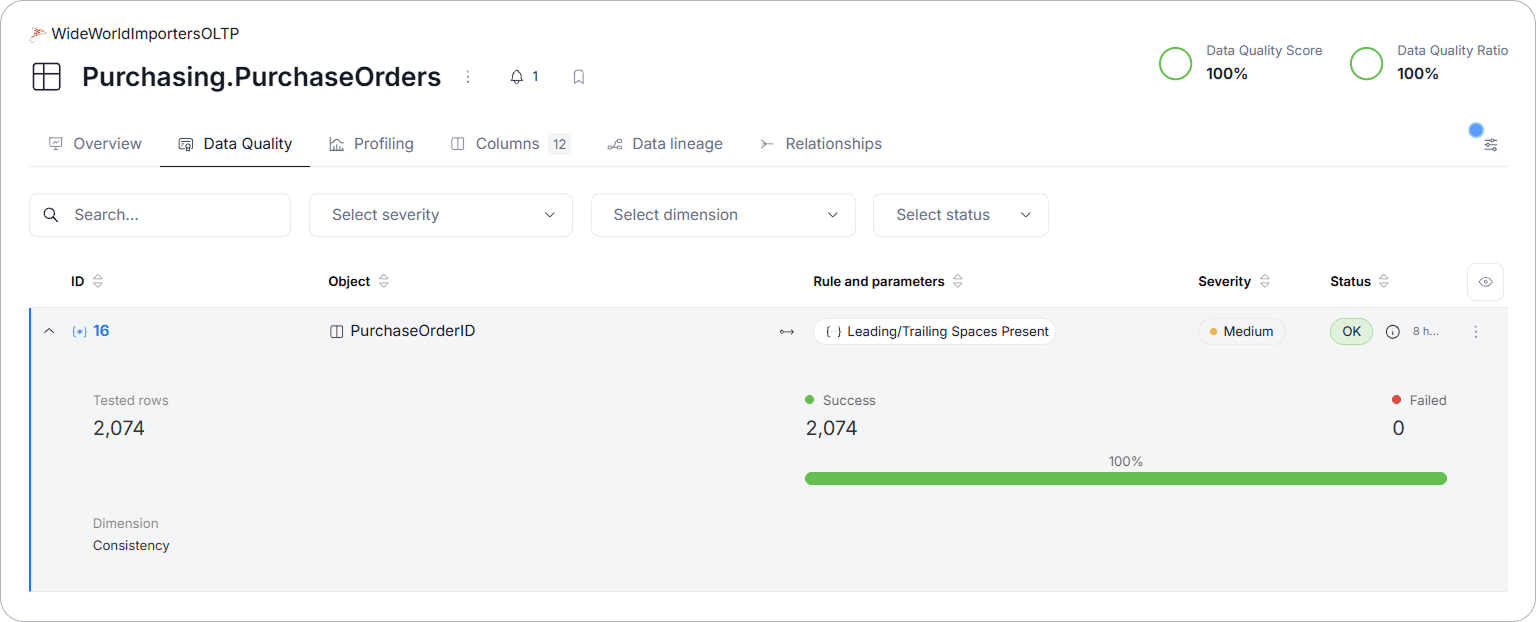
5. Put data quality next to documentation and ownership
Profiling, quality rules, thresholds and failed-row inspection are right in the documentation. Users can move from an asset to its definition, owner, lineage and quality status in one place, and quality issues reach the right steward faster.
6. Governance for people and AI agents
Microsoft ties its announcement directly to AI: agents need to know what data means, who can use it and whether it can be trusted. That makes good metadata more important, not less. Dataedo's MCP server gives AI assistants read-only access to the catalog: assets, descriptions, lineage, glossary terms, domains and data products. It respects each user's permissions. In hosted mode, users sign in through Dataedo's own login, including SSO, which suits Copilot Studio, Claude on the web and ChatGPT. In local mode it runs on the user's machine for Claude Desktop. The integration is currently in beta, so confirm the status and supported clients when you plan it.
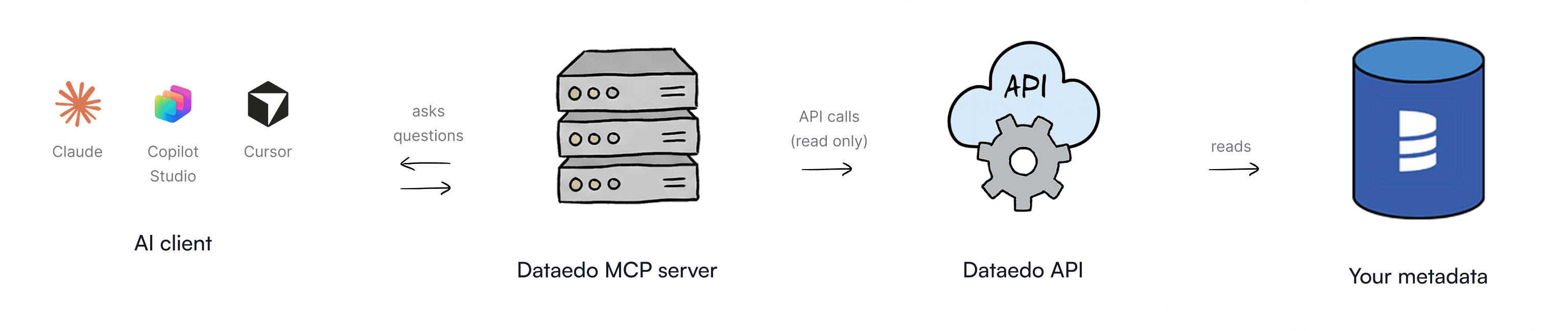
AI assistants should draw on an authoritative metadata source, not guess from undocumented schemas and scattered files.
Who should evaluate Dataedo now?
While teams with simple, Fabric-only environments have room to wait, organizations with broader data landscapes or mature governance programs benefit from testing alternatives early. You should put Dataedo on your shortlist now if:
- You have a mixed technology estate. Fabric matters, but core data still lives in Oracle, SQL Server, Snowflake, Databricks or on-premises systems.
- You have invested heavily in Purview governance content. Start early enough to reconcile and validate it. A deadline-driven export in the last quarter leaves no time to check completeness.
- Glossary and stewardship are central. Test the full lifecycle: create a term, assign an owner, link it to assets, review and approve it, and communicate a change.
- You need detailed lineage now. Validate each critical source-to-report flow rather than relying on a general product statement.
- You need to self-host. Dataedo runs on-premises or self-hosted on AWS, Azure or Google Cloud.
What Dataedo does not replace
As you evaluate Dataedo for the scenarios above, plan for it to work alongside Microsoft Purview rather than replace it completely. Keep Purview for sensitivity labels, information protection, DLP and compliance, which is exactly the part Microsoft is investing in. Use Dataedo for the governance work that needs to be preserved and extended: catalog, glossary, ownership, lineage, quality, workflows and AI-ready metadata.
Start with a four-week proof of concept
The lowest-risk way to validate your target architecture is to test it on a representative slice of your real environment before committing to a full migration. Keep the scope tight enough to finish in four weeks. A focused Dataedo proof of concept could include:
- one Fabric Lakehouse or Warehouse;
- one Power BI workspace;
- one non-Fabric source, such as SQL Server, Oracle, Snowflake or Databricks;
- 20 to 30 priority business terms;
- two business-critical reports or data products;
- one source-to-report lineage scenario;
- three to five data quality rules.
Put this slice in front of a small working group, for example a data steward, a data engineer, and a report consumer, to see how it holds up in daily work. At the end of the four weeks, judge the pilot on five practical questions rather than a generic feature checklist:
- Can people find the right data without knowing its database, workspace or technical name?
- Can they understand what it means through an approved definition, owner and classification?
- Can they trace where it came from from a Power BI measure back to the source system?
- Can they see whether it is trustworthy through certification, quality results and an accountable owner?
- Does it scale across Fabric and non-Fabric systems without creating separate governance silos?
A 12-month transition plan
With support ending on 12 November 2027, starting early lets you pace the move through deliberate validation, parallel running, and team adoption. That timeline reflects a measured organizational rollout, but if you are starting later in the cycle, Dataedo is simple enough that you can move through deployment, metadata import, and pilot testing significantly faster.
| Phase | Timing | What to do |
|---|---|---|
| Inventory | Nov–Dec 2026 | List glossary terms, domains, data products, critical data elements, owners, classifications, quality rules, lineage, workflows and scanned sources. Split them into migrate, redesign, retire, and stays in Purview. |
| Prove | Jan–Mar 2027 | Run a Dataedo proof of concept with Fabric and non-Fabric sources. Validate connectors, glossary usability, lineage, quality rules, workflows and deployment. |
| Design | Mar–Apr 2027 | Decide the system of record for the glossary, domain and data product ownership, the split of responsibilities between Purview, OneLake and Dataedo, and audit requirements. |
| Migrate | Apr–Jul 2027 | Import technical metadata with the Purview connector, bulk-load glossary terms and assets from Excel or CSV, rebuild domains, data products and quality rules, and validate lineage. |
| Run in parallel | Aug–Oct 2027 | Train stewards, onboard business users, test permissions, monitor adoption, connect AI assistants and close content gaps. |
| Switch off | Before 12 Nov 2027 | Make Dataedo the system of record for governance, retire Purview Data Governance workloads, and keep Purview for labels, DLP and compliance. |
How to evaluate the options
Feature comparisons often look similar on paper, so the most reliable way to weigh the OneLake or another catalog against Dataedo is to test how each handles your actual workflows during a proof of concept. Evaluate both options across the nine practical scenarios below, scoring them on a simple scale:
- 0 unsupported,
- 1 needs substantial custom work,
- 2 partially supported,
- 3 supported with configuration,
- 4 supported natively and proven in the pilot.
| Scenario | What to test | Score |
|---|---|---|
| Business discovery | Can an analyst find the approved definition and the certified asset? | |
| Ownership | Can users identify the accountable owner and steward? | |
| Source-to-report lineage | Can a Power BI measure be traced to its source? | |
| Change impact | Can a team see which reports a changed column affects? | |
| Data quality | Can a steward see failing rules and the affected rows? | |
| Mixed estate | Do Fabric and non-Fabric assets share definitions and ownership? | |
| Audit evidence | Can you show what changed, who approved it and when? | |
| AI readiness | Can an authorised assistant read trusted metadata without changing it? | |
| Deployment control | Does the platform meet hosting, network and residency requirements? |
Capturing these scores alongside real examples from your pilot gives technical and business stakeholders an objective baseline to agree on the right target architecture.
Frequently asked questions
Does Dataedo replace Microsoft Purview completely?
Do I have to choose between Dataedo and the OneLake catalog?
Can I move my Purview content into Dataedo?
Does Dataedo support Microsoft Fabric?
Do I need Fabric to use Dataedo?
Can Dataedo run on-premises?
Does Dataedo work with Copilot?
Is the OneLake catalog free?
Next steps: Start with your current setup
Twelve months is enough to move calmly, but only if you start now. Before deciding where governance goes, find out which Purview capabilities you really use, what must be preserved, how much of your data is located outside Fabric, and what your stewards, auditors and AI assistants will need.
Evaluating your options before Purview Data Governance retires? Book a free 30-minute Purview-to-Dataedo migration consultation. We’ll show you what you can migrate from Purview into Dataedo and how our product covers the governance features you rely on today.


