


Data teams have looked for Purview alternatives for years: lineage is missing for many non-Azure sources, consumption billing is hard to budget, and analysts find a security product awkward to use as a data catalog. Until this month, switching was a question of fit. Microsoft's latest announcement turned it into a deadline.
On November 12, 2026, Microsoft announced that Purview Data Governance will be retired. In the announcement on the Microsoft Security Community Blog, Microsoft states that "Support for Purview Data Governance will end Nov. 12, 2027." Microsoft Fabric, with the OneLake catalog, becomes Microsoft's data governance product. Purview itself stays, but only for data security and compliance: classification, sensitivity labels and data loss prevention.
The Purview connector documentation is more specific. It says the Unified Catalog and the classic data governance capabilities (formerly Azure Purview) are being retired, no new accounts can be created, and existing capabilities stay in maintenance mode until November 12, 2027.
That gives you one year. If you run Purview's catalog today, you need a replacement live before support ends, and catalog migrations (connectors, glossary, ownership, lineage, stewardship habits) rarely take less than two quarters. If you were evaluating Purview, stop: you can no longer create an account.
Why people look for Purview alternatives
The retirement settles the question for current customers. But teams were shopping for Purview alternatives well before November 2026, and the reasons they gave still matter, because some of them apply to Microsoft's replacement too.
1. Lineage and connector coverage outside Azure
Purview's own connector overview lists lineage support per source. Tableau, Salesforce, Amazon Redshift, MongoDB, SAP HANA and SAP BW show no lineage. On-premises SQL Server shows lineage only when the table is a source or sink in an Azure Data Factory or Synapse pipeline. Azure resources have to sit in the same tenant as the Purview account unless the documentation says otherwise. If your stack runs on Redshift, Salesforce and Tableau, a large part of your lineage graph was never going to appear.
2. Cost you could not predict before scanning
Purview data governance was billed on consumption. In its announcement, Microsoft points out that governance in Fabric "is included in Fabric capacity" with no separate meters, which tells you how customers felt about the old model. Finance teams want a number for the budget line before the first scan.
3. A security product doing a catalog's job
Purview grew out of Azure Purview and the Microsoft 365 compliance portal. Its strengths are classification, sensitivity labels and data loss prevention. The people who use a data catalog every day (analysts looking for the right table, stewards writing definitions, engineers checking what a column change will break) need search, documentation and collaboration first. Microsoft has now drawn the same line: Purview keeps security and compliance, and the catalog moves to Fabric.
What to look for in a Purview alternative
Start with two questions: what do you lose when Purview goes, and who will look after the replacement? A team with one SQL Server warehouse and Power BI needs a different tool from a bank with a governance office and dozens of domains. Write down what you rely on in Purview today (glossary terms, classifications, owners, scans), name the person who will maintain the new catalog, and test your shortlist on your own data. Vendor feature grids look alike, so a short proof of concept is where the differences show.
These are the criteria we would use, in order of how often they decide the outcome:
- Lineage for your actual stack. Ask for column-level lineage on your own pipelines (for example SQL Server stored procedures into Power BI, or dbt into Snowflake into Tableau). A logo on the connector page only proves the vendor can read table names.
- A migration path out of Purview. Your glossary terms, asset descriptions, owners and classifications are the expensive part. Check whether the tool can import them from Purview or whether you will copy them by hand.
- Microsoft Fabric and Power BI support. Most Purview customers run Power BI. Your new catalog should scan Fabric workspaces, semantic models and reports, and show lineage from source tables into reports.
- A price you can budget. Ask for a written quote for year one and year three at your expected scale: number of sources, editors and viewers. Few vendors publish prices; Dataedo does (see the table below).
- Deployment that fits your compliance rules. Microsoft's announcement tells customers in highly regulated industries to engage their account team early. If your data cannot leave your network, you need a tool that runs on premises or in your own cloud tenant. Several vendors on this list are SaaS only.
- Who will run it. Some platforms need a dedicated admin team and an implementation partner. Ask reference customers of your size how many people maintain the catalog and how long it took to go live.
- Data quality in the same tool. If you have data quality checks elsewhere (dbt tests, Great Expectations, Soda), a catalog that shows those results may be enough. If you have none, a tool with built-in rules saves a second purchase.
Purview alternatives comparison summary
| Tool | Gartner Peer Insights (ratings) | Deployment | Public pricing | Best for |
|---|---|---|---|---|
| Dataedo | 4.7 (105) | On premises, self-hosted on AWS, Azure or GCP, or Dataedo-hosted | Yes, from $18,000 per year | Mid-size data teams on Microsoft and SQL stacks that need lineage and a fixed budget |
| DataGalaxy | 4.7 (120) | SaaS (EU or US); on premises per vendor | No | Governance organized around data products and business value |
| Alation | 4.6 (340) | SaaS or customer-managed | No | Large analyst communities where search and adoption matter most |
| Atlan | 4.6 (177) | SaaS | No | Purview customers moving to Fabric with sources outside it; cloud-native stacks and AI agent context |
| Informatica CDGC | 4.4 (1,378, whole IDMC suite) | SaaS | No, consumption units | Companies already running Informatica IDMC |
| Ataccama ONE | 4.4 (103) | Cloud or on premises | No | Programs where data quality is the main problem |
| Collibra | 4.3 (312) | SaaS (self-hosted edition launched in 2024; confirm availability) | No | Large enterprises with a formal governance office and policy workflows |
| Microsoft Fabric OneLake catalog | Not rated as a catalog | Part of Fabric (SaaS) | Included in Fabric capacity | Data estates already consolidated in Fabric |
Gartner Peer Insights ratings are the all-markets product score on gartner.com, checked on November 18, 2026. Purview Data Governance scores 4.2 from 107 ratings on the same scale.
The 8 best Purview alternatives for data governance
1. Dataedo
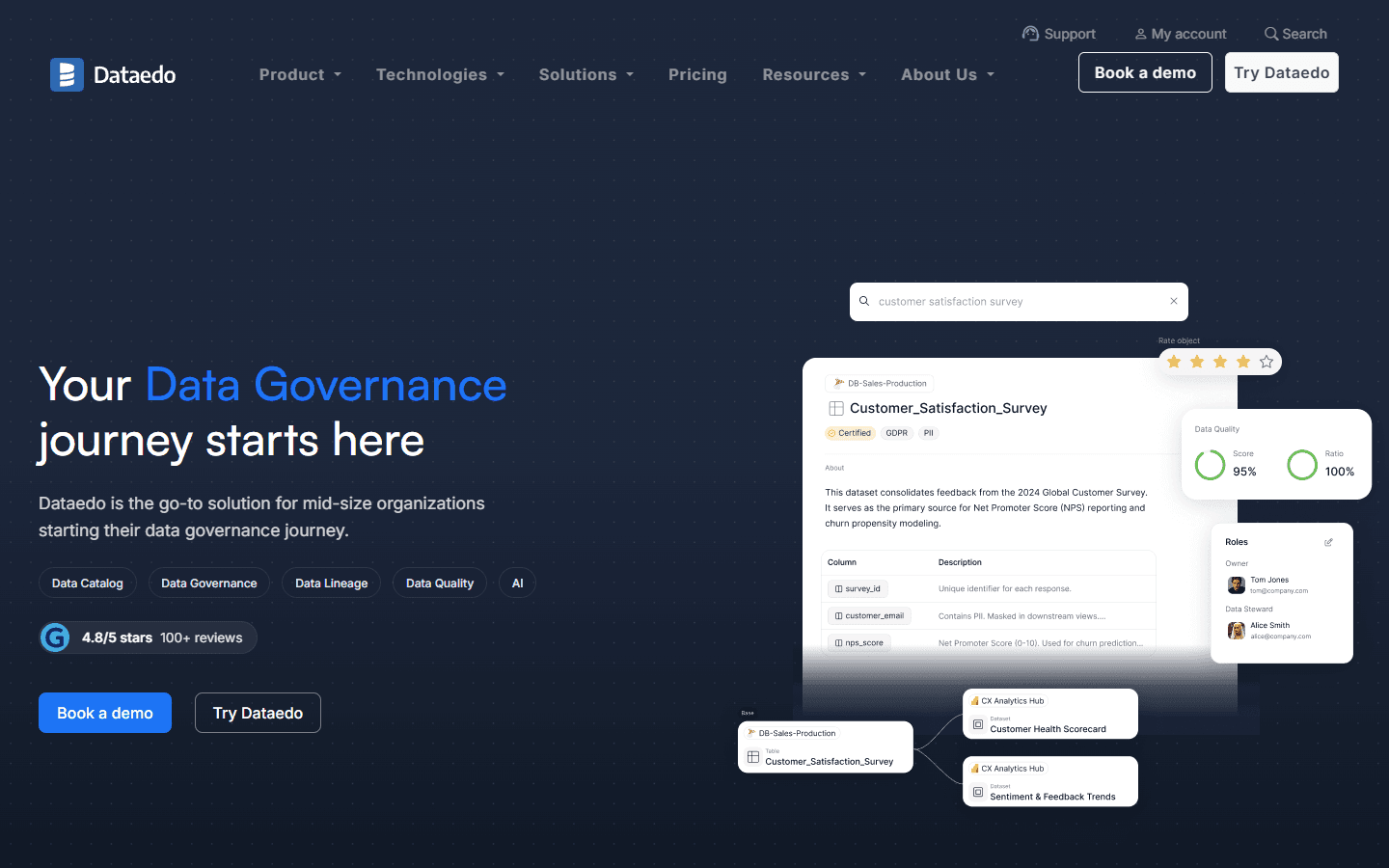
Dataedo is a data catalog and governance platform built for mid-size organizations that need governance working without a dedicated governance office. One tool covers the data dictionary, business glossary, ER diagrams, object and column-level lineage, data profiling, classification and data quality (90+ built-in rules plus custom SQL rules). AI Autodocumentation drafts descriptions for tables, columns and glossary terms, so the catalog does not start empty. Dataedo connects to 100+ sources natively, from SQL Server, Oracle and Snowflake to Power BI, Power BI Report Server, Microsoft Fabric, Azure Data Factory and Azure Synapse Pipelines (full connector list).
For Purview customers, Dataedo's Purview connector imports your existing Purview assets, technical metadata, classifications and managed attributes, with predefined mappings for 24 Purview services such as SQL Server, Azure SQL Database, Snowflake, Fabric and Tableau Server. Dataedo's native connectors then add column-level lineage across those sources, and Solution Engineers help move what the import does not carry.
Pricing is on the website: $18,000 per year for Essentials, $24,000 for the Data Lineage plan and $32,000 for the Data Quality plan, each with a minimum of three editors and unlimited viewers.
Pros:
- Public pricing, where all plans come with unlimited connectors and viewers, so rolling the catalog out to every analyst does not change the bill.
- Runs on premises or self-hosted on AWS, Azure or GCP, which matters for regulated teams leaving Purview.
- Purview, Power BI and Fabric connectors give Purview customers an easy migration path.
- Strong on relational databases such as SQL Server, Oracle and legacy systems that cloud-first catalogs treat as an afterthought.
Cons:
- Policy management and approval workflows are lighter than Collibra's. A governance office with formal policy lifecycles will outgrow it.
- No master data management or access control.
- Pricing starts at three editors and $18,000 a year. A team with one database and one analyst may get by with the OneLake catalog that comes with Fabric.
Best for: Mid-size companies, especially on Microsoft and SQL stacks, who want lineage and documentation running within weeks on a budget they can state upfront. On-premises deployment also makes it a strong fit for highly regulated industries such as finance, healthcare and public institutions, where metadata has to stay inside your own network.
Gartner Peer Insights: 4.7 out of 5 from 105 ratings.
2. Microsoft Fabric OneLake catalog
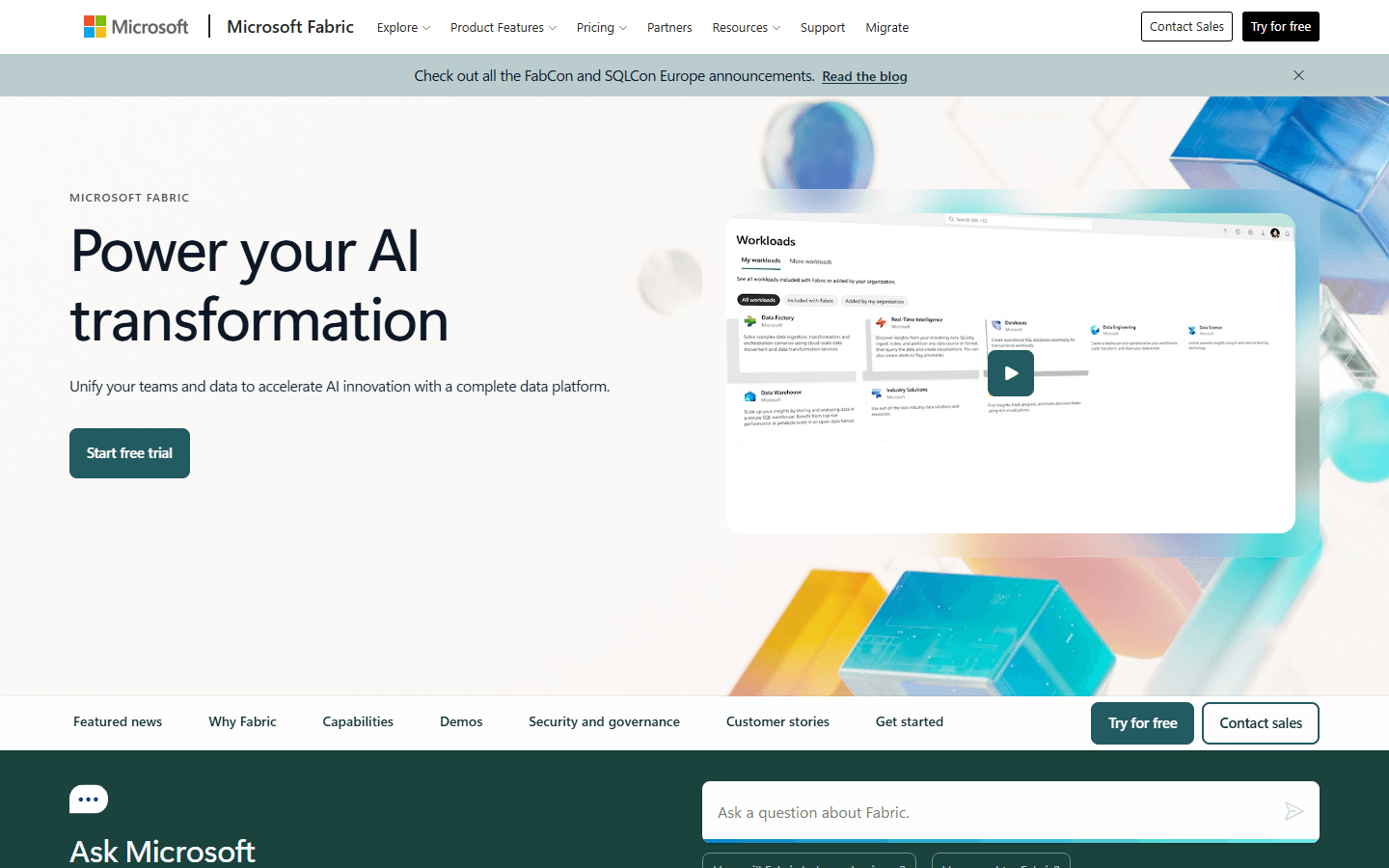
The OneLake catalog is Microsoft's own answer. The retirement announcement calls it "the single foundation for governing data across your entire estate". It governs Fabric items directly and reaches Azure and third-party data through shortcuts, mirroring and connectors. Governance is included in Fabric capacity, with no separate meters.
According to the OneLake catalog overview on Microsoft Learn, the catalog has three tabs. Explore is for finding Fabric items (lakehouses, warehouses, mirrored databases, semantic models, reports) with descriptions, tags, schemas, lineage and permissions in the item view. Govern shows governance health for the data you own: domains, endorsements, metadata scanning, policies, governance insights and recommended actions, plus the admin settings that used to sit in the Fabric admin portal. Secure brings workspace roles and OneLake security roles into one view for access reviews. The catalog is also embedded in Teams, Excel and Copilot Studio, and developers can query it through the Catalog Search REST API; Microsoft's February 2026 blog post adds the Fabric MCP server and the Fabric CLI.
It is already widely deployed. In a February 2026 Fabric blog post, Microsoft said more than 230,000 organizations had adopted the OneLake catalog within about a year of launch, with over 30 million monthly active Power BI and Fabric users. The same post describes how the Govern tab reports Purview sensitivity label coverage and Purview DLP coverage, which is how the security side of Purview and the new catalog fit together.
Pros:
- No new contract or vendor if you already pay for Fabric capacity.
- Power BI users already have it: the catalog sits in the Fabric navigation and inside Teams and Excel, so adoption does not depend on a rollout.
- Purview sensitivity labels and DLP keep working alongside it, and the Govern tab reports their coverage.
- Domains, endorsements and governance insights give a small team a working governance model for Fabric content without configuration projects.
Cons:
- Coverage depends on getting data into or next to OneLake. Systems you do not mirror or shortcut, such as an on-premises ERP or a Tableau server, sit outside its view. Microsoft's own documentation describes the catalog in terms of Fabric items.
- Lineage is shown per Fabric item. The pages we read do not describe column-level lineage from source systems outside Fabric, which is the gap Atlan and other partners pitch themselves into.
- We found no data quality rule engine in the OneLake catalog documentation. If you relied on Purview's data quality features, plan a replacement.
- Moving governance into Fabric ties your catalog to your Fabric capacity decisions.
- Microsoft has just changed its governance product once. Some teams will not want to bet on the next version.
Best for: organizations whose analytics already run on Fabric and Power BI, with few sources outside Azure. It is also the baseline every other option on this list should be compared against, since most Purview customers will have it whether they choose it or not.
Gartner Peer Insights: not rated as a separate catalog product.
3. Atlan
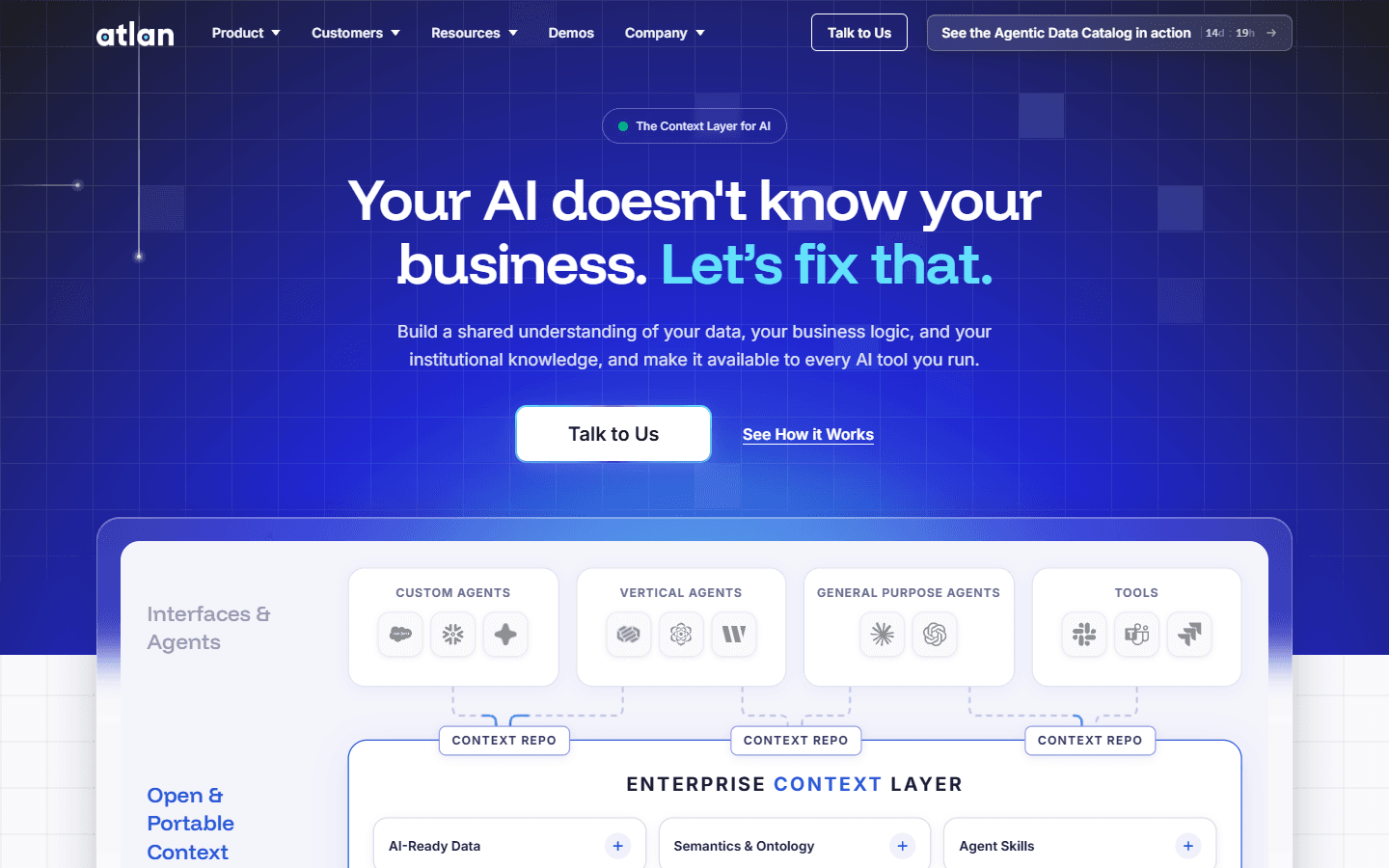
Atlan positions itself as "the context layer for AI". It is a SaaS catalog built around active metadata: it syncs metadata between tools such as Snowflake, Databricks, dbt, Looker and Fabric, and exposes it to AI agents and copilots.
Of all the vendors here, Atlan has the most developed answer to the Purview retirement. Its OneLake catalog partner page pitches Atlan as the layer on top of the OneLake catalog for everything outside Fabric. It lists a native Fabric connector covering lakehouses, warehouses, semantic models and Power BI, next to 120+ other connectors, with column-level lineage where the source exposes it, and says Microsoft named Atlan one of four spotlight Fabric partners at FabCon Europe 2026. It also offers a Migration Studio for Purview Data Governance: because Purview's Data Map and Atlan both use the Apache Atlas type system, Atlan says glossaries, governance domains, data products, custom attributes, classifications and owners carry across, read-only and with your approval at each step. Data quality rules do not migrate; Atlan rebuilds them with your team. Atlan is sold through Microsoft Marketplace, where eligible purchases count toward your Azure consumption commitment (MACC).
Pros:
- A dedicated Purview migration tool that reads your existing glossary, domains, data products and classifications and lets you run both systems side by side until cutover.
- Built to sit next to the OneLake catalog, so you keep what Fabric includes and add coverage for sources outside it.
- Buying through Microsoft Marketplace lets you spend an existing Azure commitment instead of opening a new budget line.
- Fast to connect for cloud-native stacks, with a modern interface analysts tend to like.
Cons:
- SaaS only: single-tenant, hosted on AWS, Azure or GCP. A self-deployed runtime can sit in your network to reach on-premises sources, but the catalog itself does not run there.
- No public pricing; the quote comes with the migration assessment.
- Data quality rules from Purview do not migrate and have to be rebuilt.
Best for: Purview customers moving to Fabric who have sources outside it and want their governance work migrated with tooling instead of by hand, and cloud-first teams on Snowflake or Databricks building AI use cases on their catalog.
Gartner Peer Insights: 4.6 out of 5 from 177 ratings.
4. Collibra
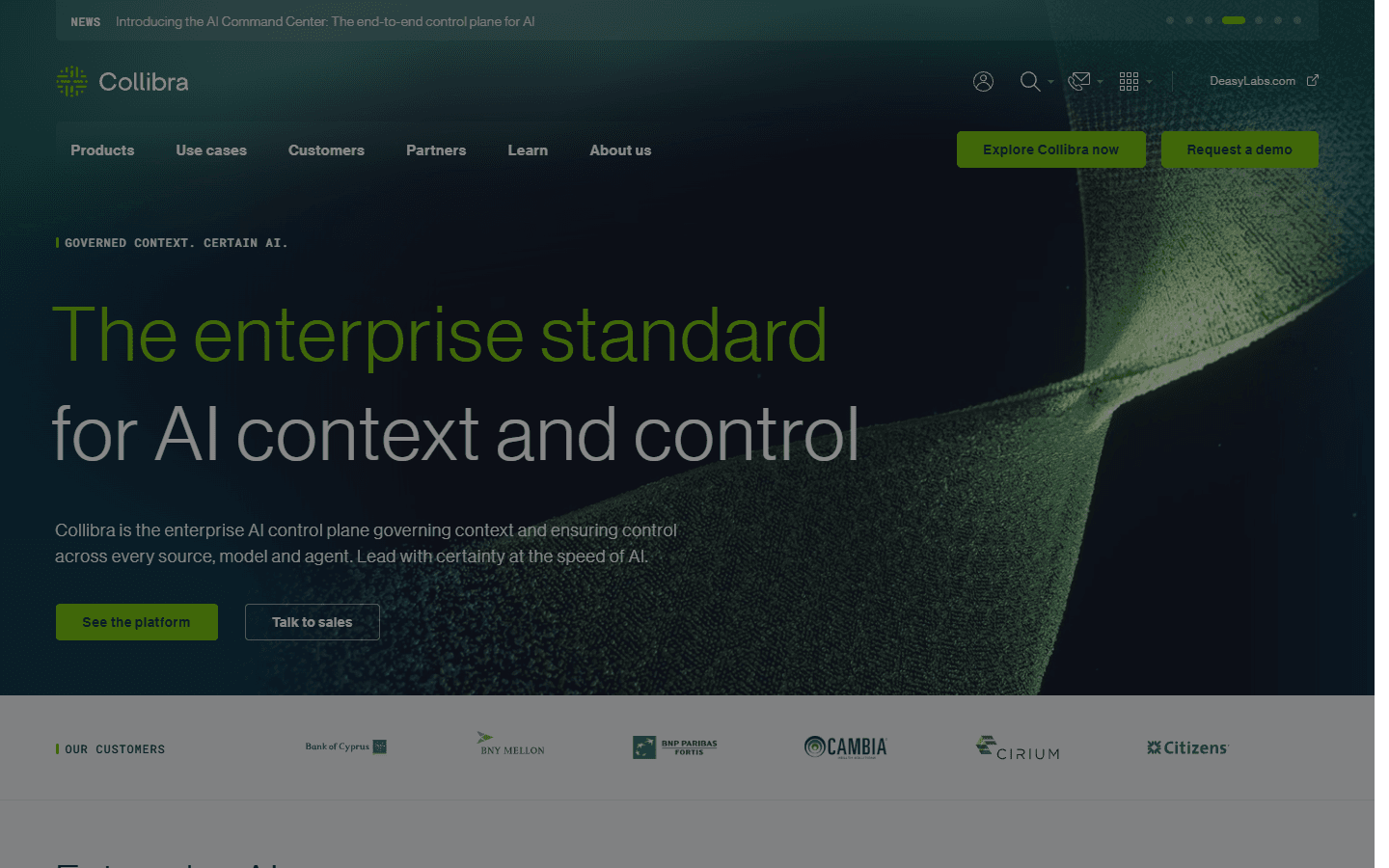
Collibra is the enterprise governance platform many large banks, insurers and pharma companies standardize on, and it now markets itself as a control plane for enterprise AI. The platform bundles a data catalog, data governance, data lineage, data quality and observability, data privacy and a data marketplace. Its core is a configurable operating model: domains, roles, responsibilities and workflows for approving definitions, policies and access requests. A newer AI Command Center registers AI models and agents, scores them and maps them to frameworks such as the EU AI Act and NIST AI RMF. Collibra has been a Leader in the Gartner Magic Quadrant three times.
Collibra lists 100+ native integrations, while its lineage page cites lineage for nearly 40 data sources. Microsoft names Collibra as a Fabric integration partner, and Collibra has built for it. In June 2026 it announced a Microsoft Fabric integration that harvests technical metadata from SQL Server, Fabric lakehouses and Fabric warehouses on a schedule, without moving the data. Databases, schemas, tables, views, columns, files, lakehouses and warehouses arrive as related assets in Collibra's knowledge graph, ready for classification, data quality results and policy enforcement alongside every other source. Collibra also lists a Power BI connector with technical lineage, plus Azure AI Foundry traceability and Teams workflow embedding. The Fabric announcement does not describe lineage across Fabric items, and we found no Purview migration offer, so ask Collibra about this during a demo.
Pros:
- The deepest workflow and policy management on this list.
- A large ecosystem of implementation partners who have run Collibra programs before.
Cons:
- Implementations are long and usually need a partner plus dedicated internal admins.
- No public pricing, and it is among the most expensive options.
- The lowest Peer Insights score of the dedicated catalogs here.
Best for: large enterprises with a formal data governance office and regulators asking for documented ownership and policy evidence.
Gartner Peer Insights: 4.3 out of 5 from 312 ratings.
5. Alation

Alation started as a search-first data catalog and now sells the Alation Intelligence Operating System (AIOS). It covers catalog, lineage, data quality, curation, a critical data manager, data products and a marketplace, ontologies, and an Agent Studio for building AI agents that people reach in Slack, Teams, Copilot or ChatGPT through MCP. The catalog ranks assets by observed behavior (joins, query patterns, ownership and quality scores), so analysts see which tables colleagues actually use and who the experts are. Alation says more than 500 enterprises use it and it holds a 2026 Gartner Peer Insights Customers' Choice badge in both metadata management and data and analytics governance.
Alation lists 120+ connectors, including Power BI, Azure Synapse and Azure Data Lake Storage. Microsoft lists Alation as a Fabric partner, but the alation.com pages we read do not mention Purview migration yet. Alation's catalog page argues for an independent catalog outside any single data platform, which is the core question if you are choosing between the OneLake catalog and a third-party tool.
Pros:
- The largest review base of the dedicated catalogs here (340 ratings), with consistently high adoption scores.
- Query-log analysis surfaces popular and trusted assets automatically.
Cons:
- No public pricing. Expect enterprise contracts.
- Getting lineage and stewardship right takes a structured rollout.
Best for: organizations with hundreds of analysts where the main problem is finding and trusting data.
Gartner Peer Insights: 4.6 out of 5 from 340 ratings.
6. Informatica Cloud Data Governance and Catalog
Informatica's Cloud Data Governance and Catalog (CDGC) runs as a cloud service inside Intelligent Data Management Cloud (IDMC), next to Informatica's data integration, data quality and MDM services. CDGC combines a catalog, lineage, policy automation and AI-powered classification, and connects to Informatica's data quality and observability, data access management (de-identifying sensitive data) and Cloud Data Marketplace products. CLAIRE, Informatica's AI layer, adds a copilot, CLAIRE GPT and agents.
Informatica now operates as part of Salesforce, and the site carries an "Informatica from Salesforce" brand. Pricing runs on Informatica Processing Units (IPUs), a consumption model with a usage dashboard and threshold alerts. Microsoft names Informatica as a Fabric partner, but the Informatica pages we read do not describe Purview migration yet.
Pros:
- Very broad connector coverage, including mainframe and enterprise applications.
- If you already run Informatica pipelines, lineage from those pipelines comes with little extra work.
Cons:
- Consumption pricing (Informatica Processing Units) makes cost forecasting similar to the Purview problem you are leaving.
- A heavy platform to adopt only for cataloging.
- Salesforce closed the acquisition in November 2025. Ask about the roadmap before signing a multi-year deal.
Best for: enterprises already invested in Informatica IDMC.
Gartner Peer Insights: 4.4 out of 5 from 1,378 ratings for the whole IDMC suite. In the data and analytics governance platforms market alone it scores 4.2 from 92 ratings.
7. Ataccama ONE
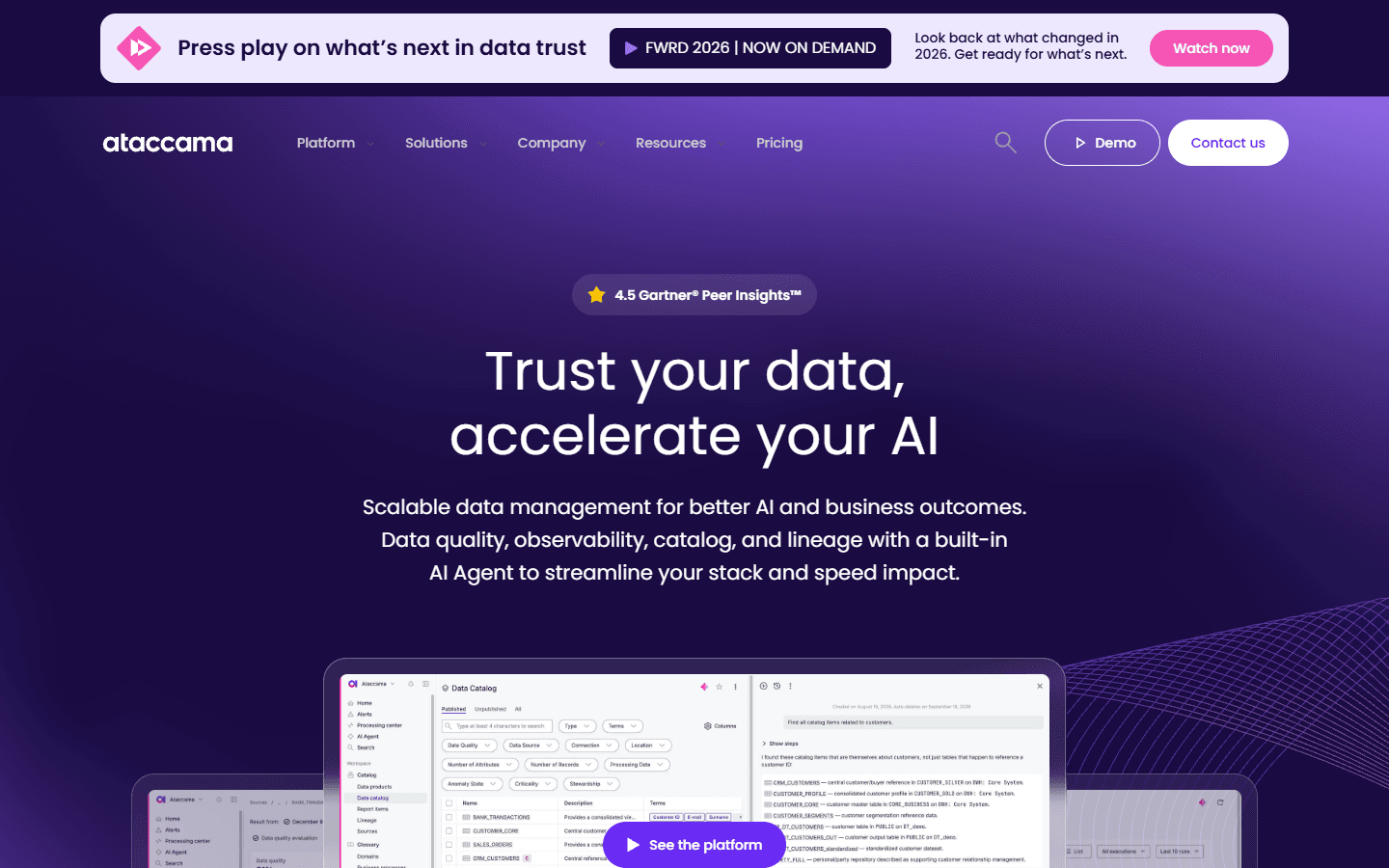
Ataccama ONE puts data quality at the center and builds the rest around it: a data catalog, lineage, reference data, data observability and master data management in one platform. Its ONE AI Agent, which Ataccama describes as a digital data steward, generates data quality rules, finds anomalies and applies fixes at the source. Ataccama Cloud runs the platform in the cloud while processing data locally, and the site says Ataccama supports both cloud and on-premises environments. Ataccama says it has been named a Leader in the Gartner Magic Quadrant for Augmented Data Quality Solutions five times.
For Microsoft shops, the connector list covers OneLake, Fabric lakehouse SQL endpoints and warehouses, Azure Data Factory, Azure SQL Database, Synapse and Cosmos DB. We found no Microsoft partnership or Purview migration offer on the site. Pricing is quoted by named users, data objects and active data quality configurations.
Pros:
- The strongest data quality engine on this list, with catalog and MDM in the same platform.
- Runs in the cloud or on premises.
Cons:
- The catalog and lineage are secondary to data quality. Teams that mainly need documentation and discovery pay for capability they will not use.
- No public prices.
Best for: organizations where bad data, not missing documentation, is the main governance problem.
Gartner Peer Insights: 4.4 out of 5 from 103 ratings.
8. DataGalaxy
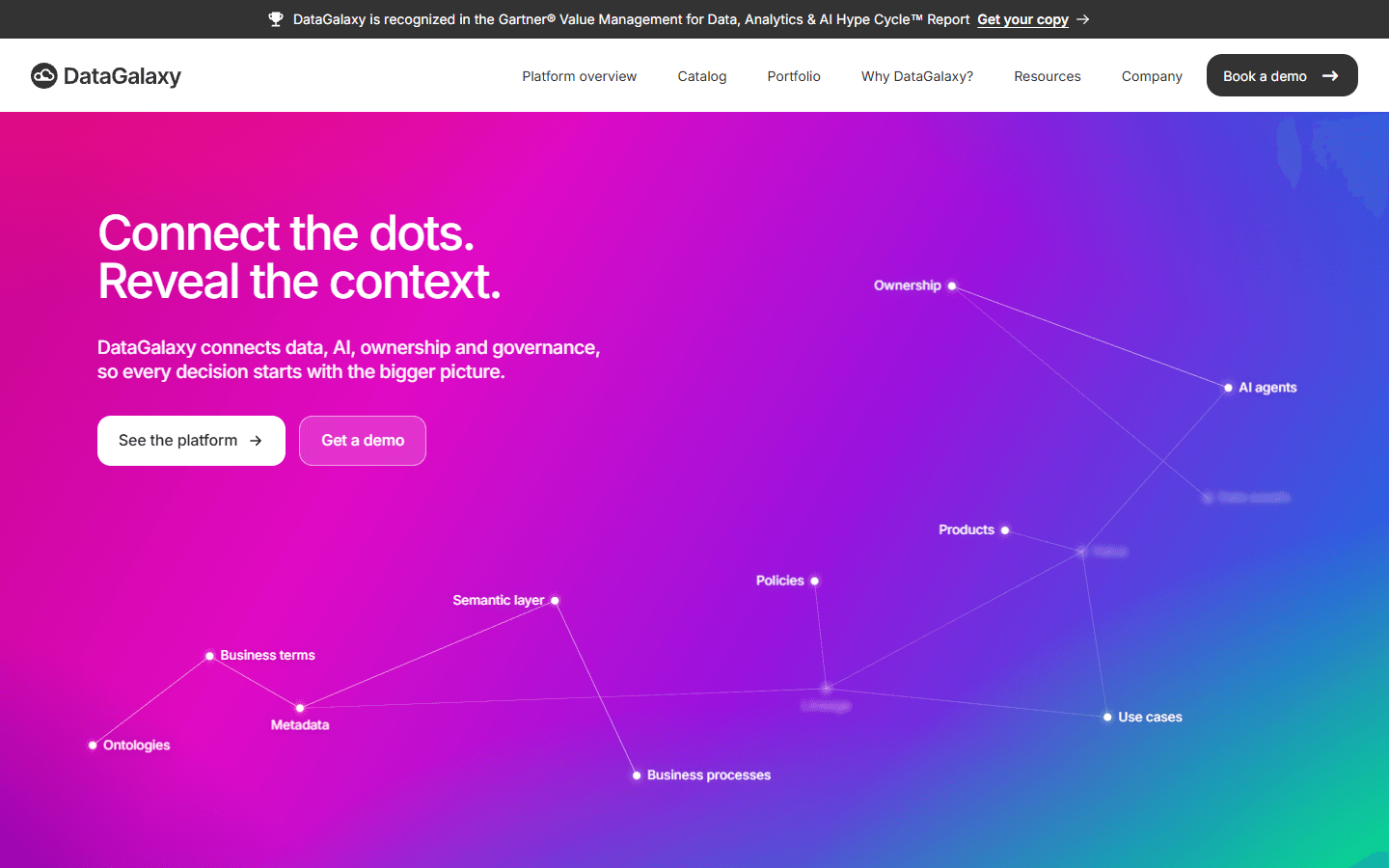
DataGalaxy, a French vendor, now markets its product as an AI context and value engine. The platform has three parts: a catalog (glossary, automated lineage, governance, an AI data steward that classifies data, data quality monitoring and data products), collaboration tools (the Blink AI copilot, a browser extension, a marketplace and an MCP server), and a portfolio module that tracks data and AI use cases and the value they deliver. DataGalaxy lists 70+ connectors, including Microsoft Fabric, OneLake, Power BI, SQL Server and SSIS. It has the highest Peer Insights score among the tools here with more than 100 ratings, tied with Dataedo.
Atlan, DataGalaxy and Dataedo are the vendors here with Purview migration tooling or help on their websites. DataGalaxy's DataGalaxy vs Microsoft Purview page says its team will help move metadata, glossary terms and lineage. Pricing is by quote, with tiers starting at five editors. The pricing page lists SaaS hosting in the EU or US, with an isolated tenant or private cloud, for the Portfolio plans but does not state hosting for the catalog tiers; the Purview comparison page lists on-premises deployment.
Pros:
- Business-friendly interface and a clear model for data products and their owners.
- Strong Peer Insights ratings in both governance and metadata management markets.
Cons:
- No public pricing, and a minimum of five editors on the entry tier.
Best for: European organizations organizing governance around data products and measurable business outcomes.
Gartner Peer Insights: 4.7 out of 5 from 120 ratings.
Which Purview alternative should you choose?
If all your analytics already run in Fabric and Power BI, use the OneLake catalog. You already pay for it, and adding a third-party catalog on top only makes sense once you have sources it cannot see.
If you have a mixed estate (SQL Server, Oracle, Snowflake, Power BI, a few SaaS apps) and a data team that has to do governance alongside its day job, choose Dataedo. You get lineage and a glossary running in weeks, on premises if needed, for a price you can put in this year's budget.
If you are a large regulated enterprise with a governance office and policy workflows to evidence, shortlist Collibra and Alation. Choose Collibra when the workflows are the point, Alation when analyst adoption is. If you are moving to Fabric and want your Purview glossary and domains migrated with tooling, or run a cloud-native stack with AI plans, look at Atlan. Already on Informatica, stay with Informatica. If bad data is your real problem, start with Ataccama.
Whatever you pick, plan backwards from November 12, 2027. A realistic timeline: shortlist and proof of concept in the first quarter of 2027, contract and connector rollout in the second, glossary and ownership migrated by the third, Purview switched off in October, about six weeks before support ends.
To test Dataedo against your own sources, request a demo and bring the sources you want documented first.
FAQ
Is Microsoft Purview being retired?
Purview Data Governance is being retired. Microsoft announced on November 12, 2026 that support ends on November 12, 2027, and Microsoft Learn notes that no new accounts can be created. Purview's data security and compliance features, such as sensitivity labels and data loss prevention, continue.
What replaces Purview Data Governance?
Microsoft's replacement is the OneLake catalog in Microsoft Fabric, with governance included in Fabric capacity. Microsoft also names Atlan, Alation, Collibra and Informatica as third-party catalogs that integrate with Fabric. Dataedo, DataGalaxy and Ataccama ONE are other independent alternatives.
Can I still buy Microsoft Purview Data Governance?
No. According to Microsoft's connector documentation, new Purview data governance accounts can no longer be created. Existing accounts stay in maintenance mode until November 12, 2027.
What is the best Purview alternative for mid-size companies?
Dataedo is built for mid-size data teams. It has published pricing from $18,000 per year with unlimited viewers, runs on premises or in your own cloud, connects to Purview, Power BI and Microsoft Fabric, and comes with solution engineer support for the Purview migration and source setup. It scores 4.7 out of 5 from 105 ratings on Gartner Peer Insights.


