Support

Snowflake has become a central platform for modern analytics. It scales easily, supports diverse workloads, and allows teams to move fast with SQL-based transformations, dynamic tables, and pipelines. But as Snowflake adoption grows, so does a familiar problem: Data moves faster than governance.
Tables multiply.
Views become layered.
Business logic spreads across SQL, pipelines, and BI tools.
And teams start asking:
- Can we trust this data?
- Who owns this table or KPI?
- Is this dataset safe to use for reporting?
- What happens if we change this column?
This is where data governance in Snowflake becomes essential.
In this article, you’ll learn:
- What data governance really means in a Snowflake environment,
- Why Snowflake alone is not enough for governance,
- And how Dataedo helps teams govern Snowflake data in a practical, scalable way.
What Is Data Governance in Snowflake?
Data governance in Snowflake is not about slowing teams down or adding bureaucracy.
In practice, it means:
- knowing what data exists in Snowflake,
- understanding what it represents from a business perspective,
- defining who owns and maintains it,
- assessing data quality and sensitivity,
- and controlling how changes affect downstream users.
Governance connects technical metadata (tables, columns, SQL logic) with business context (definitions, domains, ownership, usage).
Without it, Snowflake becomes powerful-but risky.
Why Data Governance Is Especially Hard in Snowflake
Snowflake makes it easy to build analytics fast.
That same flexibility creates governance challenges.
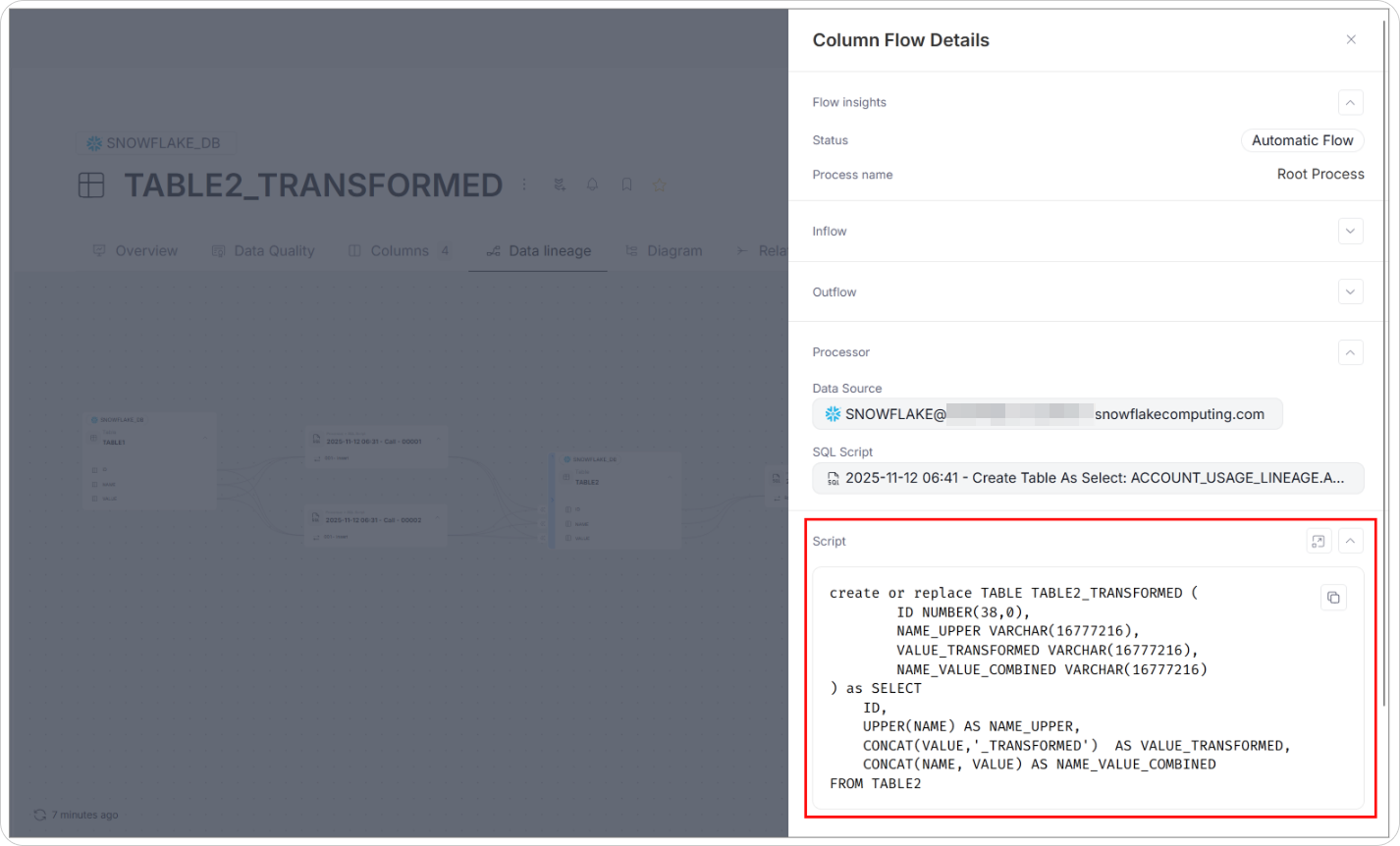
1. SQL-Centric Logic Is Hard to Track
Business logic often lives inside:
- views,
- materialized views,
- dynamic tables,
- pipelines and transformations.
Without documentation and lineage, this logic becomes invisible.
2. Multiple Data Sources Converge in Snowflake
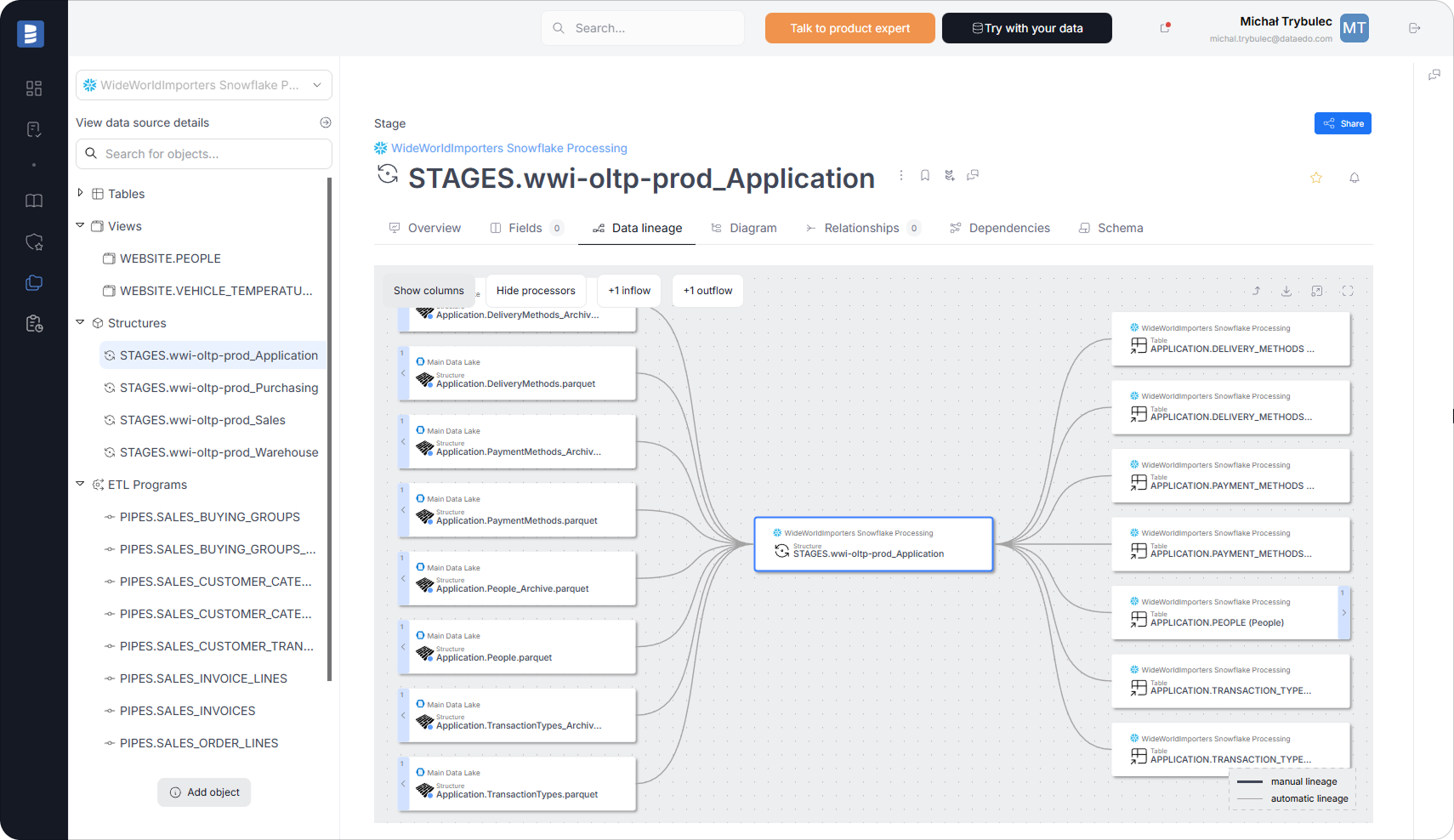
Snowflake often integrates data from:
- operational databases,
- external stages (S3, Azure Blob),
- ingestion pipelines,
- streaming systems.
Governance must span multiple schemas, databases, and domains-not just individual tables.
3. Ownership and Accountability Fade Over Time
As environments evolve:
- original authors leave,
- logic is reused without context,
- no one knows who to ask when data looks wrong.
Without clear ownership, governance breaks down.
4. Snowflake Metadata Alone Is Not Enough
Snowflake exposes rich technical metadata-but:
- business definitions are missing,
- ownership is not enforced,
- data quality is not evaluated,
- downstream BI usage is invisible.
This is where an external governance layer becomes critical.
What Good Snowflake Data Governance Looks Like
Effective governance in Snowflake answers four key questions:
1. What Is This Data & Who Owns It?
Data governance in Snowflake starts with clarity - both about the data itself and about responsibility for it.
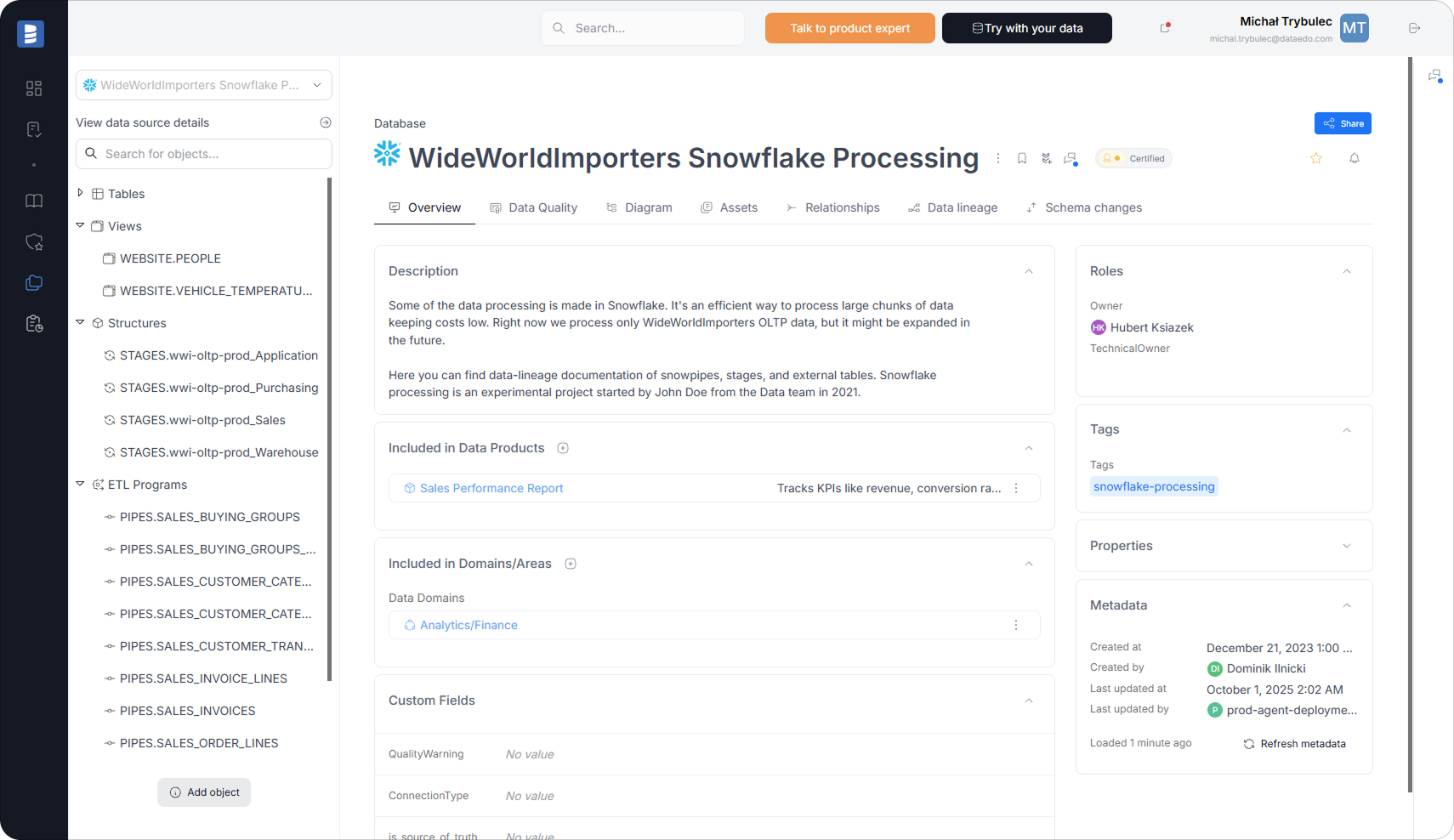
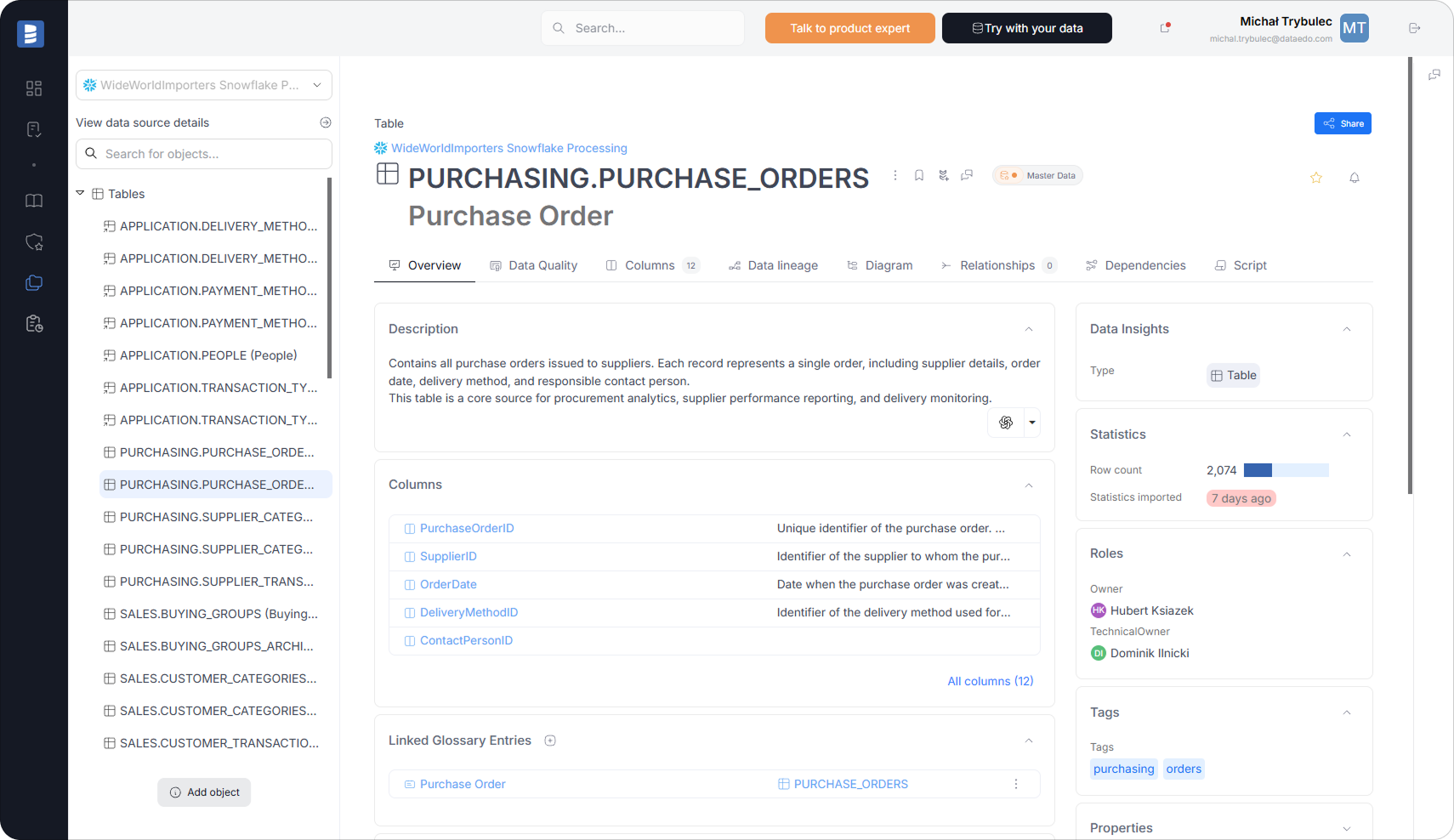
With Dataedo, teams can document Snowflake tables and columns using business-friendly descriptions, while at the same time assigning clear ownership and stewardship.
Instead of relying on table names or SQL alone, each object can include:
- a plain-language description explaining what the data represents,
- column-level definitions that clarify business meaning,
- assigned Data Owner responsible for correctness and changes,
- assigned Data Steward responsible for documentation and quality.
This combination answers two critical governance questions at once:
- What does this data actually represent?
- Who is accountable when something changes or breaks?
For example, a Snowflake table like PURCHASING.PURCHASE_ORDERS can be documented with a clear description of purchase order lifecycle data, while ownership is explicitly assigned to the Procurement team.
This makes it immediately clear whether the table is safe to use, who to contact with questions, and who must approve changes.
2. Can We Trust It?
In Snowflake environments, data quality issues often remain hidden until they affect reports or business decisions.
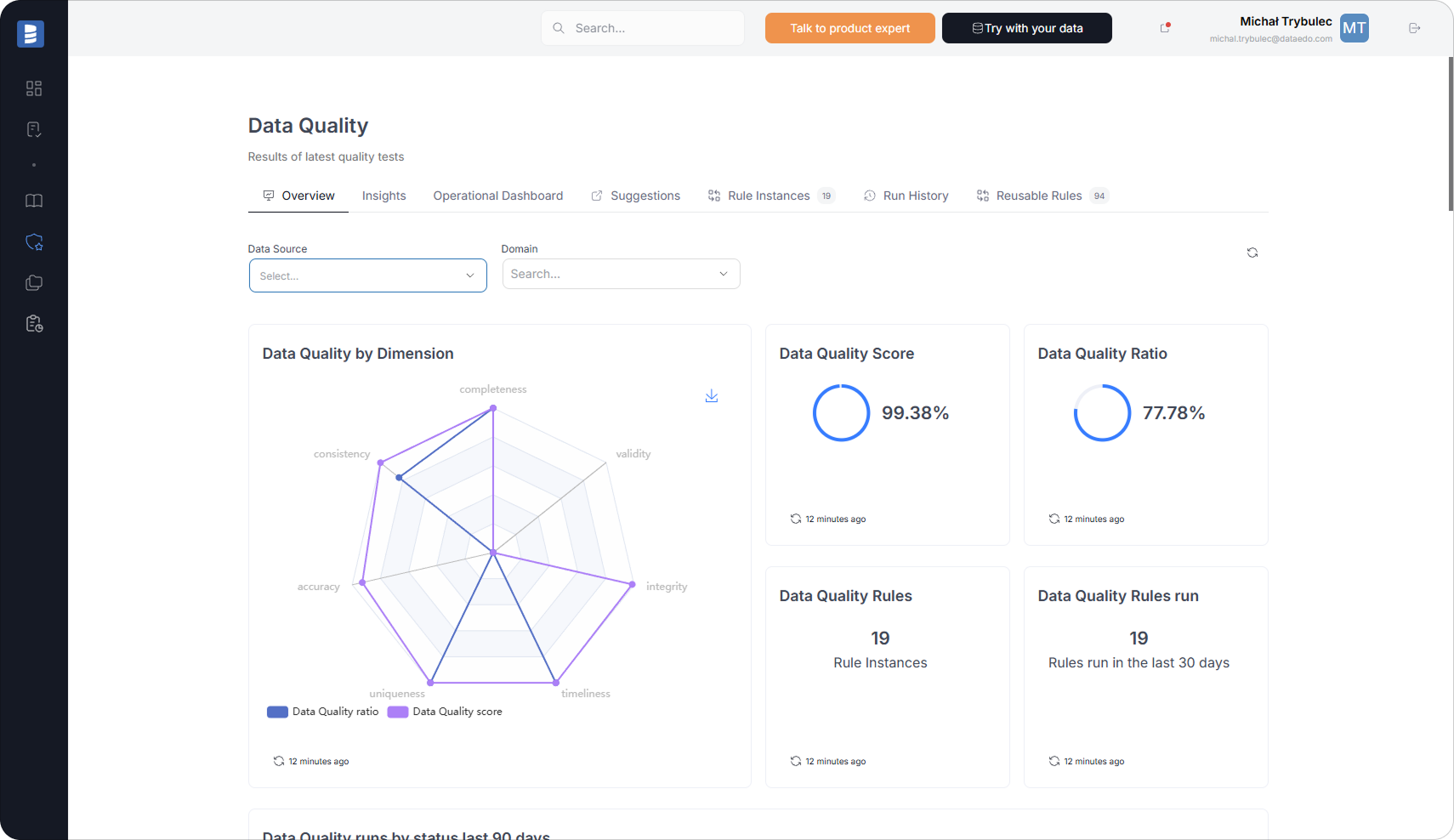
Dataedo embeds data quality directly into Snowflake governance, allowing teams to continuously validate whether data meets business expectations.
With Dataedo, teams can define data quality rules on Snowflake tables, views, and columns using:
- predefined rules (e.g. completeness, uniqueness, ranges),
- custom SQL rules for business-specific logic,
- configurable thresholds and severity levels.
Rules can be executed cyclically, so data quality is monitored over time-not just checked once.
Results are summarized as data quality indicators and ratios at column, table, and business domain level.
Failed rows can be saved and reviewed directly from Snowflake when deeper investigation is needed.
Because quality results are visible in object documentation and lineage diagrams, teams immediately see whether upstream Snowflake data can be trusted before it is used downstream.
3. What Depends on It?
In Snowflake, even a single column can have far-reaching consequences.
A column that looks simple at the database level is often reused across:
- multiple views and dynamic tables,
- transformation logic in pipelines,
- semantic models in BI tools,
- dashboards and reports consumed by the business.
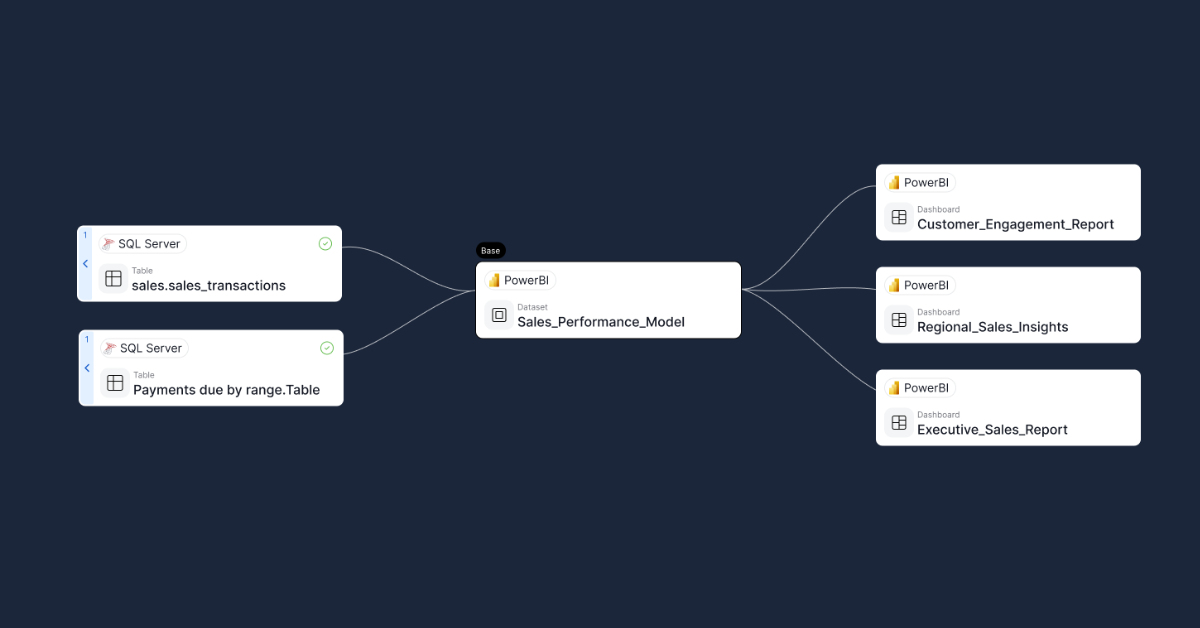
This is where lineage becomes a core pillar of data governance.
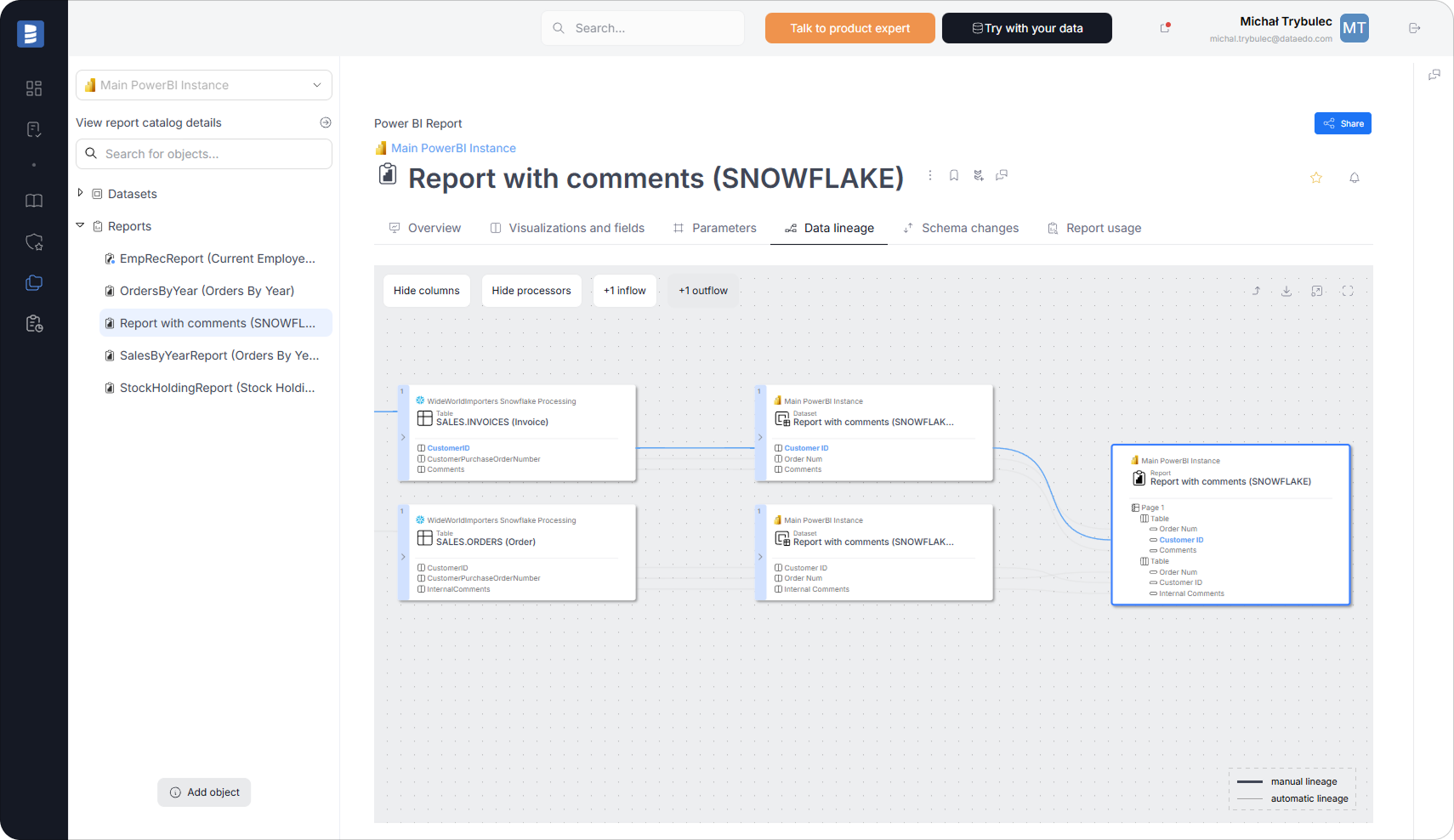
In the screenshot, you can see column-level lineage traced end-to-end for a single field:
- CustomerID in the INVOICES table in Snowflake,
- into a Power BI dataset,
- and finally used in a Power BI report.
With this level of visibility, teams can immediately answer questions such as:
- Which reports rely on CustomerID from INVOICES?
- Is this column transformed, renamed, or filtered along the way?
- Will a change in Snowflake affect customer-level KPIs in Power BI?
- Which downstream datasets and reports must be validated after a change?
This turns impact analysis from guesswork into a repeatable, governed process.
Instead of discovering broken dashboards after deployment, teams can:
- assess impact before changing Snowflake schema or SQL logic,
- identify affected BI assets and their owners,
- prioritize validation for business-critical reports.
This visibility allows Snowflake teams to move from reactive fixes to controlled change management.
Data governance succeeds only when dependencies are transparent - not just inside Snowflake, but all the way to the reports where data is actually used.
4. Governance That Scales Across Domains
Good Snowflake governance is not table-by-table - it’s domain-driven.
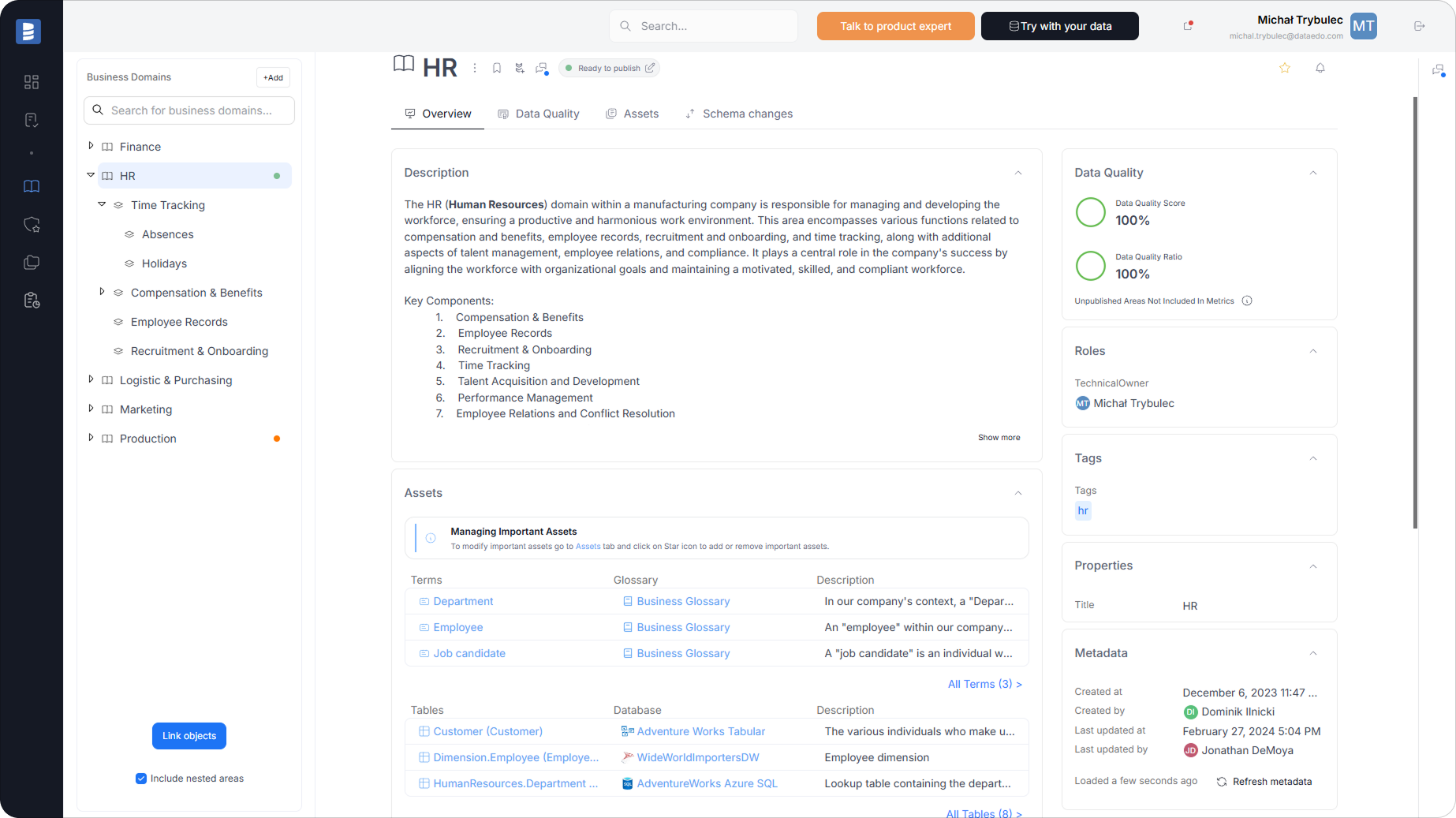
With Dataedo, teams can define Business Domains (e.g. HR, Finance, Sales) and link Snowflake objects across databases and schemas to those domains.
Each domain can include:
- a business description,
- linked glossary terms,
- associated Snowflake tables and views,
- aggregated data quality indicators.
This creates a shared language between technical and business teams and allows governance decisions to be made at the domain level - not just per object.
Snowflake Governance Beyond the Database (Without Losing Focus)
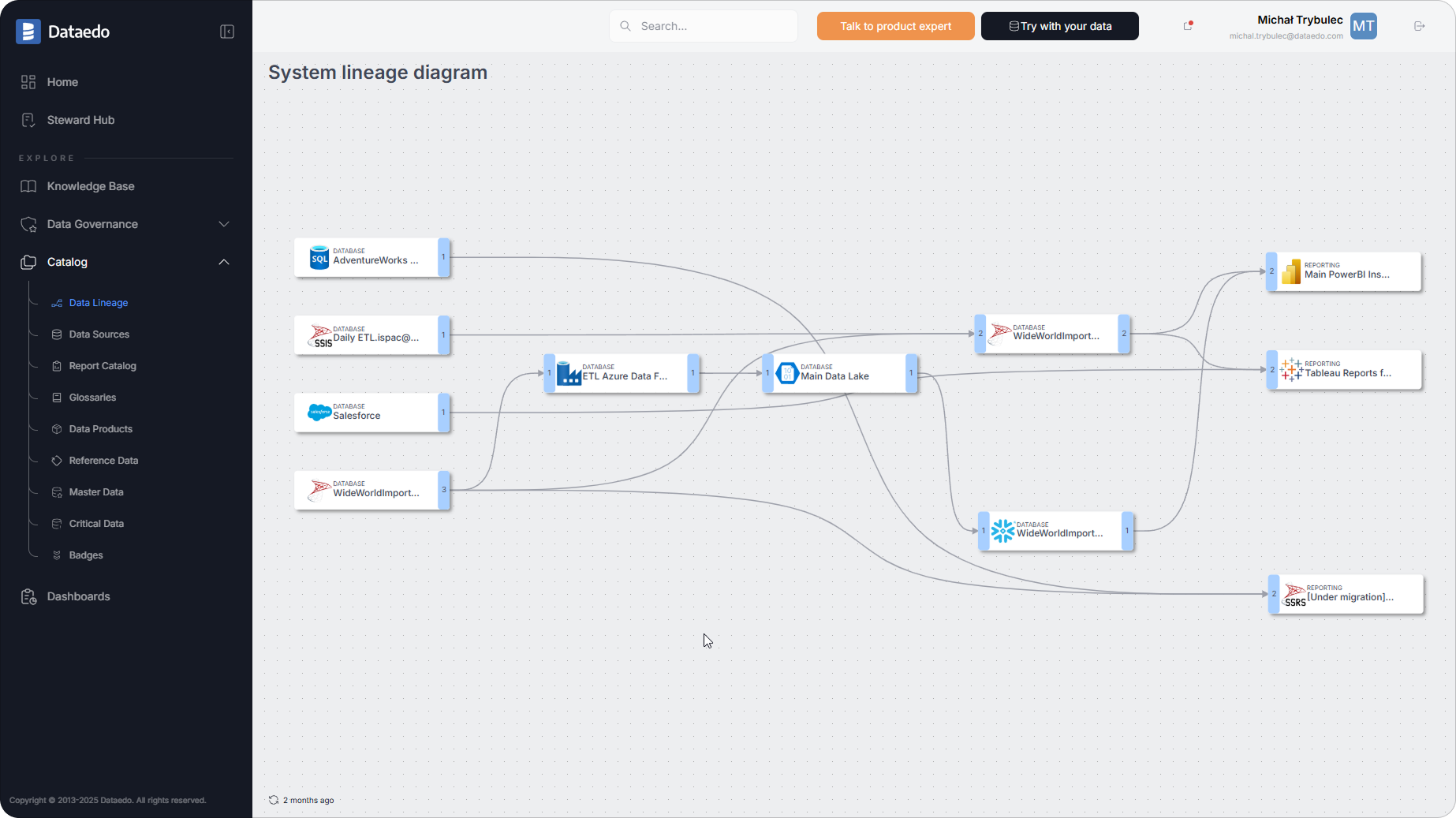
While this article focuses on governance inside Snowflake, Snowflake rarely exists alone.
When Snowflake is documented together with:
- ETL tools,
- semantic models,
- BI reports,
the same governance model naturally extends downstream.
Snowflake remains the foundation-but governance becomes end-to-end.
Why Snowflake Data Governance Matters
Without governance, Snowflake environments become:
- hard to trust,
- risky to change,
- expensive to maintain.
With governance, Snowflake becomes:
- transparent,
- reliable,
- scalable across teams.
Dataedo helps teams move from Snowflake as a data store to Snowflake as a governed analytics platform.
Govern Snowflake with Confidence
Snowflake enables speed. Data governance ensures sustainability.
See how Dataedo helps govern Snowflake data with documentation, lineage, business context, and data quality.
Book a demo or start a free trial to bring clarity and trust to your Snowflake environment.