 Support


The easiest way to understand the difference is to imagine a team waking up to a broken dashboard. Observability is what tells them the dashboard output is wrong in the first place. A freshness check failed, row counts dropped, null rates spiked, or a schema changed after a deployment. Lineage is what tells them where that bad result came from, which transformation introduced it, and which other reports or models are likely to be affected.
That is why these terms are often mentioned together. Both sit close to operational analytics work, but they solve different moments in the same incident. Observability answers, “Is something off right now?” Lineage answers, “Where did it go wrong, and what else should we worry about?”
Start With The Symptom
Teams usually notice observability first because it is closer to the symptom. A pipeline is late. A dataset is suddenly smaller. A column that was populated yesterday is mostly null today. Those are operational signals, and they matter because they tell you the data can no longer be trusted without review.
That is the core of data observability. It is not mainly about diagrams or documentation. It is about whether a pipeline, table, or field is behaving the way the team expects. Freshness, volume, completeness, uniqueness, schema drift, and unusual distributions all belong here because they are warnings about the present state of the data.
Observability is therefore strongest at detection. It is what makes a team look up from delivery work and say, “Something changed.”
Then Follow The Path
Once the team knows something changed, the next question is rarely another metric question. It is usually a dependency question.
Where did this field come from? Which transformation touched it? Does the issue stop in one dataset, or does it travel into a KPI, a semantic model, or an executive report? Those are lineage questions, because lineage is about the path of the data, not only its current health.
Data lineage shows how data moves from source to destination and how transformations shape what appears downstream. Depending on the stack and the risk, that can mean object-level lineage, column-level lineage, source-to-report flow, or system-level paths across tools. What matters is not the type label. What matters is whether the team can see enough of the path to explain impact.
A Practical Difference
If you want the shortest possible distinction, it is this: observability is about condition, lineage is about dependency.
| Topic | Data Observability | Data Lineage |
|---|---|---|
| Primary purpose | Detect health and reliability issues | Trace flow and dependencies |
| Main question | Is the data healthy right now? | Where did it come from and what does it affect? |
| Best for | Monitoring, alerting, anomaly detection | Change management, troubleshooting, impact analysis |
| Common signals | Freshness, volume, completeness, schema drift, outliers | Sources, transformations, objects, columns, downstream assets |
| Main value | Early warning | Dependency visibility |
| Typical outcome | Fewer surprises in production | Smaller blast radius during change |
Observability can tell you that something changed. Lineage can tell you where to look next.
| Data Observability | Data Lineage |
|---|---|
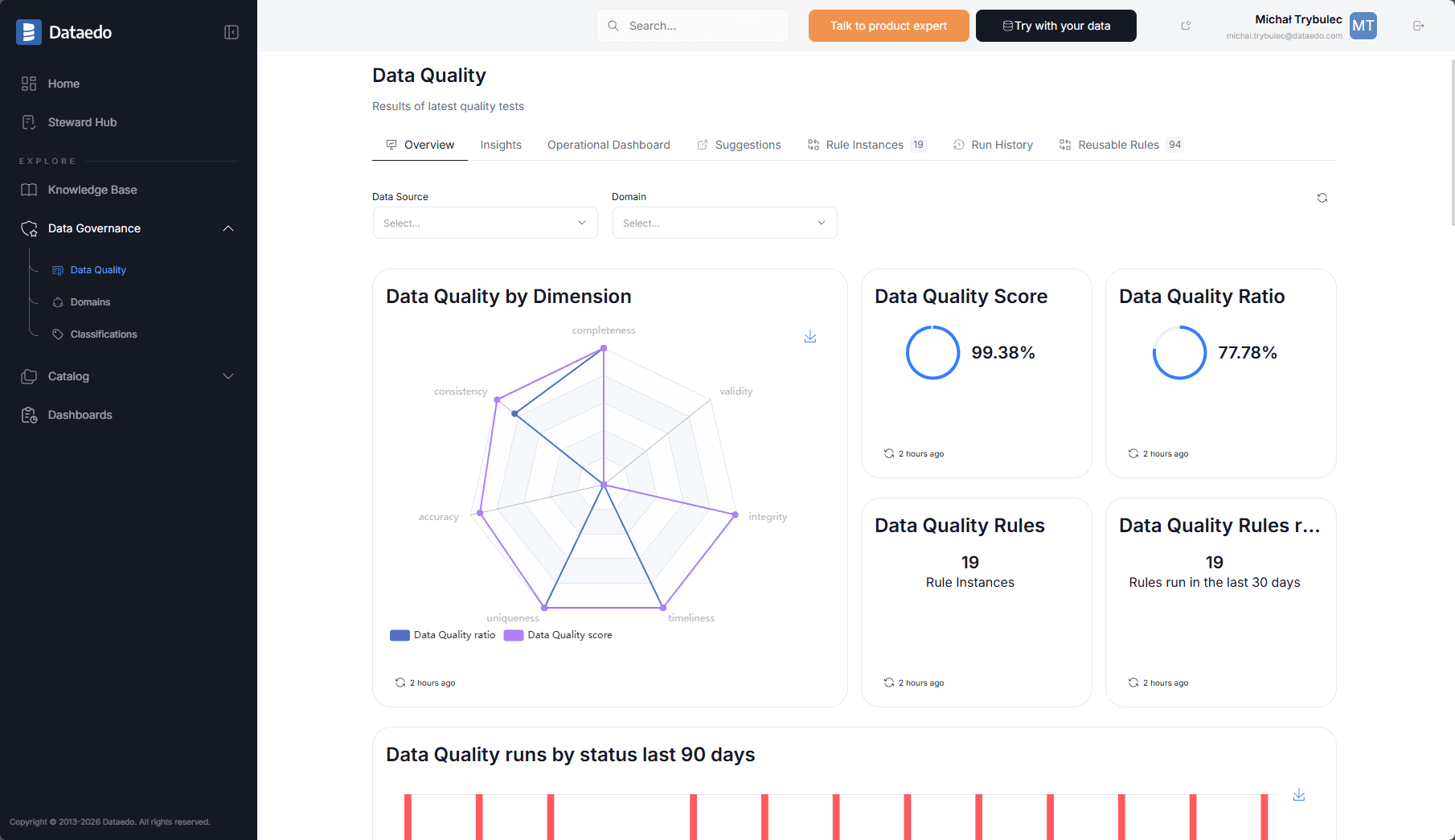 |
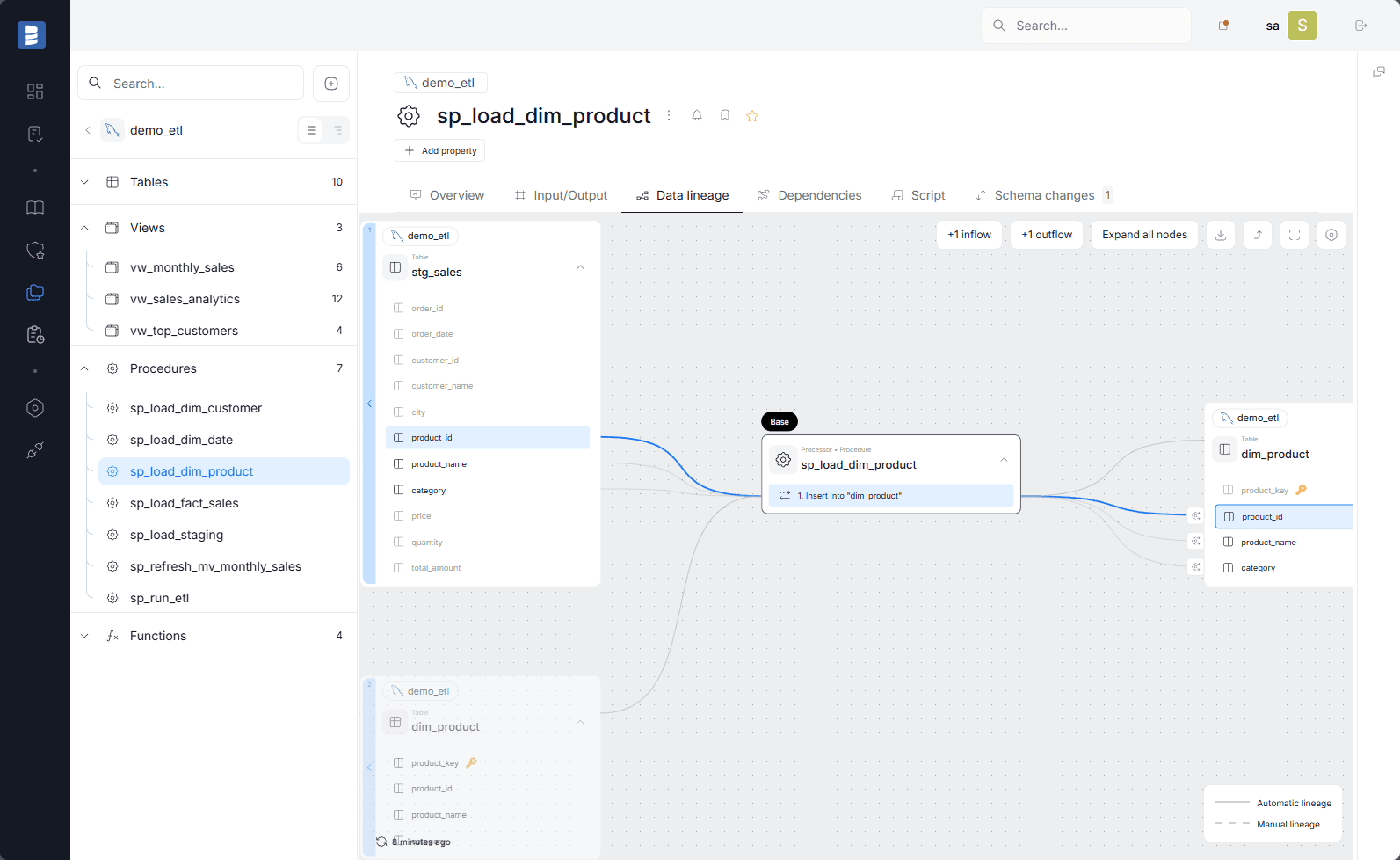 |
| Operational signals such as quality and freshness that help teams spot issues early. | Dependency view that shows upstream sources, transformations, and downstream effects. |
That sounds simple, but it materially changes how teams respond under pressure. If a dashboard suddenly shows fewer rows, observability tells you that the row count changed and that the freshness check may also have failed. Lineage then shows which source table, intermediate model, and downstream reports are connected to that metric. One tells you that the data is suspect. The other tells you where to investigate and how wide the issue might be.
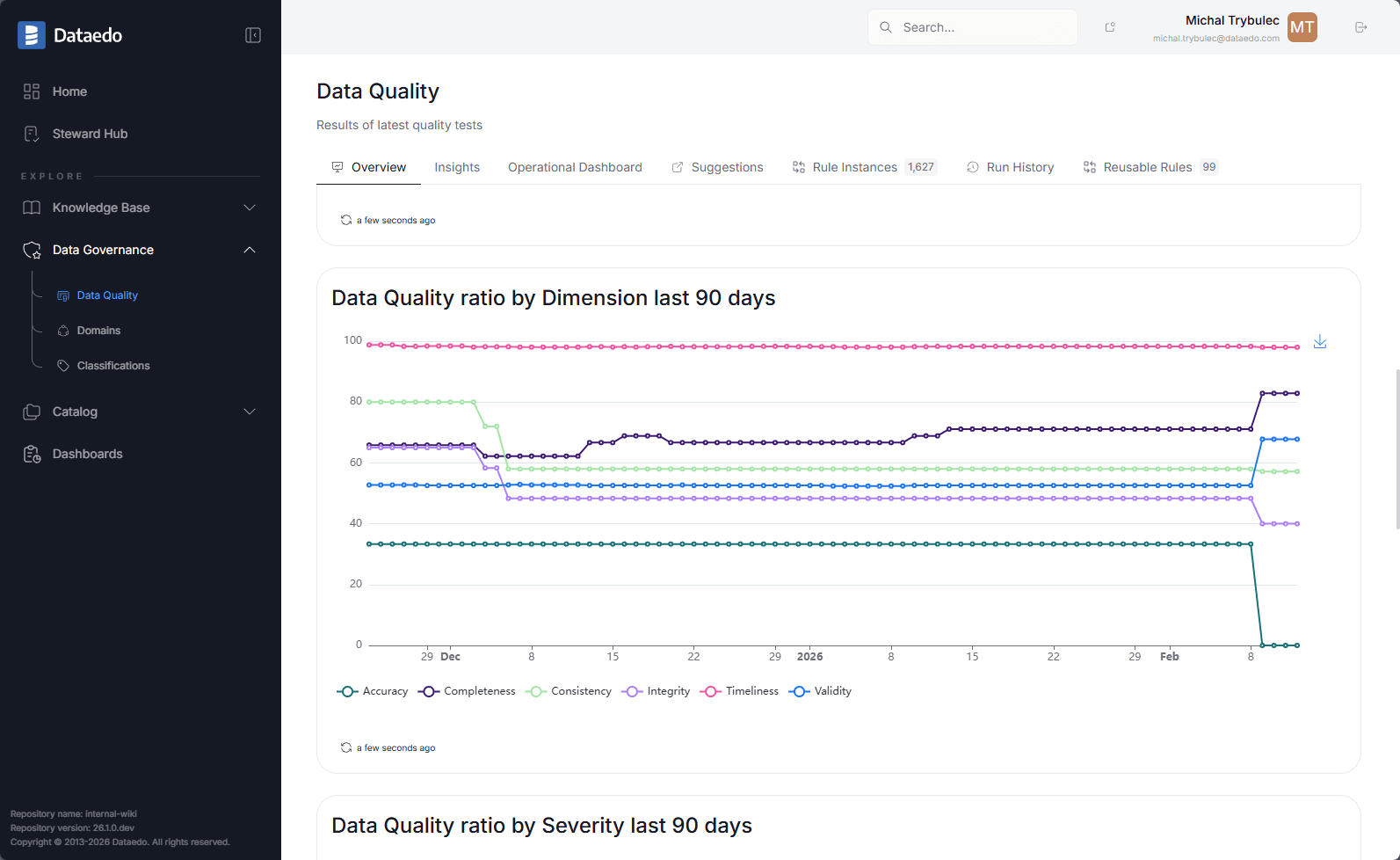 Trend-based quality signals help teams confirm whether the drop is a one-off incident or the start of a broader degradation pattern.
If a critical field starts returning unexpected nulls, observability highlights the shift quickly. It shows the anomaly and proves it is not only anecdotal. Lineage then traces the field through the upstream source and the transformations that shaped it. That is the difference between detecting a symptom and explaining its origin.
And when the problem is a planned schema change rather than a live incident, the order flips. Lineage becomes the first tool because the team needs to know what depends on the field before the release happens. Observability becomes the second tool because it can confirm whether the change later introduced a regression into production.
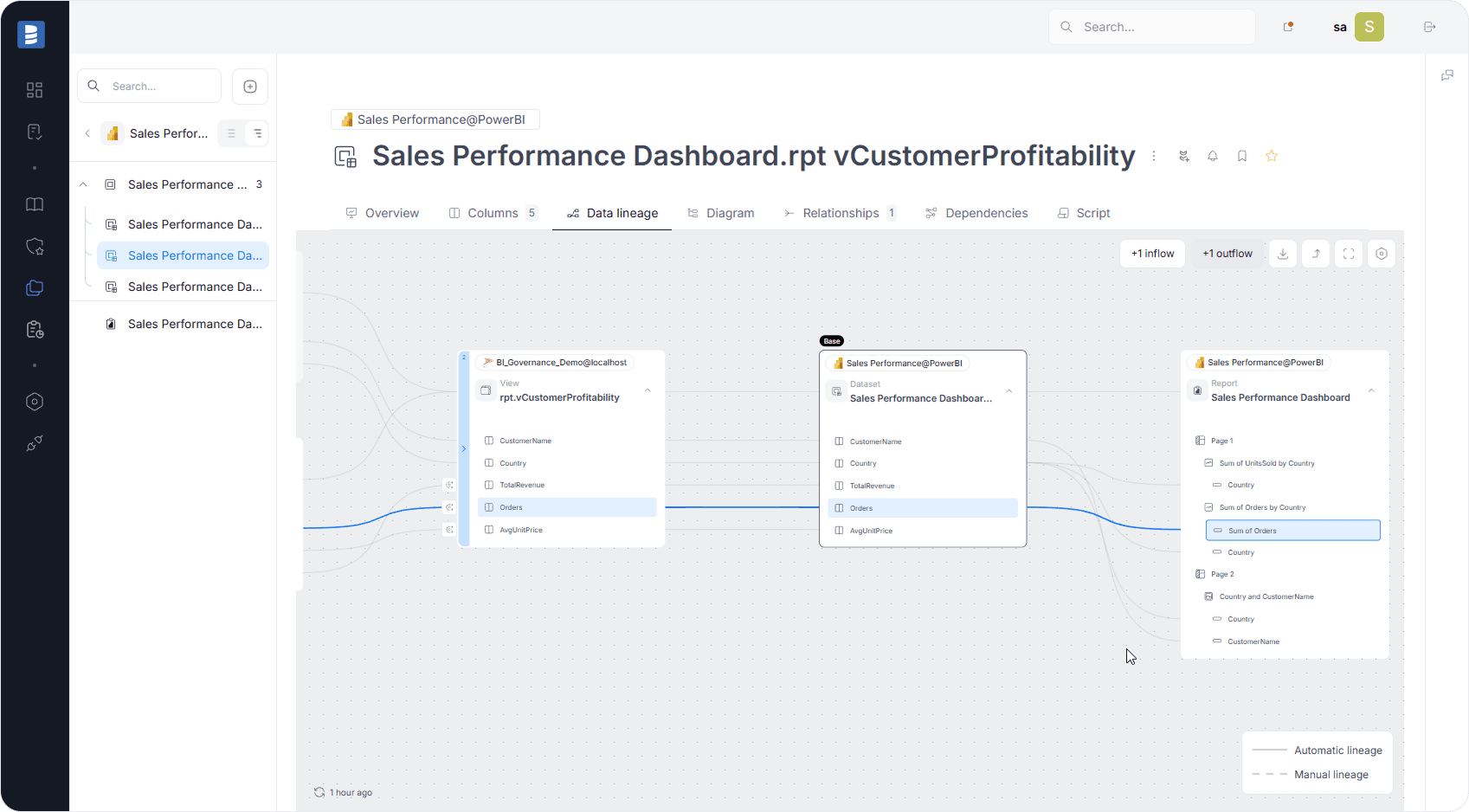 Column-level lineage gives the planned schema change a concrete blast-radius view before the release happens.
How The Two Work Together
The mistake is to frame observability and lineage as alternatives. In healthy teams, they form a handoff.
Observability catches the moment something drifts away from expectation. Lineage gives investigators and reviewers the dependency map they need next. In incident response, that means faster root-cause analysis. In release planning, that means fewer blind changes. In governance work, it means that trust signals are tied back to real documented assets rather than floating in a separate monitoring conversation.
If a team only has observability, it can know that something is wrong and still spend too long chasing the cause. If it only has lineage, it can understand the flow and still miss the moment the data stopped being healthy. The stronger operating model is not “pick one.” It is “use each at the right point in the workflow.”
How Dataedo Helps Teams Connect Both
Dataedo is useful here because it does not force teams to separate the health conversation from the dependency conversation. In the product, lineage, catalog context, ownership, profiling, and data quality signals can live in the same documentation model. That matters because real investigations rarely stay inside a single discipline.
Once a quality check fails, teams usually want to know what changed, where the data came from, who owns the asset, and which downstream objects will feel the impact. Once a release is planned, they want the same metadata from the opposite direction: what depends on the object, who should review it, and what should be watched after deployment. Dataedo supports that combined workflow better than a setup where monitoring, documentation, and dependency analysis are scattered across unrelated tools.
FAQ
Is data observability the same as data lineage?
No. Observability focuses on health signals and anomalies. Lineage focuses on data flow, transformations, and dependencies.
Can data lineage tell me if data is healthy?
Not directly. Lineage shows the path and the dependencies, but it does not replace quality checks, freshness checks, or anomaly detection.
Can data observability replace lineage?
No. Observability helps teams detect problems, but lineage is still needed to understand impact and trace how data moves through systems.
What should teams implement first?
If the main pain is broken dashboards or late loads, start with data quality and observability signals. If the main pain is change risk and dependency blindness, start with lineage. In most teams, both are needed.
Final Takeaway
Data observability and data lineage solve different problems.
Observability tells you whether the data looks healthy. Lineage tells you where the data came from and what it affects.
If you want fewer surprises in production and faster root-cause analysis, you need both.
See how Dataedo combines data quality, profiling, catalog, lineage, and ownership so teams can spot issues earlier and trace impact faster. Book a demo or try for free.


