


Connecting an AI agent to a data catalog sounds like a new security problem. Some of it genuinely is. Much of it is not.
The important question is not whether a language model can "see Dataedo." It's narrower and far more answerable: under whose identity does the agent read the catalog, what is that identity permitted to see, what leaves your environment, and what is the agent allowed to do with the result?
Frame it that way and the architecture becomes tractable. Frame it as "AI and data governance" and you'll spend three meetings not deciding anything.
The five-layer model
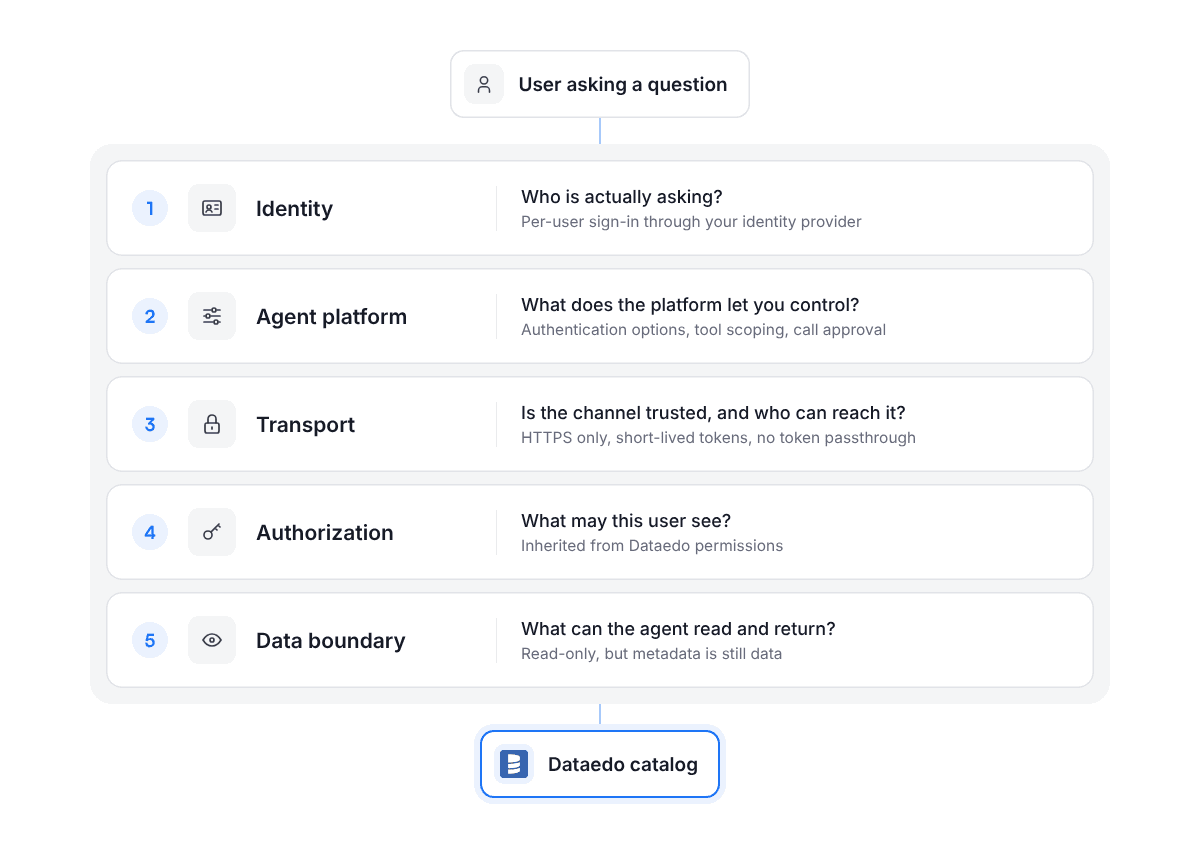
Layer 1: Identity - who is actually asking?
This is the most consequential decision in the entire build, and it's usually made by accident.
There are two shapes available, and the difference is enormous. Shared identity is the default a hurried pilot drifts into. It is also the one decision here that cannot be partly right.
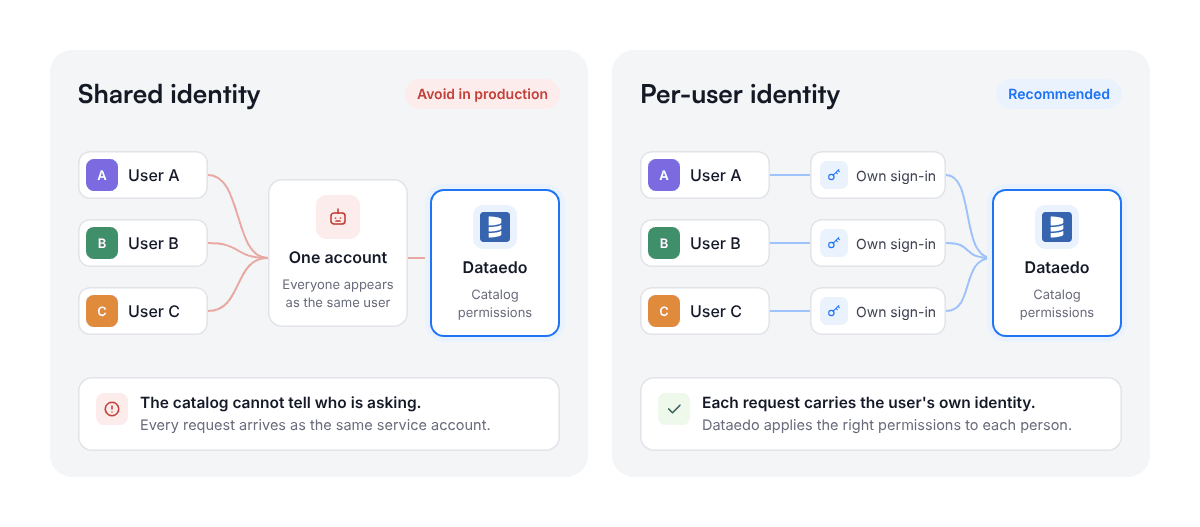
Microsoft Foundry names this distinction directly: shared authentication means every user of the agent authenticates as the same identity and user context doesn't persist, while individual authentication means each user authenticates with their own account so their context is preserved.
For a data catalog, per-user identity is the correct default, because Dataedo's permission model is per user to begin with. In Hosted Mode, users sign in through your own Dataedo login page using any method enabled there, including SSO, so each person sees only the data they have permission to view.
The principle worth writing into the architecture paper:
The agent must not become a new route around catalog permissions. Where the platform supports it, each user authenticates as themselves and the catalog applies the access model it already has.
A note on wording, because this gets paraphrased badly: this is not single sign-on shared across AI platforms. Each client authenticates independently through its own registration. What is preserved is the identity of the person asking, and therefore the permission boundary that applies to them.
Layer 2: The agent platform is part of the boundary
Each delivery platform offers a different set of levers. We will go into detail about this in parts 6 to 8, but the summary is worth having early, because it affects which platform your security team will be comfortable approving first.
| Control | Copilot Studio | Microsoft Foundry | Claude / generic client |
|---|---|---|---|
| Authentication options | None, API key, or OAuth 2.0 | Key, Entra identity, OAuth identity passthrough, or none | OAuth, static header credential, or none |
| Tool scoping | Enable or disable discovered tools | Explicit allow-list per agent | Per-tool allow / ask / block |
| Human approval of calls | — | Review and approve tool calls | Per-call approval by default |
| Organisation-level gate | Power Platform data policies | Project RBAC and connections | Admin can disable custom connectors |
Layer 3: Transport - is the channel trusted, and who can reach it?
The first is ordinary hygiene. The MCP specification is prescriptive: all authorization server endpoints must be served over HTTPS, authorization servers should issue short-lived access tokens, and tokens must be validated as issued specifically for the server receiving them. Token passthrough is explicitly forbidden.
The second is that cloud AI clients call inbound to your endpoint. Claude is unusually explicit about this — a custom connector reaches your server from Anthropic's cloud infrastructure rather than from the user's device, across every client including the desktop app. A server behind a VPN will not connect even though you can reach it perfectly from your own laptop.
That has a direct architectural consequence. "We will keep it on the internal network" does not work for most cloud agent platforms unless you build private connectivity specifically for them. Microsoft Foundry supports private endpoint patterns at the cost of additional network architecture; Copilot Studio and Claude remote connectors generally expect a reachable HTTPS endpoint. Settle this before you build an agent, not after.
Layer 4: Authorization - what may this user see?
The good news is that there's nothing to invent. The MCP server does not need a second authorization model — it defers to Dataedo, where permissions already exist and are already managed. The published container describes permission-aware responses that honour the caller's view permissions on the backend.
Which extends the series principle:
Govern metadata once. Preserve identity. Respect permissions everywhere.
Layer 5: Data boundary - read-only, and why that isn't the end of it
AI enabled data catalogs, like Dataedo's integration is read-only; the AI cannot modify data stored in your repository and the server never mutates the catalog. That removes an entire category of risk, and it's the single easiest thing to put in front of a risk committee.
But read-only is safer, not risk-free. An agent can still surface anything the authenticated identity is entitled to read:
- object, database and system names
- business definitions and glossary terms
- ownership and stewardship assignments
- lineage and integration paths
- structural detail that reveals architecture Integrity risk goes down. Confidentiality risk does not disappear.
Metadata is data too
Organisations reassure themselves with "we are only exposing metadata." Consider what metadata alone reveals:
Customer_Master
├── SAP_ECC
├── CRM_PRODUCTION
├── Credit_Risk_Scoring
└── Executive_Revenue_Reporting
Not one customer record has moved. And yet you now know which systems hold customer data, that credit risk scoring consumes it, and that it feeds executive reporting. For a competitor, an auditor, or somebody doing reconnaissance, that is genuinely useful.
The classification rule:
Classify catalog metadata by what it reveals, not by the fact that it is not transactional data. Read-only removes integrity risk. It does not remove confidentiality risk.
MCP is a connection standard, not a security product
The protocol's convenience invites complacency, so it is worth being blunt. MCP standardises how a client discovers and calls tools. It does not supply identity, authorization, TLS, secrets management, logging, or a decision about which clients your organisation permits. The protocol's own security guidance catalogues real attack classes — confused-deputy problems in proxying servers, token passthrough, session hijacking — and the OWASP cheat sheet adds tool poisoning, changes to tool definitions after approval, and exfiltration through legitimate-looking calls.
Most of those are risks of connecting to untrusted third-party servers. Your own Dataedo deployment is a very different risk profile from an unvetted community server. But the governance lesson transfers directly, and it leads to the third principle:
Connect through standards. Approve deliberately.
MCP compatibility is not organizational approval. Your architecture might support any compliant client; your policy should still name which ones are allowed. The table below describes threats and and the controls that address them.
| Scenario | Primary control |
|---|---|
| A user retrieves metadata they should not see | Per-user authorization in the catalog; test with two differently permissioned accounts |
| A shared identity exposes too much | Individual authentication; treat shared service credentials as development-only |
| A client secret or token is stolen | Secret store, short lifetimes, rotation, and a revocation runbook that has been tested |
| The agent combines catalog context with another service | Platform data policy plus deliberate tool scope |
| The agent invents an object | Grounding instructions, the never-invent rule, and repeated fake-object release testing |
| An unapproved client connects | One registration per approved platform; a named client allow-list |
| Excessive context is returned to the model | Narrow tool scope and least-privilege design |
| A tool response contains manipulative text | Treat tool output as untrusted input; keep the service read-only and the scope narrow |
| The server or its tool list changes unexpectedly | Pinned versions, change review, refreshed tool inventory, regression tests |
The architecture review paper
If you need to summarise this for a review board, this is the honest version:
- Read-only. The integration cannot modify catalog content.
- No new copy of metadata. Queries hit the live repository; there is no index to secure separately.
- Authentication delegated to your existing identity provider through the catalog's own login.
- Authorization inherited from the permissions the catalog already enforces.
- One new inbound endpoint, HTTPS-only, monitored, version-pinned — plus one registration per approved client. The genuinely interesting questions in that review will not be about the server. They will be about who gets to use the agent, and whether your metadata classification is good enough to answer that.
That second question is worth anticipating, because it is the one that tends to stall an otherwise straightforward approval. If nobody can say which domains are sensitive, the honest answer is to scope the pilot to a domain where everybody agrees the answer is "not particularly", and use the time to classify the rest properly. That is a better outcome than a six-week argument about a control that would have been unnecessary.
What to take into the next part
Per-user identity wherever the platform supports it. Inherited permissions rather than a second access model. A narrow tool scope. And an agent that is explicit about what it could not find. Those four decisions are the input to the agent design.
Next up → Part 4 (coming soon)


