Support

Modern data platforms rely heavily on SQL-not only to query data, but also to define transformations, business logic, and entire data pipelines. As SQL code grows in volume and complexity, understanding how data flows between tables, views, and individual columns becomes increasingly challenging. This is exactly where the SQL Parser in Dataedo plays a crucial role.
The Dataedo SQL Parser is a core engine designed to analyze SQL code and extract meaningful metadata from it. By parsing SQL queries, views, procedures, and scripts, Dataedo automatically identifies source and target tables, column-level dependencies, and the transformations applied to the data. This information is then used to build automated data lineage, enrich technical documentation, and significantly improve the transparency and trustworthiness of data models.
Dataedo supports parsing SQL written in multiple dialects, including Transact-SQL (SQL Server), PostgreSQL, Snowflake, and MySQL. Depending on the database engine, the parser understands dialect-specific syntax such as common table expressions (CTEs), joins, aliases, expressions, and derived columns. This makes it possible to document heterogeneous data environments using a single, consistent approach-even when data is distributed across different technologies.
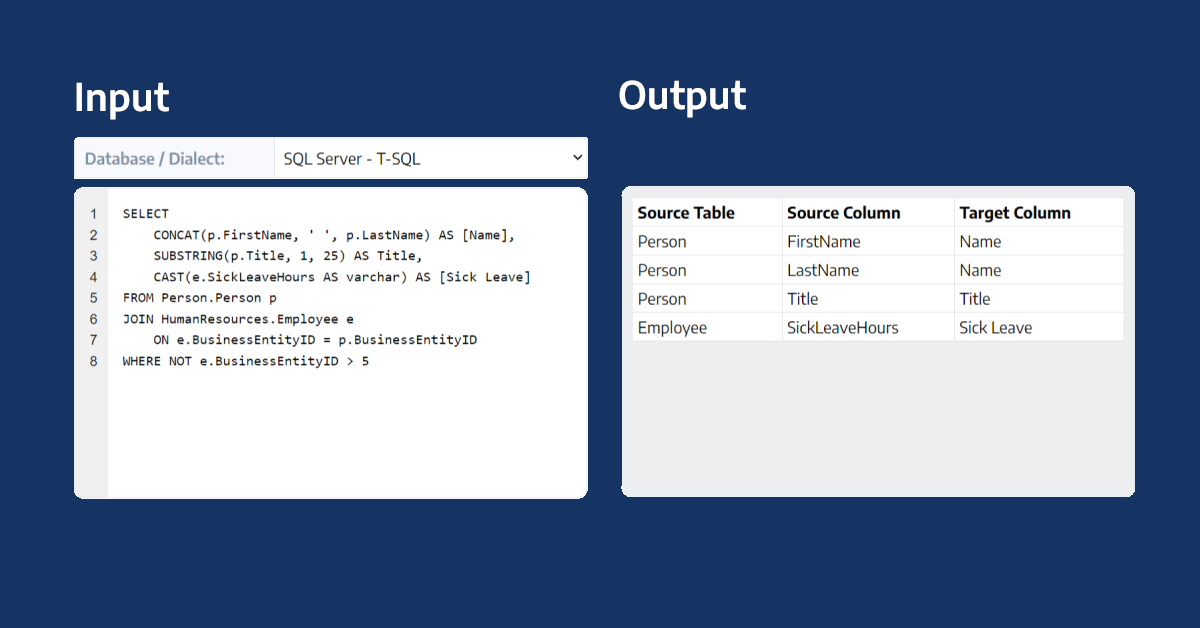
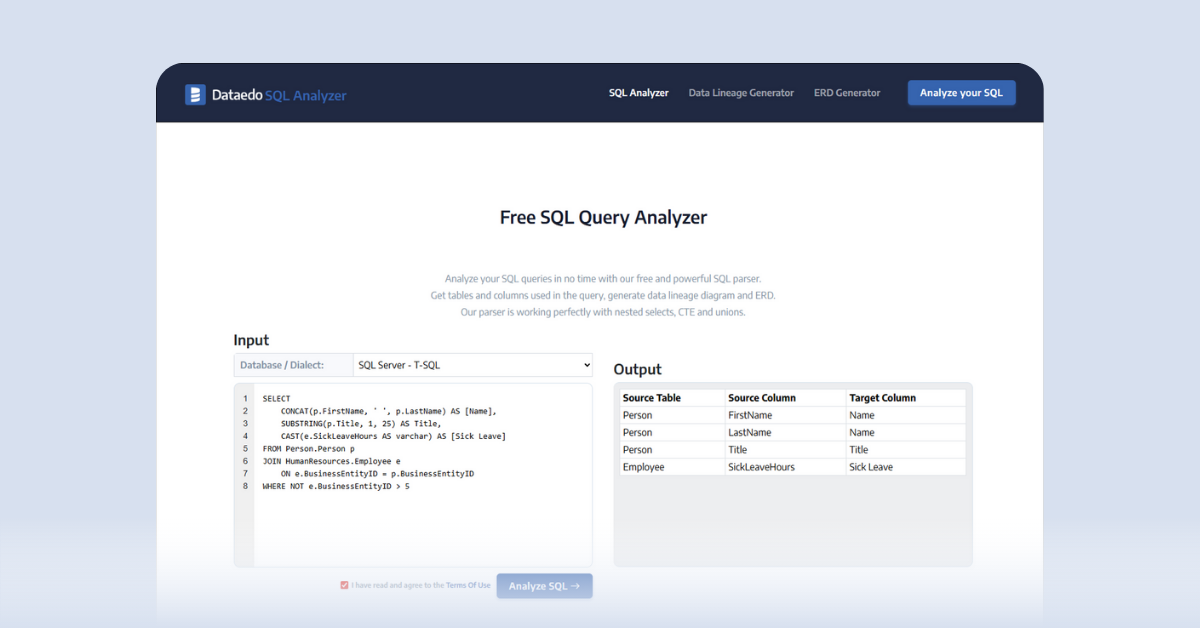
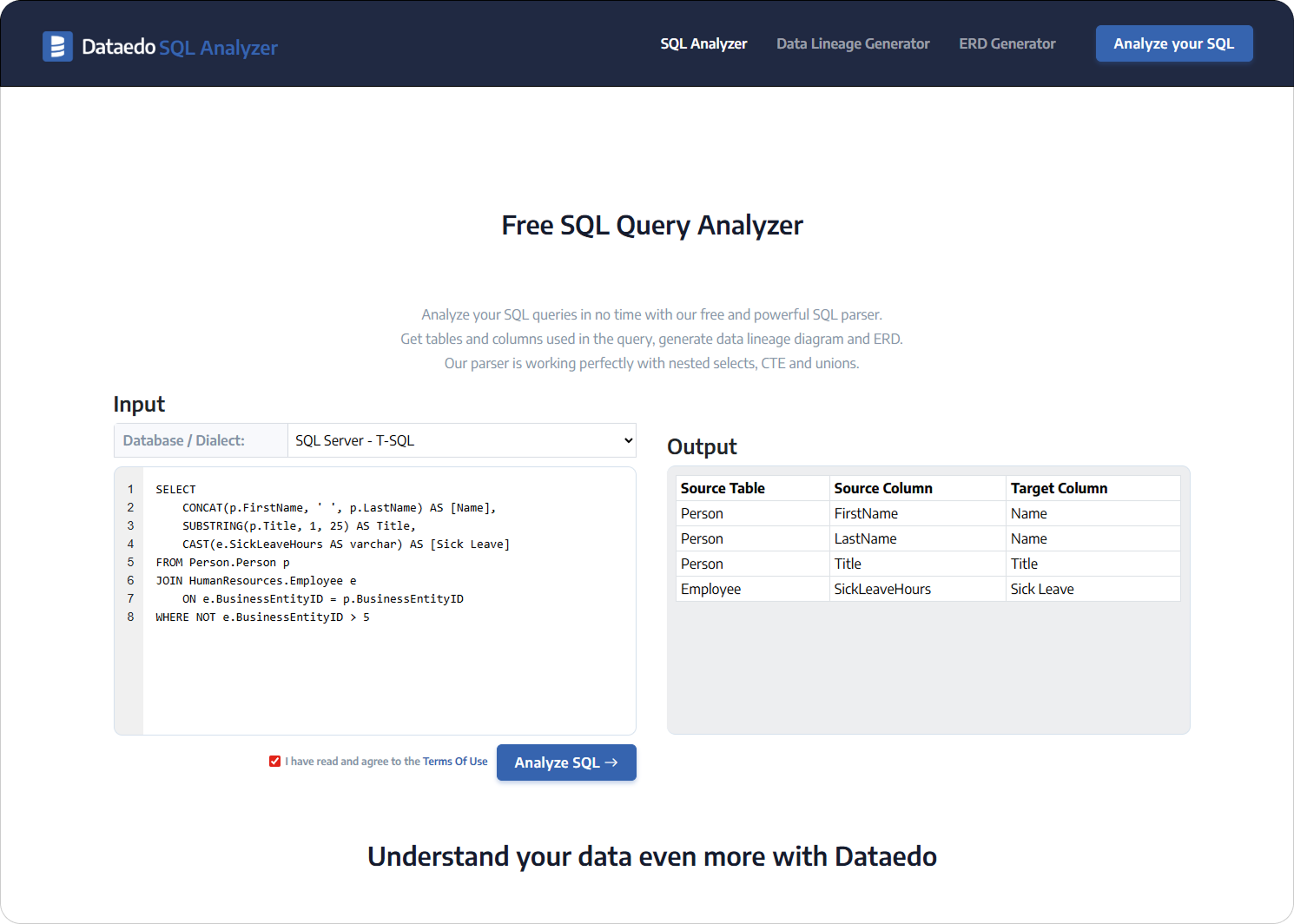
To help users better understand how SQL parsing works in practice, Dataedo provides a free public SQL Analyzer available online.
This tool allows anyone to paste a SQL query and instantly see how Dataedo interprets it, including detected tables, columns, and relationships. While the online analyzer exposes only a subset of the full SQL Parser capabilities, it is an excellent way to explore the fundamentals before using the parser within Dataedo Desktop or Dataedo Portal.
How the Dataedo SQL Parser Works
At its core, the SQL Parser in Dataedo is designed to transform raw SQL code into structured, actionable metadata that can be easily understood, documented, and visualized. Instead of treating SQL as plain text, the parser breaks down queries, views, stored procedures, and functions into logical components and analyzes how data flows through them across tables, views, and columns.
Step 1: Parsing SQL Syntax
When SQL code is submitted-either during metadata import or through the SQL Analyzer-the parser first interprets the syntax of the SQL dialect being used. This applies not only to standalone queries, but also to SQL embedded inside views, stored procedures, and functions. The parser recognizes standard SQL statements such as SELECT, FROM, JOIN, WHERE, GROUP BY, and WITH (CTEs), as well as database-specific constructs unique to a given platform.
At this stage, the parser builds an internal representation of the SQL structure-similar to an abstract syntax tree-which allows it to understand what the code does, not just how it is written.
Step 2: Identifying Data Sources
Next, the parser detects all source objects referenced in the SQL code, including:
- tables,
- views,
- subqueries,
- common table expressions (CTEs).
When parsing stored procedures and functions, this step applies to each logical statement and execution path, ensuring that all referenced objects are correctly identified. This step is essential for accurately establishing dependencies and serves as the foundation for both object-level and column-level data lineage.
Step 3: Resolving Columns and Expressions
The parser then analyzes SELECT lists and result sets to determine:
- which columns are selected directly from source tables,
- which columns are renamed using aliases,
- which columns are derived using expressions such as calculations, functions, or CASE statements.
Even when a column is transformed-whether in a query, view, or procedural step-Dataedo preserves its relationship to the original source columns. This makes it possible to trace exactly how each final output column was created.
Step 4: Understanding JOINs and Relationships
JOIN clauses are parsed to understand how tables are connected and how data flows between them. The parser identifies:
- join types (INNER, LEFT, RIGHT, etc.),
- join conditions,
- relationships between key columns and referenced fields.
This applies equally to joins defined in queries, views, and procedural logic, forming the basis for understanding how datasets are combined across multiple sources.
Step 5: Preparing Lineage Metadata
Once all elements of the SQL code are parsed, the extracted information is ready to be used for:
- automatic data lineage generation,
- dependency and impact analysis,
- enriching technical documentation with detailed query and procedure logic.
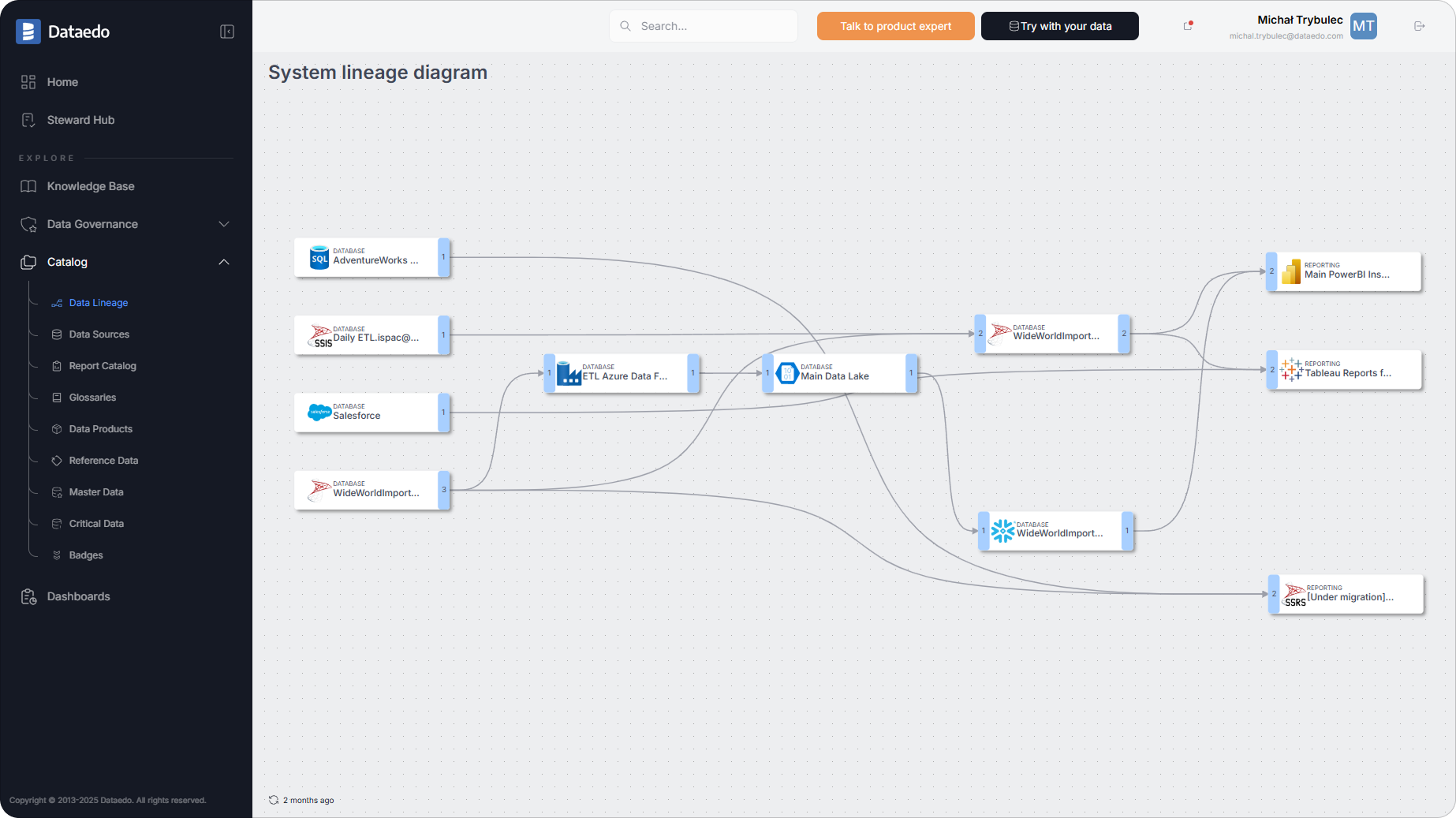
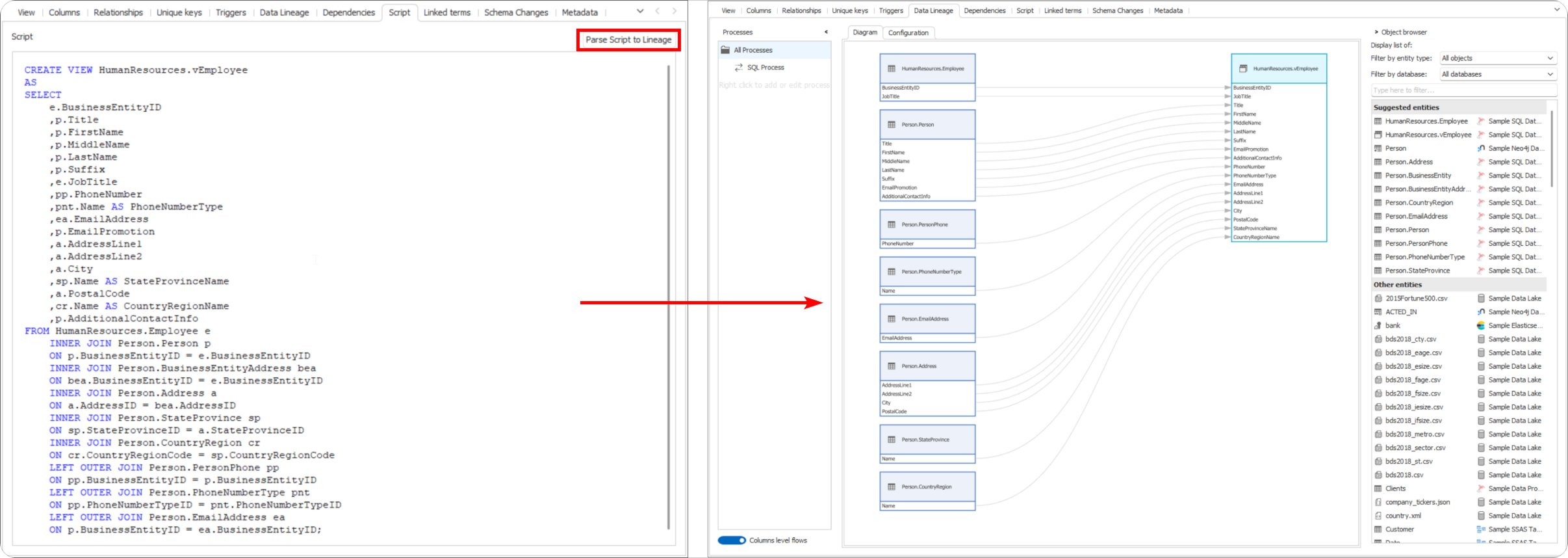
When stored procedures and functions are involved, Dataedo can represent lineage across multiple internal steps, showing how data flows through successive stages of procedural logic. In the online SQL Analyzer, users can observe the early stages of this process-such as detected tables, columns, and joins. In the full Dataedo product, the same parsing engine feeds directly into interactive lineage diagrams and searchable, continuously updated documentation.
Parsing Stored Procedures and Functions
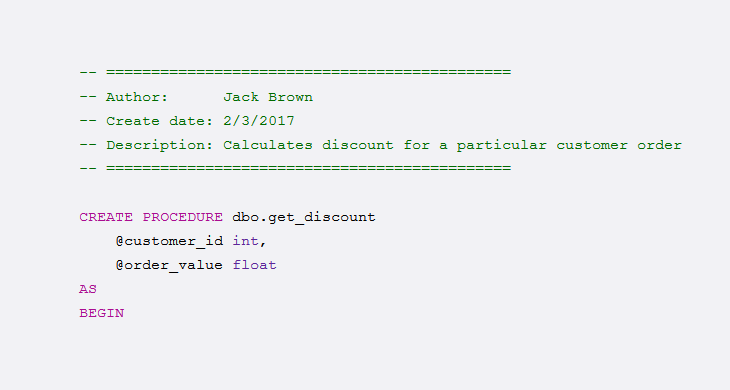
A key capability that sets the SQL Parser in Dataedo apart is its ability to analyze not only queries, tables, and views, but also stored procedures and functions. In many data environments, the most critical transformations are implemented inside procedural SQL, where business logic is spread across multiple statements, conditional branches, and intermediate steps.
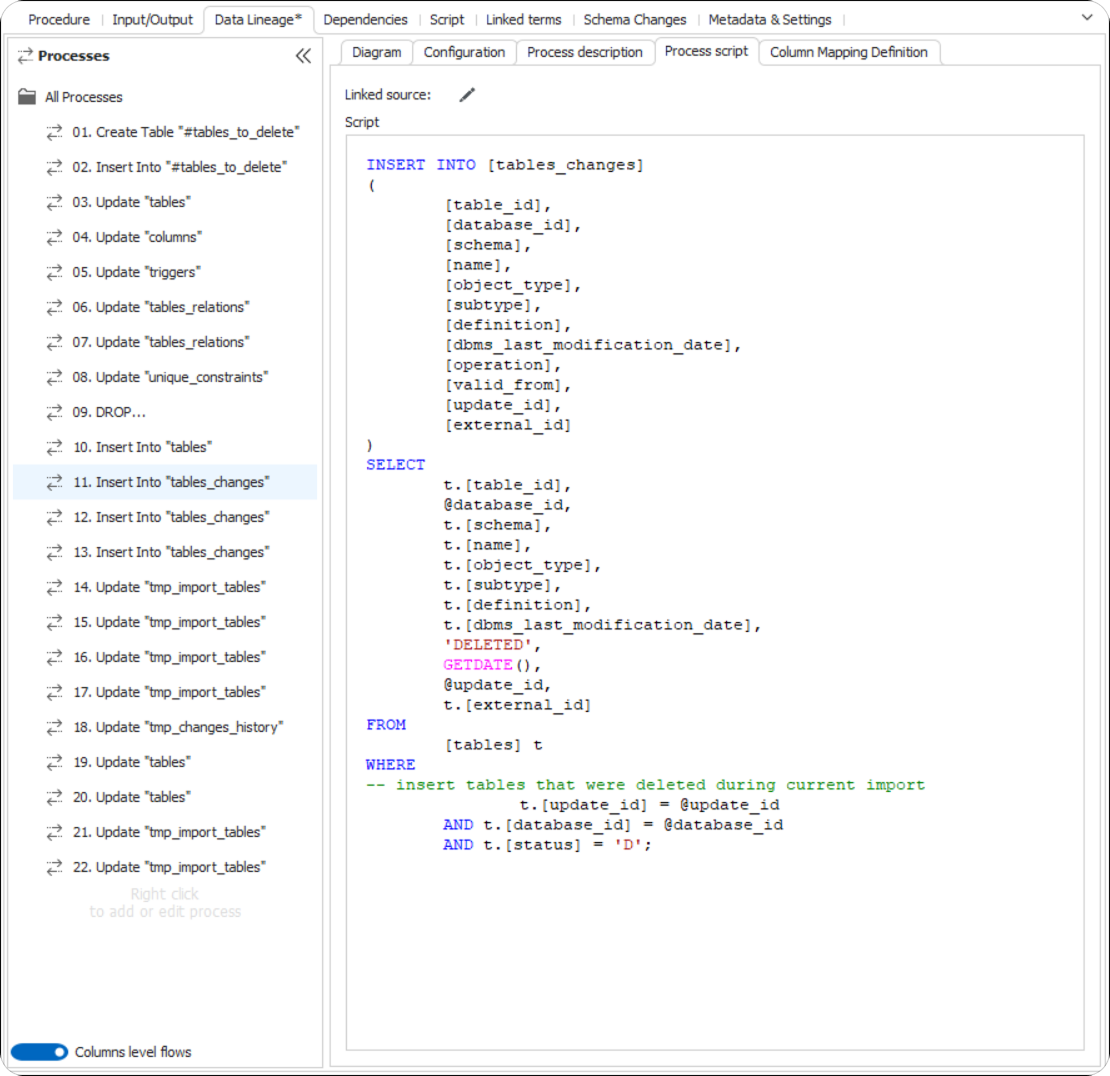
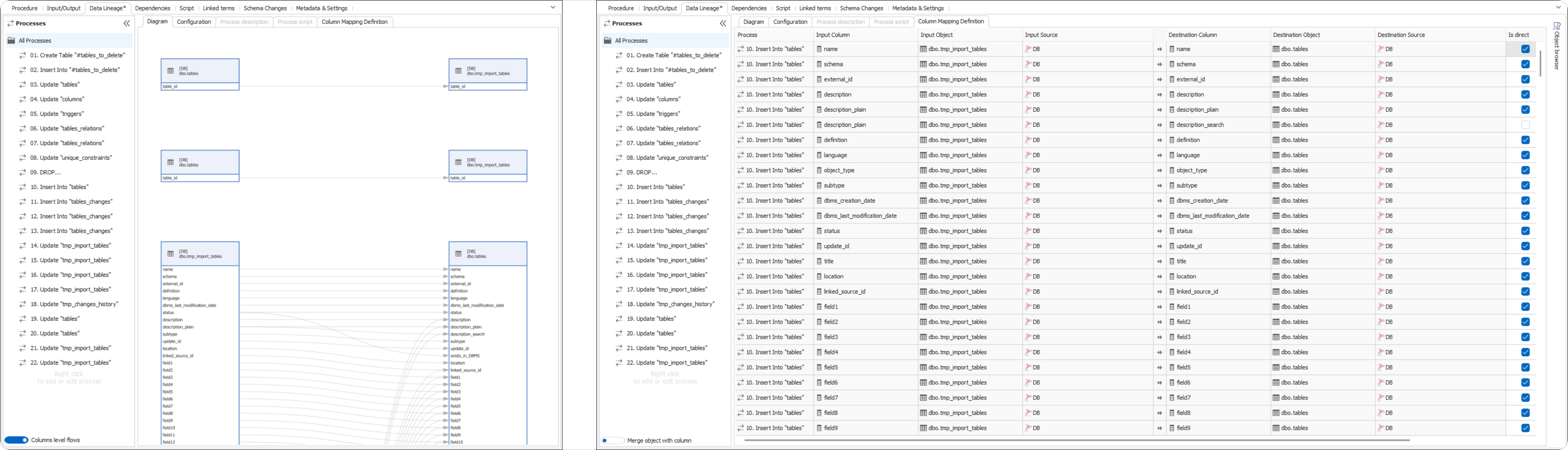
When parsing stored procedures and functions, Dataedo analyzes the SQL code statement by statement, identifying source objects, intermediate results, and output targets at each stage of execution. This allows Dataedo to capture lineage within the procedure itself, not just at its inputs and outputs.
As a result, users can see how data flows through successive steps of a procedure-such as temporary tables, intermediate SELECTs, and final INSERT or UPDATE statements-and understand how each step contributes to the final result. This step-by-step breakdown provides a much deeper level of insight than treating a procedure as a single black box.
By visualizing lineage across individual stages of procedural logic, Dataedo makes complex stored procedures easier to understand, document, and maintain. This is especially valuable for impact analysis, troubleshooting data issues, and onboarding new team members who need to quickly grasp how critical transformations are implemented.
What You Can Test with the Online SQL Analyzer
The online SQL Analyzer is a lightweight, publicly accessible way to experience how the SQL Parser in Dataedo works in practice. While it does not expose the full range of functionality available in the desktop and portal versions, it allows users to explore and validate several core SQL parsing capabilities.
Supported Features in the Online Analyzer
Using the SQL Analyzer, you can test how Dataedo parses:
Basic SELECT queries
Including column lists, aliases, and simple expressions.
Source tables and views
The analyzer automatically detects which tables and views are referenced in the query and presents them as source objects.
JOINs and relationships
INNER and OUTER JOINs are recognized, along with the join conditions that define how tables are connected.
CTEs (Common Table Expressions)
Queries using WITH clauses can be analyzed, showing how intermediate result sets are created and reused within a query.
Derived columns
Columns created using expressions, functions, or CASE statements are parsed and displayed together with their underlying logic.
These capabilities allow users to quickly confirm whether a SQL query can be correctly interpreted and to understand how column dependencies and relationships are inferred.
What Is Not Available Online
It is important to note that the SQL Analyzer is intended primarily for demonstration and exploration. Some advanced capabilities are intentionally limited or not exposed, including:
- full database context and schema resolution,
- parsing of complex stored procedures and functions,
- advanced or dynamic SQL constructs,
- visualization of complete end-to-end lineage across multiple objects.
All of these features are available when the same SQL is analyzed inside Dataedo Desktop or Dataedo Portal, where parsed metadata is fully integrated with documented database objects.
Why the Online SQL Analyzer Is Useful
Despite its limitations, the online SQL Analyzer remains a valuable tool for:
- learning how Dataedo interprets SQL queries,
- testing sample SQL before importing it into Dataedo,
- demonstrating SQL parsing and data lineage concepts to both technical and non-technical stakeholders.
It provides a fast, no-installation way to understand the foundation of automated SQL parsing and lineage that Dataedo delivers at scale.
Supported SQL Dialects and Parsing Scope
One of the key strengths of the SQL Parser in Dataedo is its ability to accurately understand multiple SQL dialects. Because SQL syntax, functions, and behavior vary significantly between database platforms, effective SQL parsing requires dialect-aware logic rather than a generic, one-size-fits-all approach.
SQL Dialects Supported by Dataedo
Dataedo’s SQL Parser is designed to analyze SQL written for several widely used database technologies, including:
Transact-SQL (SQL Server)
Used in Microsoft SQL Server and Azure SQL Database, with support for common constructs such as CTEs, subqueries, CASE expressions, and joins.
PostgreSQL
Including PostgreSQL-compatible platforms such as Amazon Aurora PostgreSQL and Amazon Redshift, with support for standard SQL features as well as PostgreSQL-specific syntax.
Snowflake
Covering common Snowflake SQL patterns used in analytical queries, views, and derived columns.
MySQL
Including MySQL-compatible engines such as MariaDB and Percona MySQL.
Each SQL dialect is parsed using rules that reflect its specific grammar, keywords, and execution behavior. This allows Dataedo to extract accurate metadata even when similar business logic is implemented differently across platforms.
Practical Scope of SQL Parsing
Across all supported dialects, the SQL Parser focuses on the elements that are most valuable for documentation and data lineage, including:
- source tables and views,
- column selections and aliases,
- joins and table relationships,
- expressions and calculated columns,
- transformations defined using CTEs.
In the online SQL Analyzer, users can test a subset of these capabilities using representative queries written in different SQL dialects. In the full Dataedo environment, the same parsing engine is applied at scale to views, procedures, functions, and SQL scripts imported directly from databases or files.
By supporting multiple SQL dialects within a single documentation platform, Dataedo enables organizations to maintain consistent, cross-platform data lineage and metadata documentation, even in complex and heterogeneous data ecosystems.
Try Dataedo in Your Own Environment
The online SQL Analyzer is a great way to explore how Dataedo interprets SQL-but it represents only a small part of what the platform can do.
To experience the full power of SQL parsing in real-world scenarios, including stored procedures, multi-step transformations, column-level lineage, and impact analysis, we encourage you to try Dataedo with your own databases and SQL code.
With Dataedo, you can automatically document your data sources, visualize end-to-end data lineage, and understand complex SQL logic across views, procedures, and functions-all in one consistent environment.
Start a free trial or request a demo to see how Dataedo helps teams gain clarity, reduce risk, and build trust in their data.