Support

This is a list of handy SQL queries to the SQL Server data dictionary. You can also find 100+ other useful queries here.
1. List of tables with number of rows and comments
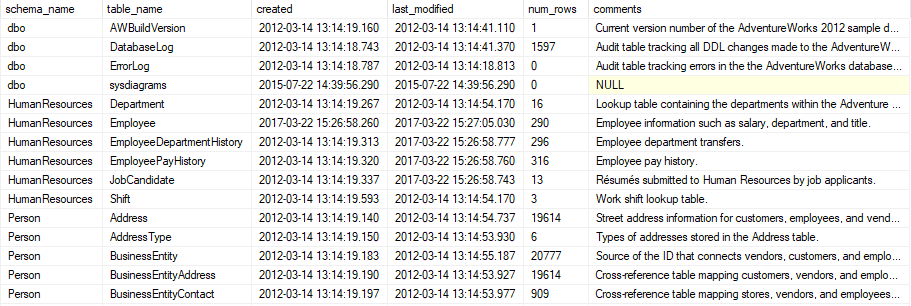
This query returns list of tables in a database sorted by schema and table name with comments and number of rows in each table.
Query
select schema_name(tab.schema_id) as schema_name,
	   tab.name as table_name,
	   tab.create_date as created,
	   tab.modify_date as last_modified,
	   p.rows as num_rows,
	   ep.value as comments
  from sys.tables tab
	   inner join (select distinct
						  p.object_id,
						  sum(p.rows) rows
					 from sys.tables t
						  inner join sys.partitions p
							  on p.object_id = t.object_id
					group by p.object_id,
						  p.index_id) p
		    on p.object_id = tab.object_id
		left join sys.extended_properties ep
		    on tab.object_id = ep.major_id
		   and ep.name = 'MS_Description'
		   and ep.minor_id = 0
		   and ep.class_desc = 'OBJECT_OR_COLUMN'
  order by schema_name,
		table_name
Rows
One row represents one table. All tables will be included.
Columns
| Column | Meaning |
|---|---|
| SCHEMA_NAME | Schema name. |
| TABLE_NAME | Table name. |
| CREATED | Table creation date and time. |
| LAST_MODIFIED | Table last modification date and time. |
| NUM_ROWS | Number of rows in the table. |
| COMMENTS | Table comments. |
Sample results
2. List of views with definition and comments
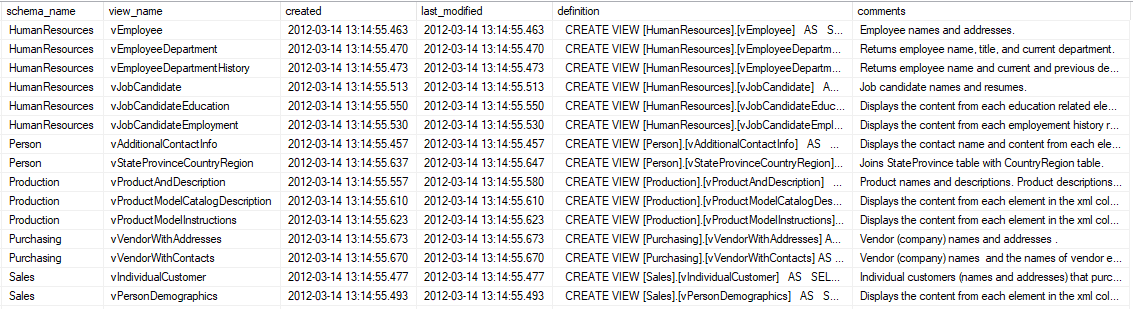
This query returns list of database views with their definition SQL and a comment.
Query
select schema_name(v.schema_id) as schema_name,
	   v.name as view_name,
	   v.create_date as created,
	   v.modify_date as last_modified,
	   m.definition,
	   ep.value as comments
  from sys.views v
	   left join sys.extended_properties ep
		   on v.object_id = ep.major_id
          and ep.name = 'MS_Description'
		  and ep.minor_id = 0
		  and ep.class_desc = 'OBJECT_OR_COLUMN'
	   inner join sys.sql_modules m
		   on m.object_id = v.object_id
 order by schema_name,
		  view_name
Rows
One row represents one view.
Columns
| Column | Meaning |
|---|---|
| SCHEMA_NAME | Schema name. |
| VIEW_NAME | View name. |
| CREATED | View creation date and time. |
| LAST_MODIFIED | View last modification date and time. |
| DEFINITION | View definition (SQL query). |
| COMMENTS | View comments. |
Sample results
3. Table columns details
This query returns list of tables and their columns with details.
Query
select schema_name(tab.schema_id) as schema_name,
	   tab.name as table_name,
	   col.name as column_name,
	   t.name as data_type,
	   t.name +
	   case when t.is_user_defined = 0 then
				 isnull('(' +
				 case when t.name in ('binary', 'char', 'nchar',
						   'varchar', 'nvarchar', 'varbinary') then
						   case col.max_length
				 				when -1 then 'MAX'
								else
									 case when t.name in ('nchar',
											   'nvarchar') then
											   cast(col.max_length/2
											   as varchar(4))
										  else cast(col.max_length
											   as varchar(4))
									 end
						   end
					  when t.name in ('datetime2', 'datetimeoffset',
						   'time') then
						   cast(col.scale as varchar(4))
					  when t.name in ('decimal', 'numeric') then
							cast(col.precision as varchar(4)) + ', ' +
							cast(col.scale as varchar(4))
				 end + ')', '')
			else ':' +
				 (select c_t.name +
						 isnull('(' +
						 case when c_t.name in ('binary', 'char',
								   'nchar', 'varchar', 'nvarchar',
								   'varbinary') then
									case c.max_length
										 when -1 then 'MAX'
										 else
											  case when t.name in
														('nchar',
														'nvarchar') then
														cast(c.max_length/2
														as varchar(4))
												   else cast(c.max_length
														as varchar(4))
											  end
									end
							  when c_t.name in ('datetime2',
								   'datetimeoffset', 'time') then
								   cast(c.scale as varchar(4))
							  when c_t.name in ('decimal', 'numeric') then
							       cast(c.precision as varchar(4)) + ', '
								   + cast(c.scale as varchar(4))
						 end + ')', '')
					from sys.columns as c
						 inner join sys.types as c_t
							 on c.system_type_id = c_t.user_type_id
				   where c.object_id = col.object_id
					 and c.column_id = col.column_id
					 and c.user_type_id = col.user_type_id
			     )
		end as data_type_ext,
		case when col.is_nullable = 0 then 'N'
			 else 'Y' end as nullable,
		case when def.definition is not null then def.definition
			 else '' end as default_value,
		case when pk.column_id is not null then 'PK'
			 else '' end as primary_key,
		case when fk.parent_column_id is not null then 'FK'
			 else '' end as foreign_key,
		case when uk.column_id is not null then 'UK'
			 else '' end as unique_key,
		case when ch.check_const is not null then ch.check_const
			 else '' end as check_contraint,
		cc.definition as computed_column_definition,
		ep.value as comments
   from	sys.tables as tab
		left join sys.columns as col
		    on tab.object_id = col.object_id
		left join sys.types as t
		    on col.user_type_id = t.user_type_id
		left join sys.default_constraints as def
		    on def.object_id = col.default_object_id
		left join (
				  select index_columns.object_id,
						 index_columns.column_id
				    from sys.index_columns
						 inner join sys.indexes
							 on index_columns.object_id = indexes.object_id
							and index_columns.index_id = indexes.index_id
				   where indexes.is_primary_key = 1
				  ) as pk
	        on col.object_id = pk.object_id
		   and col.column_id = pk.column_id
		left join (
				  select fc.parent_column_id,
						 fc.parent_object_id
					from sys.foreign_keys as f
						 inner join sys.foreign_key_columns as fc
							 on f.object_id = fc.constraint_object_id
				   group by fc.parent_column_id, fc.parent_object_id
				  ) as fk
	        on fk.parent_object_id = col.object_id
		   and fk.parent_column_id = col.column_id
		left join (
				  select c.parent_column_id,
						 c.parent_object_id,
						 'Check' check_const
					from sys.check_constraints as c
				   group by c.parent_column_id,
						 c.parent_object_id
				  ) as ch
		    on col.column_id = ch.parent_column_id
		   and col.object_id = ch.parent_object_id
		left join (
				  select index_columns.object_id,
						 index_columns.column_id
				    from sys.index_columns
						 inner join sys.indexes
							 on indexes.index_id = index_columns.index_id
							and indexes.object_id = index_columns.object_id
					where indexes.is_unique_constraint = 1
					group by index_columns.object_id,
						  index_columns.column_id
				  ) as uk
		    on col.column_id = uk.column_id
		   and col.object_id = uk.object_id
	    left join sys.extended_properties as ep
	        on tab.object_id = ep.major_id
		   and col.column_id = ep.minor_id
		   and ep.name = 'MS_Description'
		   and ep.class_desc = 'OBJECT_OR_COLUMN'
		left join sys.computed_columns as cc
	        on tab.object_id = cc.object_id
		   and col.column_id = cc.column_id
  order by schema_name,
		table_name,
		column_name;
Rows
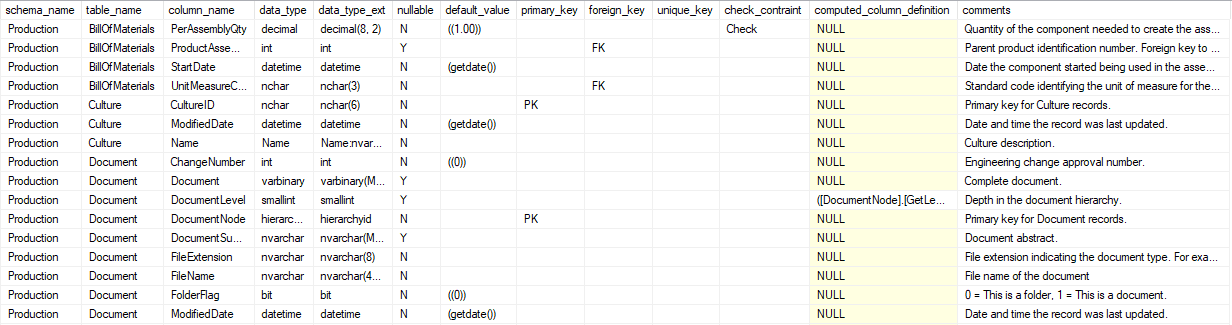
One row represents one table column.
Columns
| Column | Meaning |
|---|---|
| SCHEMA_NAME | Schema name. |
| TABLE_NAME | Table name. |
| COLUMN_NAME | Column name. |
| DATA_TYPE | Data type. For instance, varchar or decimal. |
| DATA_TYPE_EXT | Data type with information about scale/precision or string length. For instance, varchar(100) or decimal(8, 2). |
| NULLABLE | Nullable flag. "Y" if column is nullable, "N" if column is not nullable. |
| DEFAULT_VALUE | Column default value. |
| PRIMARY_KEY | Primary key flag. "PK" when column is part of table primary key. |
| FOREIGN_KEY | Foreign key flag. "FK" when column is part of foreign key. |
| UNIQUE_KEY | Unique key flag. "UK" when column is part of unique key. |
| CHECK_CONSTRAINT | Check constraint flag. "Check" when column is part of check constraint. |
| COMPUTED_COLUMN_DEFINITION | Computed column definition (not null only if column is computed). |
| COMMENTS | Column comments. |
Sample results
4. Foreign keys
This query returns list of tables and their foreign keys.
Query
select schema_name(tab.schema_id) as table_schema_name,
	   tab.name as table_name,
	   col.name as column_name,
	   fk.name as constraint_name,
	   schema_name(tab_prim.schema_id) as primary_table_schema_name,
	   tab_prim.name as primary_table_name,
	   col_prim.name as primary_table_column,
	   schema_name(tab.schema_id) + '.' + tab.name + '.' +
			col.name + ' = ' + schema_name(tab_prim.schema_id) + '.' +
			tab_prim.name + '.' + col_prim.name as join_condition,
	   case
			when count(*) over (partition by fk.name) > 1 then 'Y'
			else 'N'
	   end as complex_fk,
	   fkc.constraint_column_id as fk_part
  from sys.tables as tab
	   inner join sys.foreign_keys as fk
	       on tab.object_id = fk.parent_object_id
	   inner join sys.foreign_key_columns as fkc
		   on fk.object_id = fkc.constraint_object_id
	   inner join sys.columns as col
		   on fkc.parent_object_id = col.object_id
	      and fkc.parent_column_id = col.column_id
	   inner join sys.columns as col_prim
	       on fkc.referenced_object_id = col_prim.object_id
		  and fkc.referenced_column_id = col_prim.column_id
	   inner join sys.tables as tab_prim
		   on fk.referenced_object_id = tab_prim.object_id
 order by table_schema_name,
	   table_name,
	   primary_table_name,
	   fk_part;
Rows
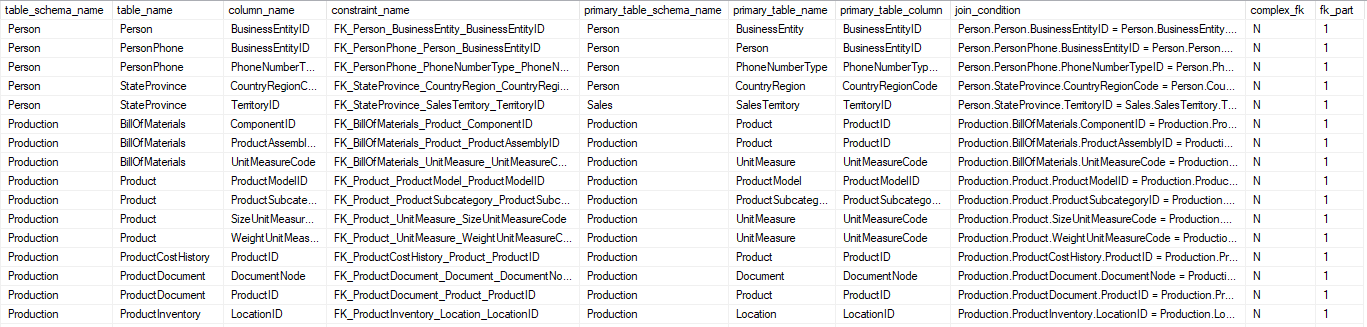
One row represents one pair of columns in foreign key.
Columns
| Column | Meaning |
|---|---|
| TABLE_SCHEMA_NAME | Foreign table schema name. |
| TABLE_NAME | Foreign table name. |
| COLUMN_NAME | Foreign table column name. |
| CONSTRAINT_NAME | Constraint name. |
| PRIMARY_TABLE_SCHEMA_NAME | Primary table schema name. |
| PRIMARY_TABLE_NAME | Primary table name. |
| PRIMARY_TABLE_COLUMN | Primary table column name. |
| JOIN_CONDITION | Join condition containing foreign and primary key tables and columns. |
| COMPLEX_FK | Complex foreign key flag. "Y" when foreign key is complex, otherwise "N". |
| FK_PART | Represents part number of foreign key. |
Sample results
5. Views columns
This query returns list of views with their columns.
Query
select schema_name(v.schema_id) as schema_name,
	   v.name as view_name,
	   col.name as column_name,
	   t.name as data_type,
	   t.name +
	   case when t.is_user_defined = 0 then
				 isnull('(' +
				 case when t.name in ('binary', 'char', 'nchar',
						   'varchar', 'nvarchar', 'varbinary') then
						   case col.max_length
							    when -1 then 'MAX'
							    else
								 	 case
										 when t.name in ('nchar',
											  'nvarchar') then
											  cast(col.max_length/2
											  as varchar(4))
										 else cast(col.max_length
											  as varchar(4))
									 end
			 			   end
					  when t.name in ('datetime2',
						   'datetimeoffset', 'time') then
							cast(col.scale as varchar(4))
					  when t.name in ('decimal', 'numeric') then
						   cast(col.precision as varchar(4)) + ', ' +
						   cast(col.scale as varchar(4))
			 	 end + ')', '')
			else ':' +
				 (select c_t.name +
						 isnull('(' +
						 case when c_t.name in ('binary', 'char',
								   'nchar', 'varchar', 'nvarchar',
								   'varbinary') then
								   case c.max_length
									    when -1 then 'MAX'
										else case when t.name in
										    		   ('nchar',
														'nvarchar')
												  then cast(c.max_length/2
													   as varchar(4))
												  else cast(c.max_length
													   as varchar(4))
											 end
								   end
							  when c_t.name in ('datetime2',
								   'datetimeoffset', 'time') then
								   cast(c.scale as varchar(4))
							  when c_t.name in ('decimal', 'numeric') then
								   cast(c.precision as varchar(4)) +
								   ', ' + cast(c.scale as varchar(4))
						 end + ')', '')
					from sys.columns as c
						 inner join sys.types as c_t
							 on c.system_type_id = c_t.user_type_id
				   where c.object_id = col.object_id
					 and c.column_id = col.column_id
		             and c.user_type_id = col.user_type_id
				 )
	   end as data_type_ext,
	   case when col.is_nullable = 0 then 'N' else 'Y' end as nullable,
	   ep.value as comments
  from sys.views as v
	   join sys.columns as col
		   on v.object_id = col.object_id
	   left join sys.types as t
		   on col.user_type_id = t.user_type_id
	   left join sys.extended_properties as ep
		   on v.object_id = ep.major_id
		  and col.column_id = ep.minor_id
	      and ep.name = 'MS_Description'
		  and ep.class_desc = 'OBJECT_OR_COLUMN'
 order by schema_name,
	   view_name,
	   column_name;
Rows
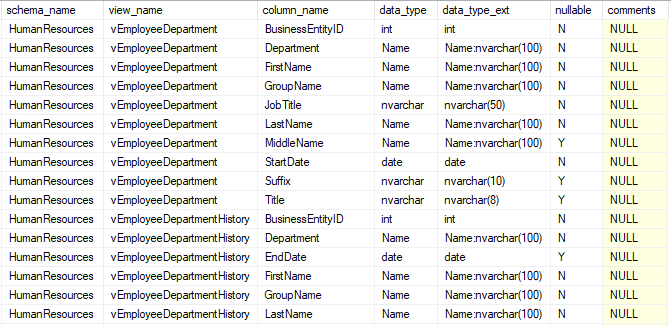
One row represents one view column.
Columns
| Column | Meaning |
|---|---|
| SCHEMA_NAME | Schema name. |
| VIEW_NAME | View name. |
| COLUMN_NAME | View column name. |
| DATA_TYPE | Data type. For instance, varchar or decimal. |
| DATA_TYPE_EXT | Data type with information about scale/precision or string length. For instance, varchar(100) or decimal(8, 2). |
| NULLABLE | Nullable flag. "Y" if column is nullable, "N" if column is not nullable. |
| COMMENTS | Column comments. |
Sample results
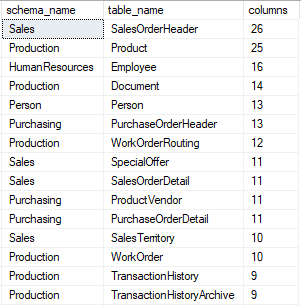
6. Tables by number of columns
This query returns list of tables sorted by the number of columns they contain.
Query
select schema_name(tab.schema_id) as schema_name,
	   tab.name as table_name,
	   count(*) as columns
  from sys.tables as tab
	   inner join sys.columns as col
		   on tab.object_id = col.object_id
 group by schema_name(tab.schema_id),
	   tab.name
 order by count(*) desc;
Rows
One row represents one user table.
Columns
| Column | Meaning |
|---|---|
| SCHEMA_NAME | Schema name. |
| TABLE_NAME | Table name. |
| COLUMNS | Number of columns table contains. |
Sample results