 Support


Join 1000+ Satisfied Customers Using Dataedo
















Turn raw tables into trusted, discoverable data assets
Data products should be self-describing, discoverable assets that teams can trust and reuse without asking "who built this?" Dataedo helps domain teams define data products with clear contracts, publish them to a central portal, and govern quality through their lifecycle.
The challenge

Reinventing the wheel
Teams repeatedly recreate the same customer or product datasets instead of reusing trusted data products.
No shared standards
Without common definitions or data contracts, teams struggle to create consistent and reliable data products.
Unclear dataset statuses
Data consumers can’t easily tell which datasets are production-ready and which are experimental or incomplete.
Cascading quality issues
Quality issues in upstream tables cascade through dozens of downstream reports.
How Dataedo helps
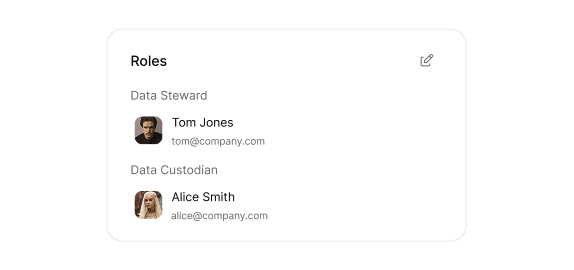
Define data products with clear ownership
Use Dataedo Ownership to assign domain stewards to each data product. Document SLAs, freshness guarantees, and support contacts.
Create data product contracts
Use the Business Glossary to define core entities with business rules, field definitions, and usage guidelines. Link terms to physical implementations.

Catalog source-to-product lineage
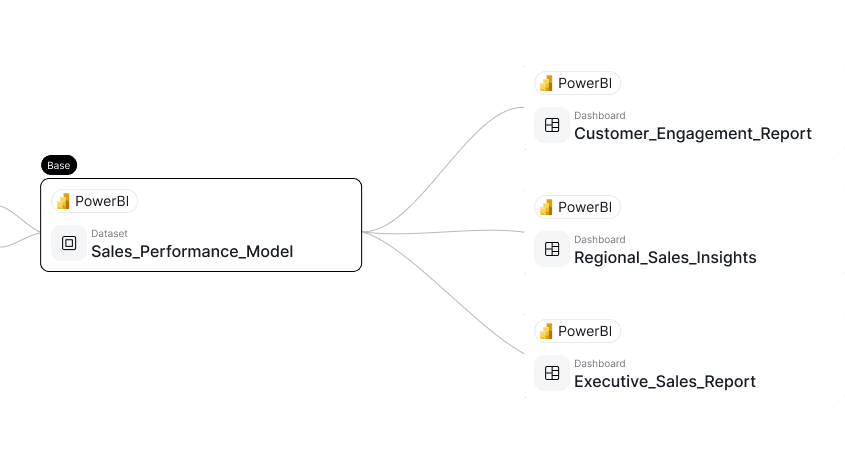
Use Automatic Data Lineage to show how raw operational tables transform into curated data products through ETL pipelines and quality checks.

Tag data products for discoverability
Apply badges and classification tags like "Certified", "Production Ready", "Self-Service Approved" to distinguish trusted assets. Document deprecation plans.

What you get

Reduced duplicate work
Teams reuse existing data products instead of rebuilding the same datasets from scratch.
Faster analytics delivery
Consumers can immediately trust and adopt certified datasets for reporting and analysis.
Clear domain ownership
Each team manages its data products end-to-end, improving accountability and consistency.
Key features

Badges
Visually highlight trusted, maintained, or recommended datasets, helping users quickly choose reliable data products without additional validation.

Business Glossary
Standardize business terminology across domains so data products use consistent definitions that are easy for both producers and consumers to understand.
Data Lineage
Provide transparency into data dependencies and downstream impact, helping teams understand how changes affect analytics and reusable data assets.
FAQs
What is a data product?
A data product is a curated, reusable dataset designed for consumption by analytics, reporting, or AI teams. It includes clear definitions, ownership, documentation, and quality standards so users can confidently rely on the data.
Why are data products important for modern data teams?
Data products reduce duplicated work by allowing teams to reuse trusted datasets instead of rebuilding them. They improve consistency, accelerate analytics, and make data easier to discover and understand across the organization.
How do data products differ from traditional datasets?
Traditional datasets are often created for a single use case, while data products are intentionally designed for reuse. They include documentation, ownership, governance rules, and defined expectations for quality and reliability.
How do users know which data products are trustworthy?
Certification badges, documentation, and governance metadata help distinguish production-ready data products from experimental or deprecated datasets, enabling faster and safer adoption.
How do data products support a data mesh approach?
In a data mesh model, domain teams own and manage their data as products. Clearly defined ownership, shared standards, and discoverability enable decentralized teams to publish reusable data assets responsibly.
Can data products improve analytics and reporting speed?
Yes. When teams can quickly find certified, well-documented data products, they spend less time preparing data and more time generating insights.
Why our customers love Dataedo?
Dataedo is a lightweight solution with great customer service and active product development (recently data quality). The ability to run SQL scripts on the repository brings additional flexibility.

We jump started all of our Data Governance efforts using the tool. We documented key databases quickly and easily and published the information to our analyst community. The Dataedo team is dream to work with and very responsive.

Dataedo is easy to use, offers great functionality, and provides excellent customer service that always listens to the customer.

Dataedo is an amazing tool that continues to grow and improve.

Dataedo excels at data cataloging, and the support from the Dataedo team is top-notch.

Datedo consistently improves while delivering exceptional support that is quick, competent, and highly reliable.

Dataedo provides ease of use and covers so many areas from a Data Governance perspective. You really can put everythng in one place.

Dataedo is a fantastic tool, and I love working with it—especially with the continuous improvements being made and planned.


Piotr Kononow
Founder
Turn raw tables into trusted, discoverable data assets
Explore Dataedo through a preconfigured data catalog with sample data, try it with your own data during a 14-day free trial, or book a demo.