 Support


Snowflake helps teams ship analytics quickly. New tables appear fast, views become layered, and transformation logic grows across SQL, pipelines, and BI tools. Speed is valuable, but at scale it introduces a familiar governance problem: teams move data faster than they can keep context, ownership, and change control up to date.
When that happens, governance debt shows up in daily operations:
- duplicated KPI logic,
- unclear accountability for critical assets,
- low trust in metrics,
- risky releases with unclear downstream impact.
Teams start asking questions like:
- Which Snowflake objects are officially trusted?
- Who approves changes to business-critical columns?
- Which reports and models depend on this field?
- Why did KPI values change after yesterday’s release?
- Is this data safe to use from a compliance perspective?
This guide explains practical Snowflake data governance best practices you can implement without slowing delivery.
In this guide, you’ll learn:
- what strong governance looks like in Snowflake environments,
- seven best practices you can operationalize,
- and how Dataedo helps make governance repeatable.
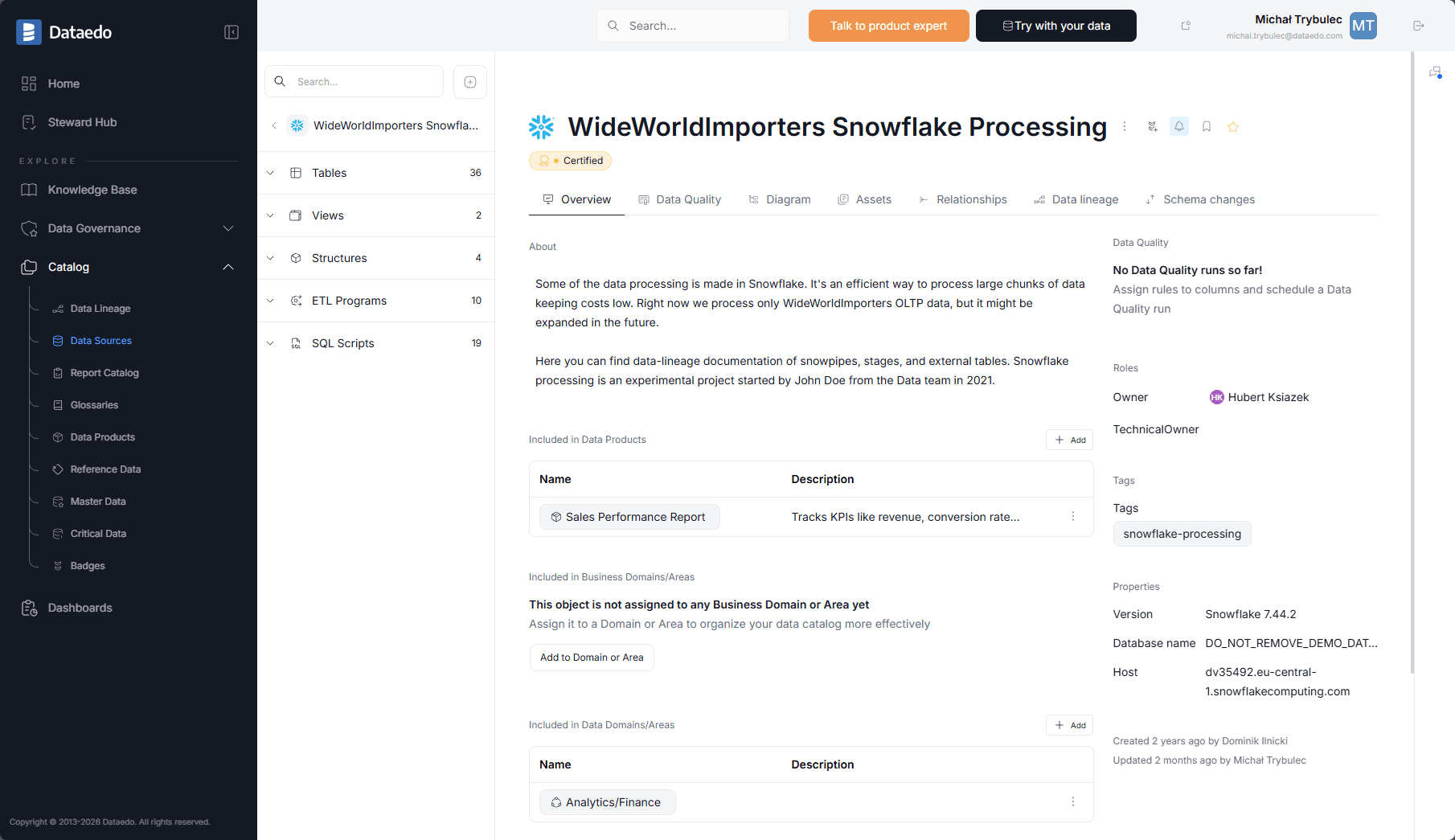 Snowflake governance context in Dataedo: object overview with roles, quality status, and domain/product linkage.
What Good Snowflake Governance Actually Means
In practice, Snowflake governance is not a policy deck. It is an operating model that connects technical metadata to business accountability.
Strong governance means teams can answer five core questions quickly and consistently:
- What does this data represent?
- Who owns it and who stewards it?
- Can we trust its quality for this use case?
- What depends on it downstream?
- What will break if we change it?
If your team cannot answer those questions without manual investigation, governance is likely incomplete, even if documentation exists.
Why Snowflake Governance Breaks at Scale
Most governance failures do not start as major incidents. They start as small gaps that accumulate:
- object descriptions are not updated during releases,
- ownership exists in org charts but not on data assets,
- glossary terms are defined once but not mapped to technical fields,
- lineage is partial, so impact analysis remains guesswork.
Over time, teams spend increasing effort validating reports and resolving definition disputes. Engineering velocity drops because every change requires manual verification.
Best Practice 1: Define Ownership at Object and Domain Level
Every critical Snowflake object should have explicit accountability. Ownership cannot live only at team level. It should be visible on the asset itself and aligned to domain context.
At minimum, separate decision ownership from operational stewardship:
- Data Owner for business correctness and release decisions,
- Technical Owner/Steward for documentation quality and implementation details.
This becomes crucial during incidents and release windows. Clear ownership shortens response time, reduces escalation loops, and improves change approval quality.
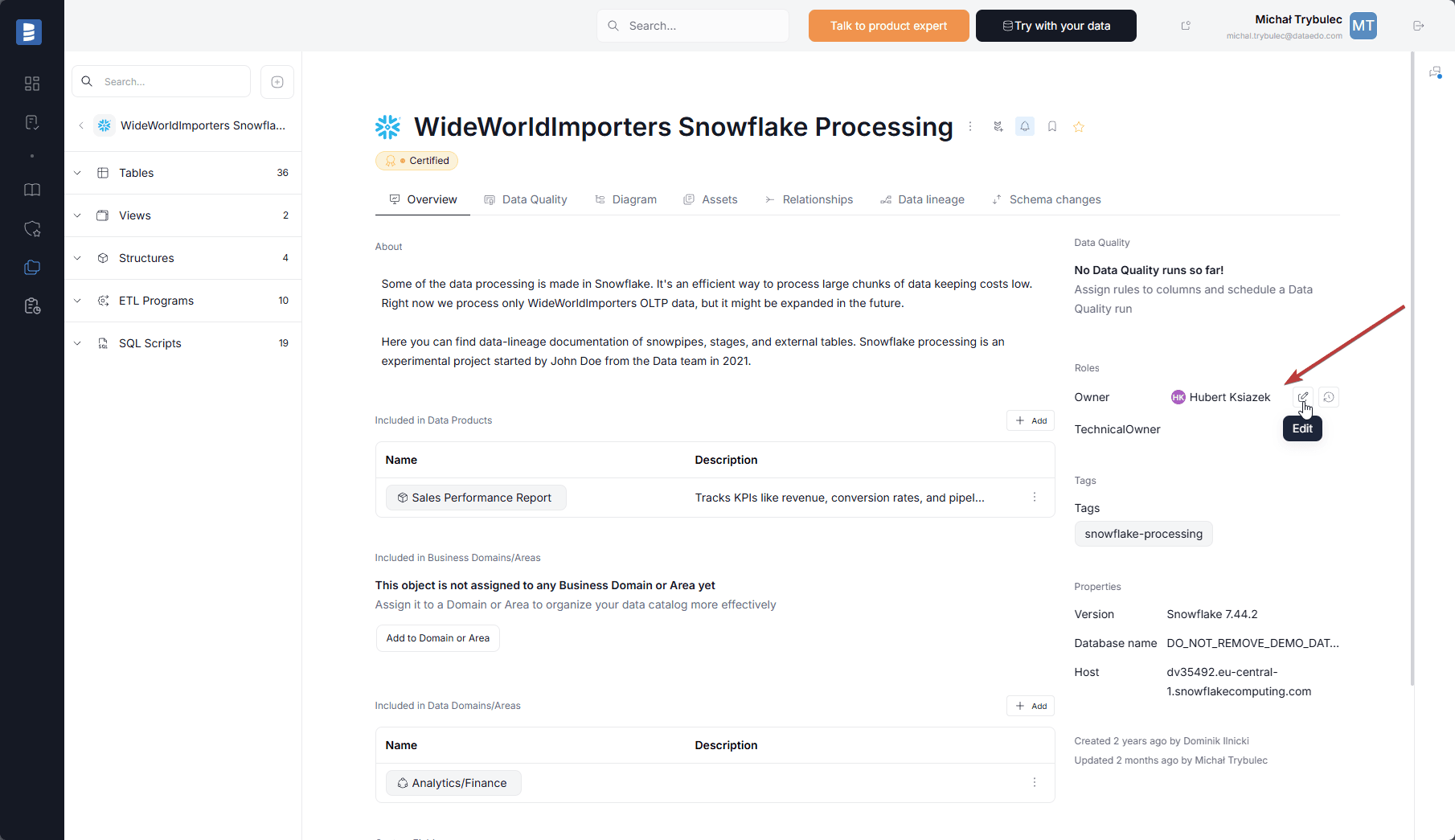 Owner and technical owner visible directly on a Snowflake object page in Dataedo.
Best Practice 2: Standardize Business Definitions with a Glossary
Snowflake can store technically consistent data while business meaning remains inconsistent across teams. Governance should prevent that by linking agreed terms to technical assets.
Terms such as “active customer,” “net revenue,” or “first purchase date” should not exist as free-form interpretations across pipelines and dashboards. They should be governed as shared definitions with mapped lineage to Snowflake columns and downstream BI fields.
A managed glossary helps teams:
- reduce KPI drift,
- accelerate onboarding,
- improve trust in cross-team reporting.
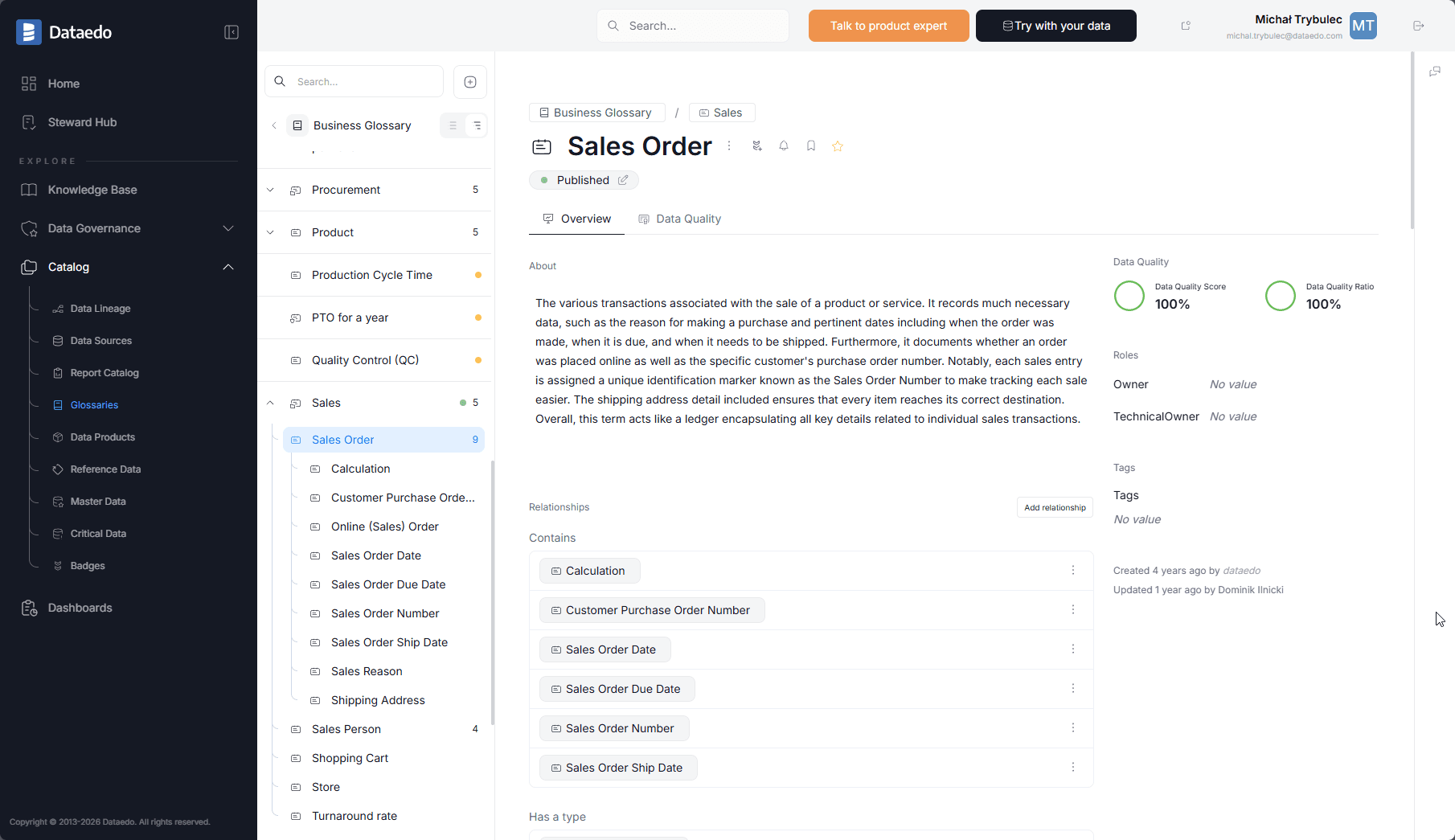 Business glossary term linked to related technical assets to keep definitions consistent.
Best Practice 3: Use End-to-End and Column-Level Lineage
Object-level lineage is useful for architecture visibility, but governance decisions often require column-level detail.
For example, changing one column in a Snowflake view can impact:
- dynamic tables,
- semantic model fields,
- report-level measures,
- operational dashboards used by business stakeholders.
Column-level lineage enables practical impact analysis before release and faster root-cause analysis after incidents.
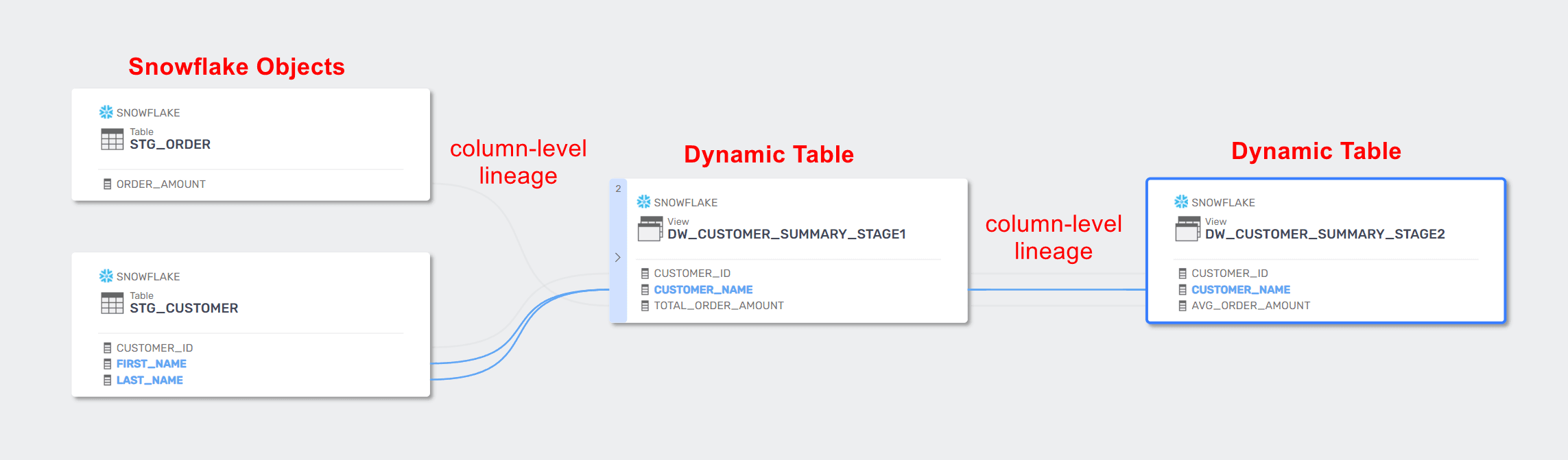 Column-level lineage across Snowflake transformation steps for dependency and impact analysis.
Best Practice 4: Document Transformation Logic Where It Is Used
Many governance programs document sources but under-document transformation layers. This is where trust usually fails.
Descriptions should exist on the actual objects where logic executes: views, dynamic tables, pipes, scripts, and semantic layers. The goal is to explain scope and intent, not only technical syntax.
Good object-level documentation should clarify:
- what the object does,
- what logic is intentionally included,
- what logic is explicitly downstream,
- which assets are sensitive to changes in this object.
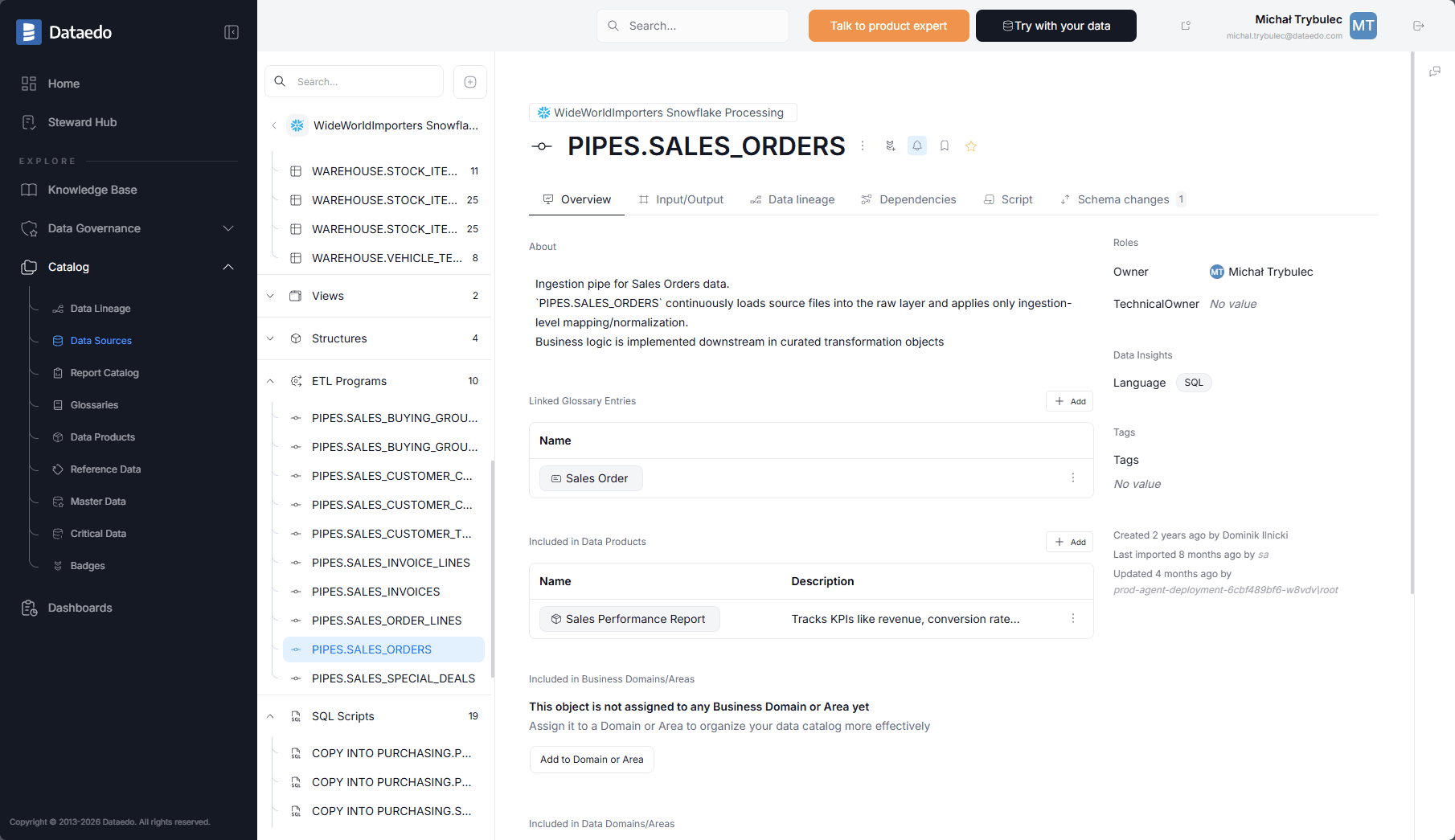 Description on PIPES.SALES_ORDERS documenting ingestion scope and downstream transformation context.
Best Practice 5: Put Governance into Release Workflow
Governance should be part of release gates, not post-release cleanup.
Before promoting Snowflake changes, teams should explicitly review:
- ownership and approver scope,
- glossary impacts,
- lineage impact on downstream assets,
- schema change implications,
- data quality risk on critical outputs.
This is where schema-change tracking and impact workflows matter. If teams only discover dependency issues after deployment, governance is reactive and expensive.
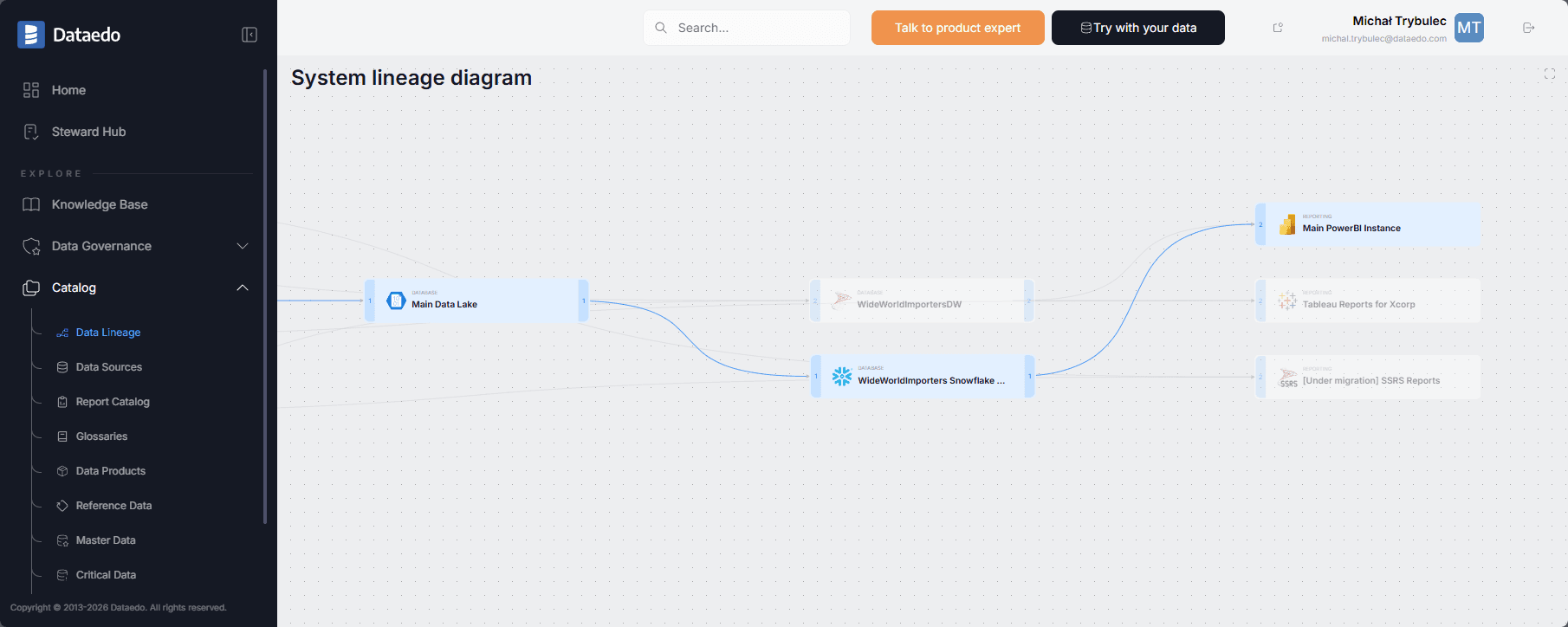 System-level lineage context used to assess downstream impact before Snowflake changes are released.
Best Practice 6: Treat Data Quality as a Governance Signal
Data quality is not a separate program from governance. It is one of the main trust signals users rely on before they use data for reporting or decision-making.
In mature setups, quality checks are:
- tied to defined rule instances,
- scheduled by severity,
- monitored over time,
- visible near the metadata and lineage context.
This is important because lineage answers “where data came from,” while quality answers “whether data is fit for use now.”
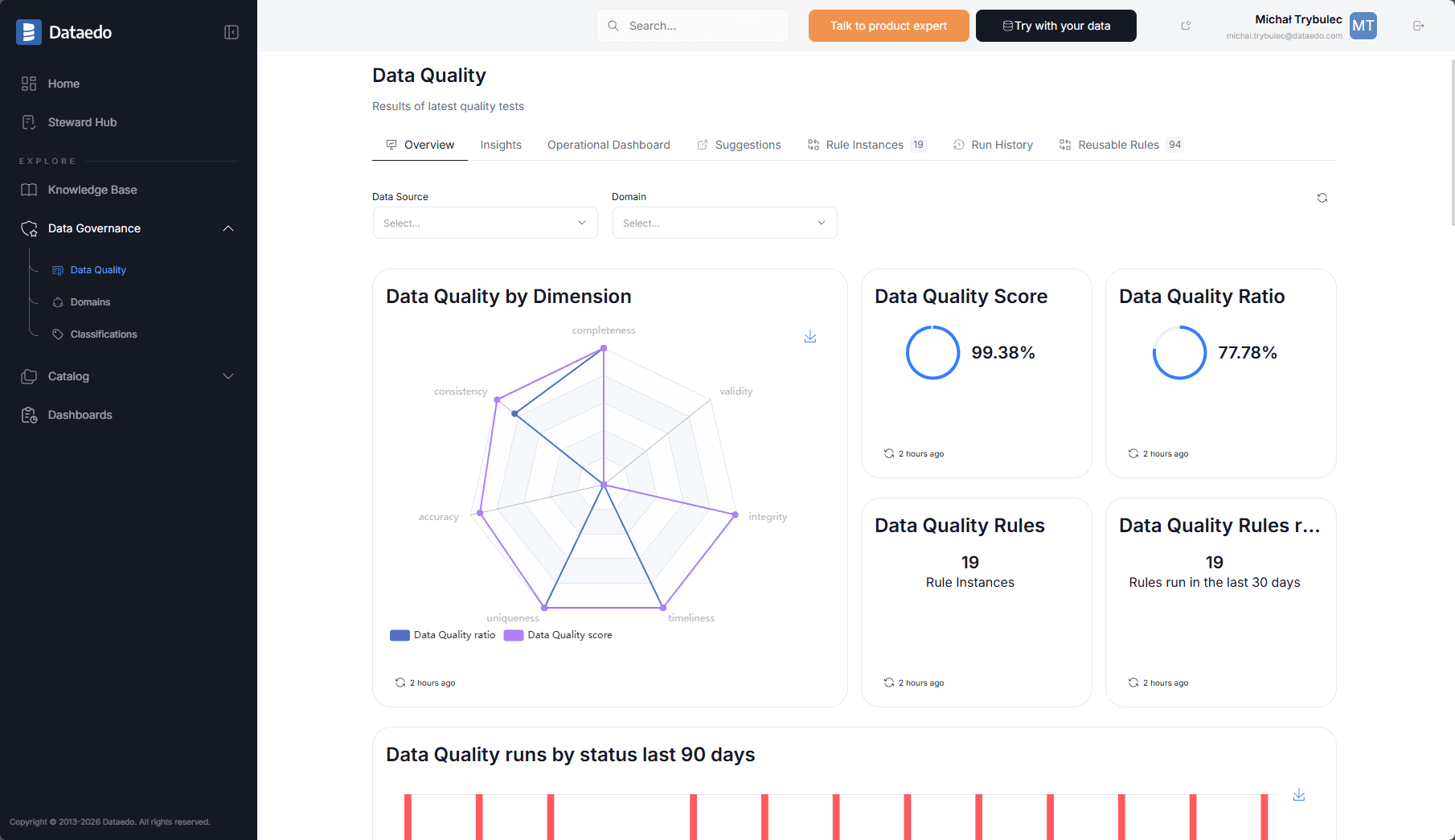 Data Quality dashboard view in Dataedo showing score, ratio, dimensions, and rule activity.
Best Practice 7: Connect Security and Access Context to Metadata
Governed self-service requires both discoverability and control.
Users should be able to discover trusted assets, but sensitive data and restricted domains must remain protected by design. Governance metadata should include classification context, ownership, and access boundaries so teams can collaborate safely without over-exposing data.
This is especially important when multiple teams, vendors, or external contributors participate in analytics delivery.
Common Mistakes to Avoid
- Treating governance as one-time documentation - Snowflake environments change continuously. Governance content must evolve with releases, schema imports, and ownership changes.
- Assigning owners without decision rights - Ownership fields alone do not solve accountability. Owners need clear authority in change and publication workflow.
- Expecting lineage alone to guarantee trust - Lineage without quality, glossary context, and ownership still leaves decision risk unresolved.
- Ignoring workflow and permissions design - If publication stages, review responsibilities, and visibility rules are unclear, governance quality degrades over time.
- Optimizing for documentation volume instead of usability - Users need concise, accurate, actionable context. Large documentation volume without clear governance signals slows adoption.
How Dataedo Helps with Snowflake Governance
- Centralize Snowflake Metadata with Governance Context - Dataedo combines technical metadata and business context in one catalog so teams can work from a shared source of truth.
- Link Glossary Terms to Real Technical Assets - Business definitions can be connected directly to Snowflake objects and downstream analytics fields, reducing metric ambiguity.
- Analyze Dependencies with End-to-End Lineage - Object-level and column-level lineage help teams perform safer impact analysis before schema and logic changes.
- Make Ownership and Stewardship Explicit - Roles and responsibilities are visible where teams work, improving accountability and incident response.
- Operationalize Data Quality Monitoring - Rule instances, scheduling, and quality insights provide ongoing trust signals instead of one-time validation.
- Support Controlled Change with Schema and Workflow Signals - Schema changes and governance workflows help teams release changes with less regression risk and better cross-team coordination.
FAQ
Can Snowflake governance be effective without dedicated governance tooling?
Only at small scale. As dependencies grow, teams usually need centralized metadata, ownership, lineage, and quality context to stay consistent.
Is object-level lineage enough for change impact analysis?
For high-level architecture, often yes. For production change decisions, column-level lineage is usually required.
Should governance start with quality rules or ownership?
Start with ownership and glossary alignment, then scale quality and lineage. Without accountability, quality programs become difficult to sustain.
How often should governance metadata be refreshed?
It should follow your change cadence. Most teams refresh frequently enough to keep schema, lineage, and quality views operationally reliable.
Does governance slow down Snowflake teams?
Poorly designed governance can. Operational governance with clear standards and workflow integration typically increases delivery speed by reducing rework and incident risk.
Final Takeaway
Snowflake enables speed. Governance makes that speed safe, trusted, and repeatable.
The strongest teams do not choose between agility and control. They operationalize both by combining ownership, glossary, lineage, quality, and change governance in one working model.
See how Dataedo helps teams scale Snowflake governance with catalog, glossary, lineage, data quality, and impact analysis. Book a demo or try for free now.
