


 Michał Trybulec
MySQL data flows often span multiple layers: source tables, transformation views, ETL logic, and BI models. As these dependencies grow, manual mapping becomes unreliable. Teams need lineage that is automatic, current, and useful for release decisions.
In this guide, you’ll learn:
- what automatic MySQL lineage means in practice,
- where lineage coverage is strongest,
- where automatic lineage has limitations,
- and how Dataedo supports impact-aware change management.
What Automatic Lineage in MySQL Actually Means
Automatic lineage is the ability to discover and visualize data dependencies without manually maintaining diagrams.
In MySQL-focused environments, this usually means tracing data flow:
- from upstream ETL or integration processes feeding MySQL,
- from tables to views,
- through view and procedure SQL logic,
- through stored procedures that produce result sets,
- into downstream reporting and BI layers (for example Power BI).
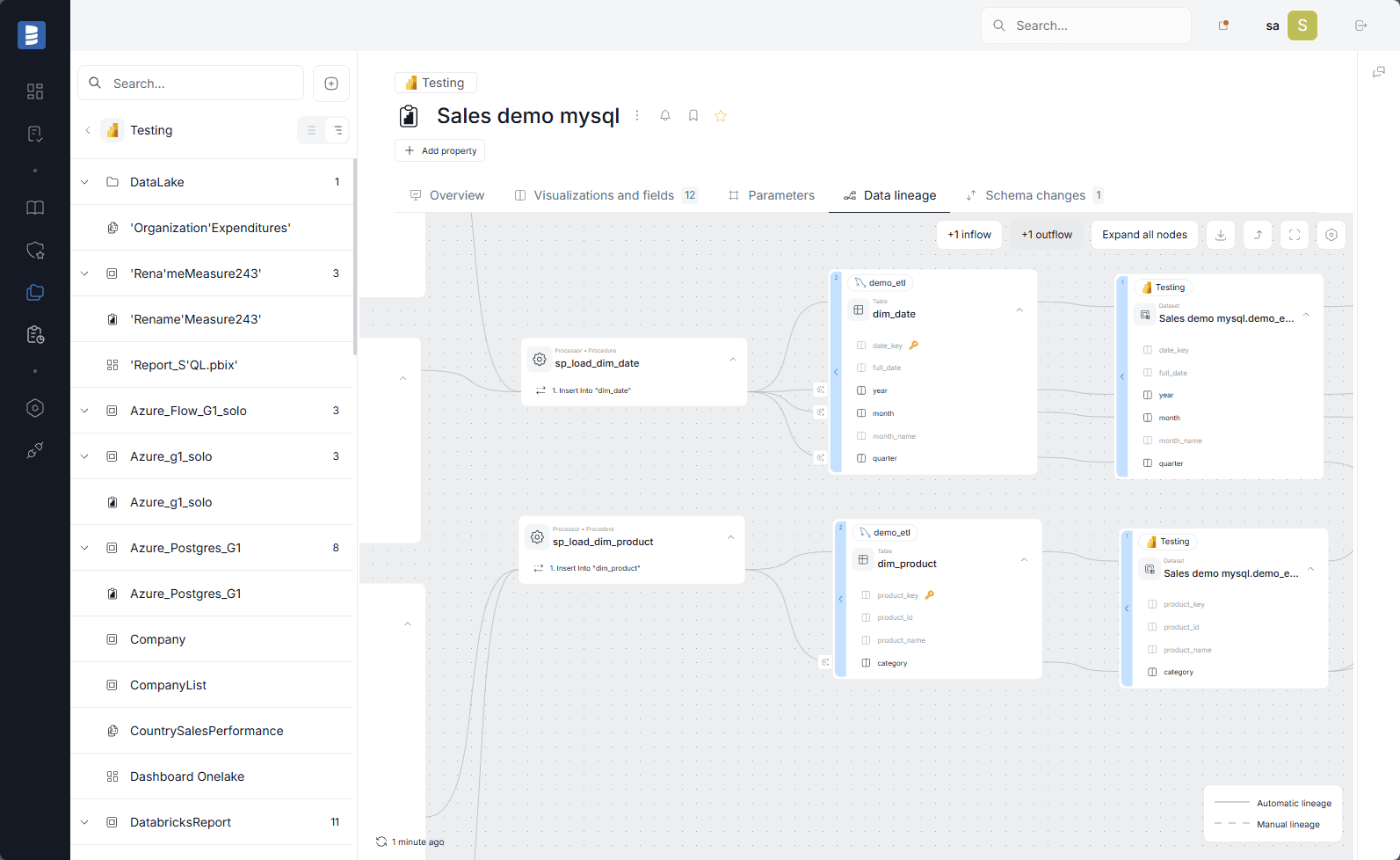 Automatic lineage view showing MySQL tables and procedure-based processing as part of a wider flow between upstream data movement and downstream analytical assets.
Why MySQL Teams Need Automatic Lineage
Manual dependency tracking fails when:
- schema changes are frequent,
- transformations are spread across many objects,
- multiple teams reuse shared tables and views,
- release cycles are short.
Common symptoms:
- unexpected report breaks after deployment,
- long root-cause analysis cycles,
- low confidence in impact assessment.
How MySQL Lineage Is Built
Lineage is typically built from:
- metadata scanning of MySQL objects,
- SQL parsing of transformations and queries,
- dependency graph construction across systems.
In Dataedo, this parsing layer is powered by an in-house proprietary SQL Parser that analyzes MySQL scripts and resolves dependencies at object and column level across views and supported procedure logic.
For stored procedures, lineage is built from supported script steps and represented through process-level flow details. If a procedure returns a result set with SELECT, Dataedo can create a SQL Query object that represents the returned dataset in lineage.
In lineage details, teams can inspect the underlying script context connected to a selected dependency path.
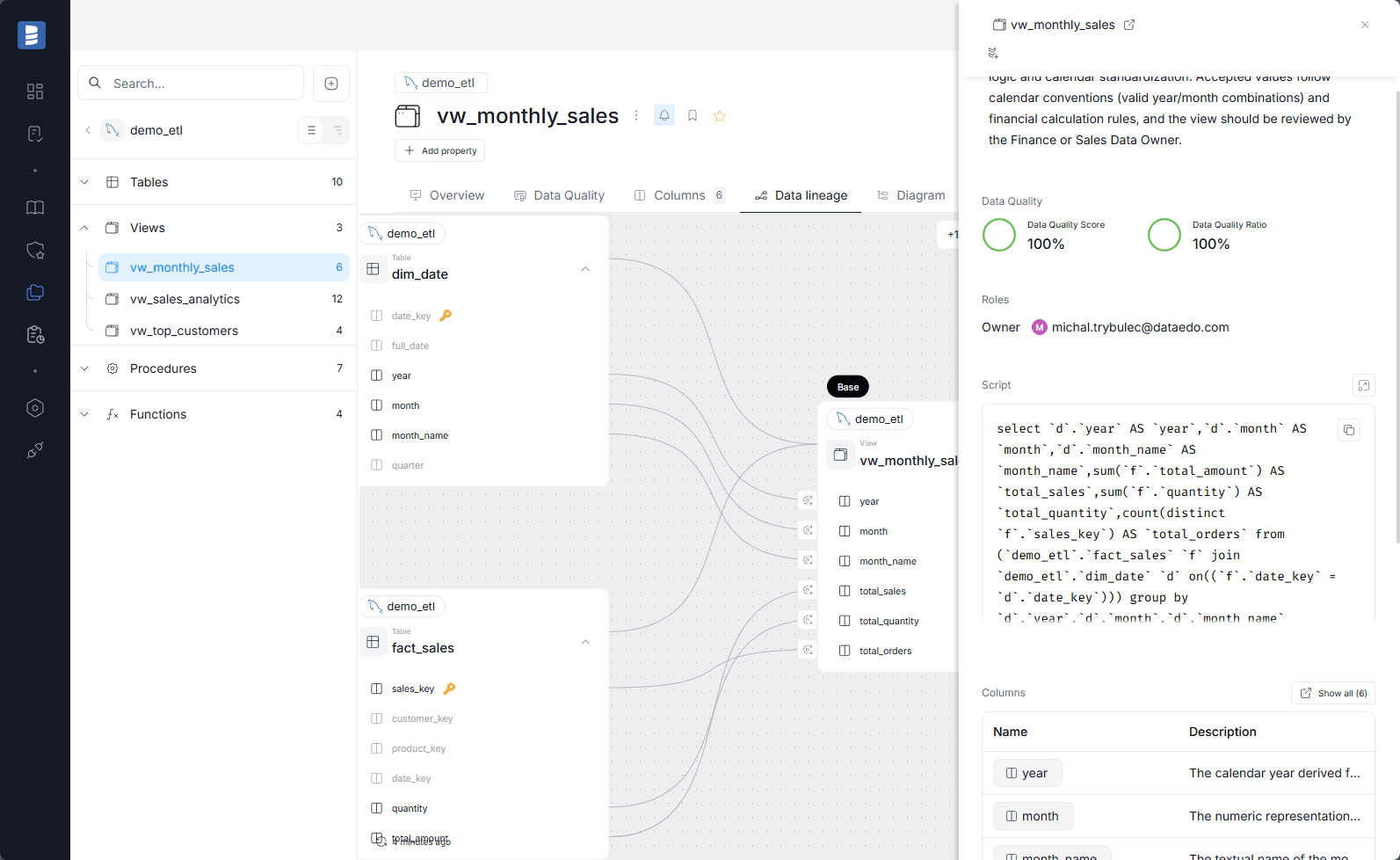 Dataedo lineage details linking parsed MySQL SQL logic to the dependency path shown on the lineage graph, which helps validate how a flow was derived.
Coverage: What Usually Works Well
Tables and Views
For most MySQL analytics use cases, object-level lineage across tables and views provides strong dependency visibility.
Stored Procedures and Returned SQL Queries
MySQL lineage can also cover stored procedures based on script parsing.
When a procedure returns a result set, Dataedo can represent that output as a SQL Query object and connect source objects to that output through the procedure (as the processor).
Column-Level Flows in Parseable SQL
When SQL logic is parseable and explicit, column-level lineage enables safer change planning across views and supported procedure steps.
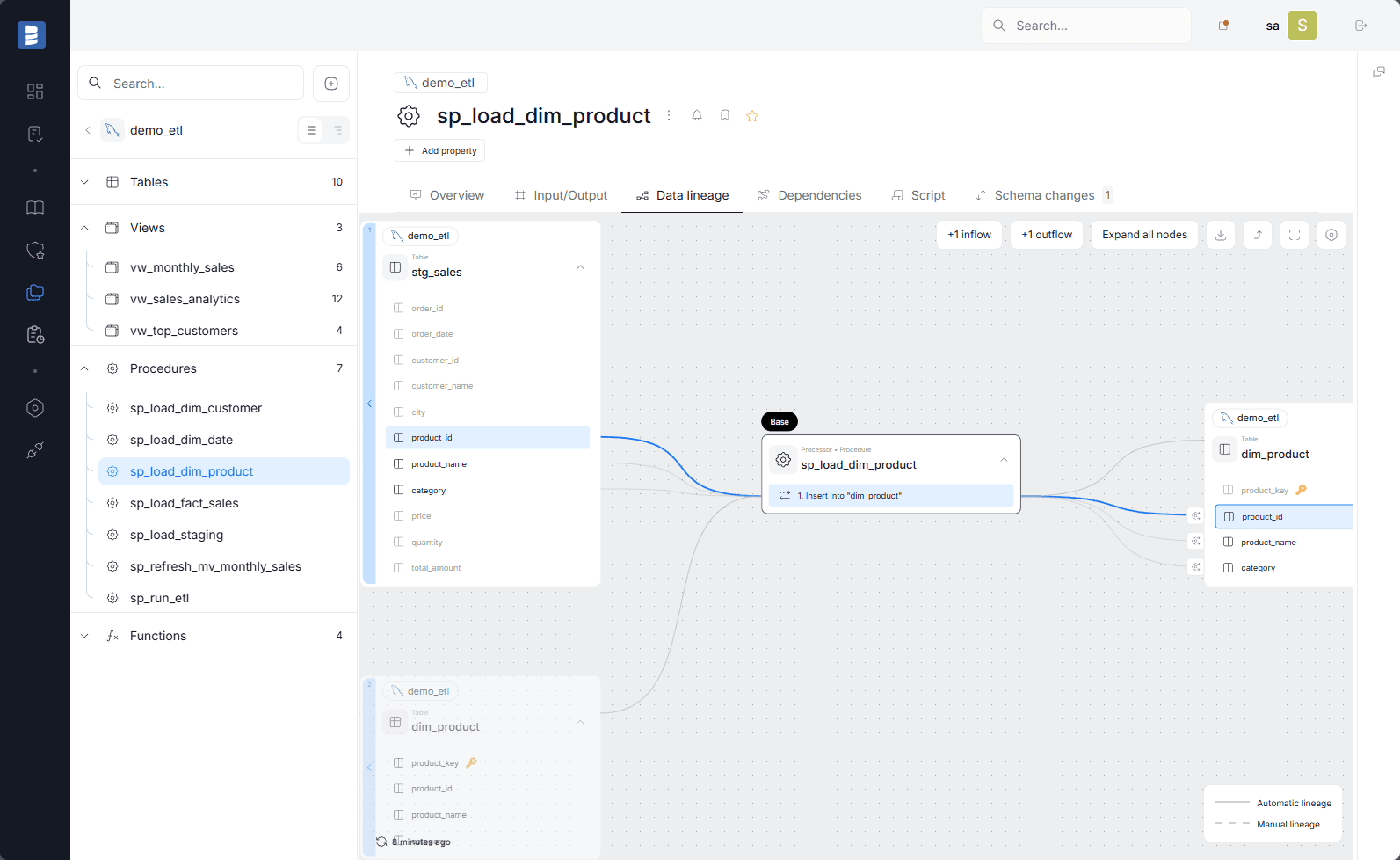 Column-level lineage view tracing MySQL source columns through transformations to downstream fields used in analytics outputs.
Cross-System Visibility
Lineage becomes operationally useful when MySQL lineage is part of a wider, global lineage map.
In practice, this means teams can see not only relationships inside MySQL, but also:
- upstream ETL/integration processes that load MySQL,
- downstream BI/reporting assets that consume MySQL data,
- the end-to-end path used for impact analysis across platforms.
This cross-system view depends on documenting the relevant ETL/BI sources in Dataedo and maintaining correct mappings (for example Linked Sources where required).
Where Automatic Lineage Has Limits
Typical limitations include:
- dynamic SQL and runtime-generated queries,
- unsupported SQL syntax in parser-covered procedures/functions,
- procedures parsed only partially when unsupported elements interfere,
- transformations implemented outside governed SQL layers,
- incomplete object documentation,
- dependencies hidden in application code,
- missing Linked Sources for cross-database lineage.
In parser-based routine lineage, unsupported steps may still appear as generic process blocks (named from the first word of the step), which is useful for orientation but not equivalent to full lineage coverage.
Automatic lineage should be the baseline, then enriched with review and governance context for critical release paths.
Object-Level vs Column-Level in MySQL
Object-level lineage supports architecture understanding. Column-level lineage supports production change safety.
Use both views together for impact analysis.
From Lineage to Release Control
Before MySQL changes go live, use lineage to verify:
- upstream jobs or integrations that may be affected,
- impacted assets and domains,
- affected KPI logic,
- downstream BI datasets/reports (for example Power BI) that consume changed fields,
- owners who must validate outcomes.
This reduces incident probability and shortens recovery time.
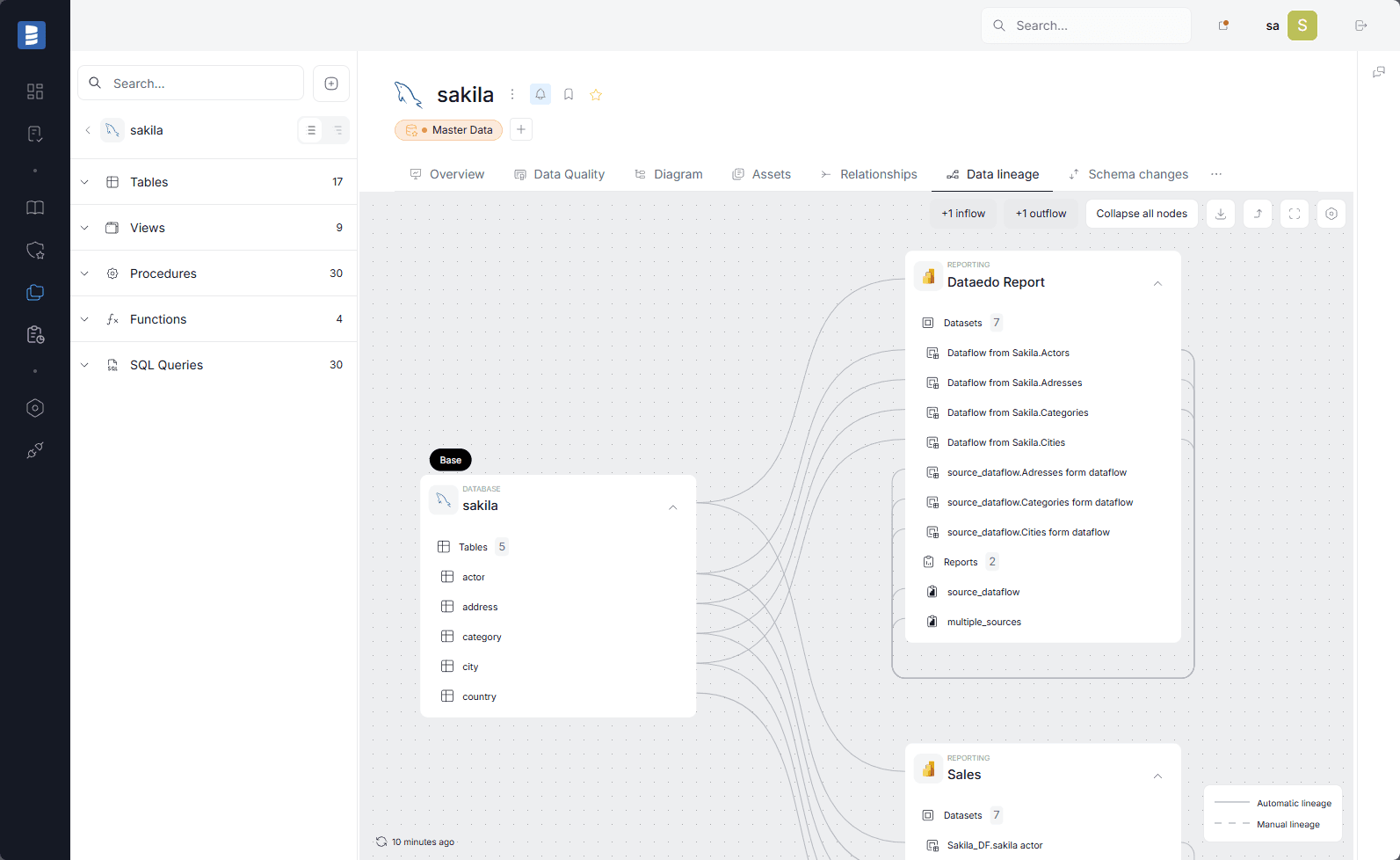 Lineage-driven impact analysis workflow used before MySQL schema or logic changes to review affected downstream assets and dependencies.
How Dataedo Helps with MySQL Lineage
Dataedo helps teams operationalize lineage through:
- automated MySQL metadata cataloging,
- object-level and column-level lineage,
- proprietary SQL Parser support for MySQL scripts,
- lineage for supported stored procedure steps,
- cross-system lineage context when MySQL is linked with ETL and BI assets in the catalog,
- lineage details with script-level dependency context,
- ownership and glossary mapping for safer decision-making.
Frequently Asked Questions
Is object-level lineage enough for MySQL change management?
Usually no for critical changes. Column-level lineage is often needed.
Does MySQL lineage cover procedures and functions?
Procedures are explicitly covered in Dataedo’s MySQL lineage docs. Coverage for routines depends on parser-supported syntax and connector/version capabilities, so validate representative procedures/functions in your environment.
Can MySQL lineage be part of end-to-end lineage across ETL and BI?
Yes, when MySQL is documented together with upstream ETL/integration tools and downstream BI assets in Dataedo. The quality of that global lineage view depends on connector support, mappings, and refresh discipline.
Can lineage replace documentation?
No. Lineage shows flow; documentation explains intent and business meaning.
How often should MySQL lineage be refreshed?
In line with schema and transformation release cadence.
What is the biggest lineage anti-pattern?
Using lineage only after incidents, instead of before release decisions.
Final Takeaway
Automatic lineage in MySQL is not just a visualization feature. It is a practical control for safer change.
Teams that combine lineage with ownership, glossary, and quality context move faster with less risk.
See how Dataedo helps teams map MySQL lineage and run impact analysis before downstream analytics break. Book a demo or start a free trial.