


 Michał Trybulec
MySQL is widely used as a source for operational and analytical reporting, especially in product, e-commerce, and SaaS environments. In practice, teams often run MySQL across multiple environments and cloud services (for example AWS RDS, Azure, or Google Cloud SQL), which makes governance consistency even harder.
The challenge is not collecting data. The challenge is keeping data meaning, ownership, and change impact under control as schemas, services, ETL pipelines, and reporting needs evolve.
In this guide, you’ll learn:
- what effective governance looks like in MySQL environments,
- which governance controls have the biggest impact,
- and how Dataedo helps teams operationalize MySQL governance.
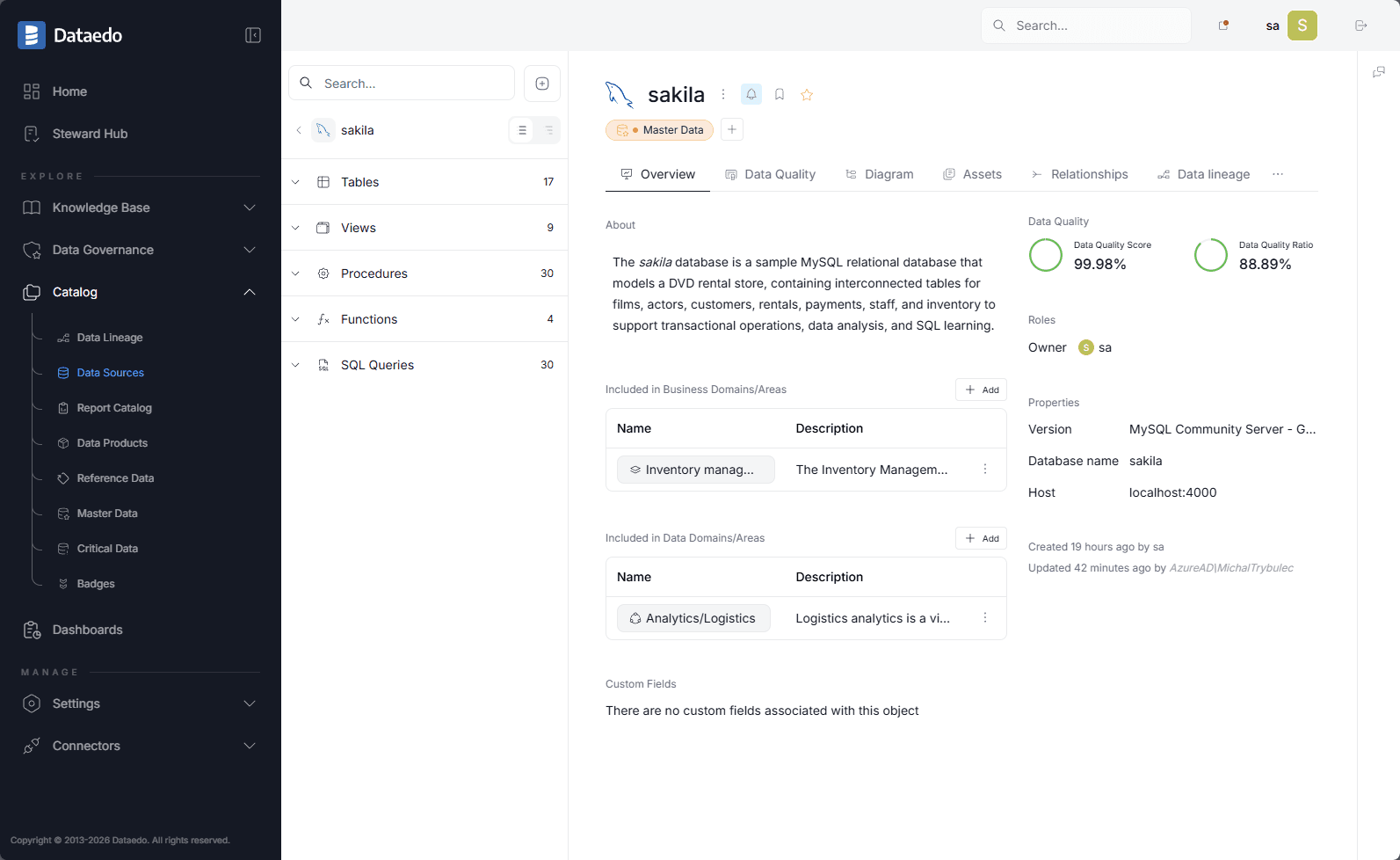 MySQL object page in Dataedo combining governance context in one place, including descriptions, ownership roles, lineage, and quality indicators.
What Good MySQL Governance Actually Means
Strong governance means teams can answer, quickly and consistently:
- What does this table or column mean in business terms?
- Who owns it and who approves changes?
- Can we trust this data for the intended KPI or report?
- What feeds this data upstream and what depends on it downstream?
- What is the impact of a schema or logic change?
If these answers require manual Slack/Jira discovery, governance is too fragile.
Why MySQL Governance Breaks at Scale
Typical failure patterns in MySQL-heavy stacks:
- fast feature delivery introduces unmanaged schema drift,
- multiple MySQL instances/environments evolve without shared governance standards,
- business logic spreads across SQL, services, and BI layers,
- MySQL is governed in isolation from ETL and BI dependencies,
- ownership stays team-level instead of asset-level,
- quality checks are inconsistent between domains.
This usually results in KPI disputes, release fear, and repeated firefighting.
Best Practice 1: Define Ownership at Data Product and Table Level
Ownership should be explicit on high-impact MySQL assets:
- core facts and dimensions,
- shared reporting views,
- business-critical columns used in KPIs.
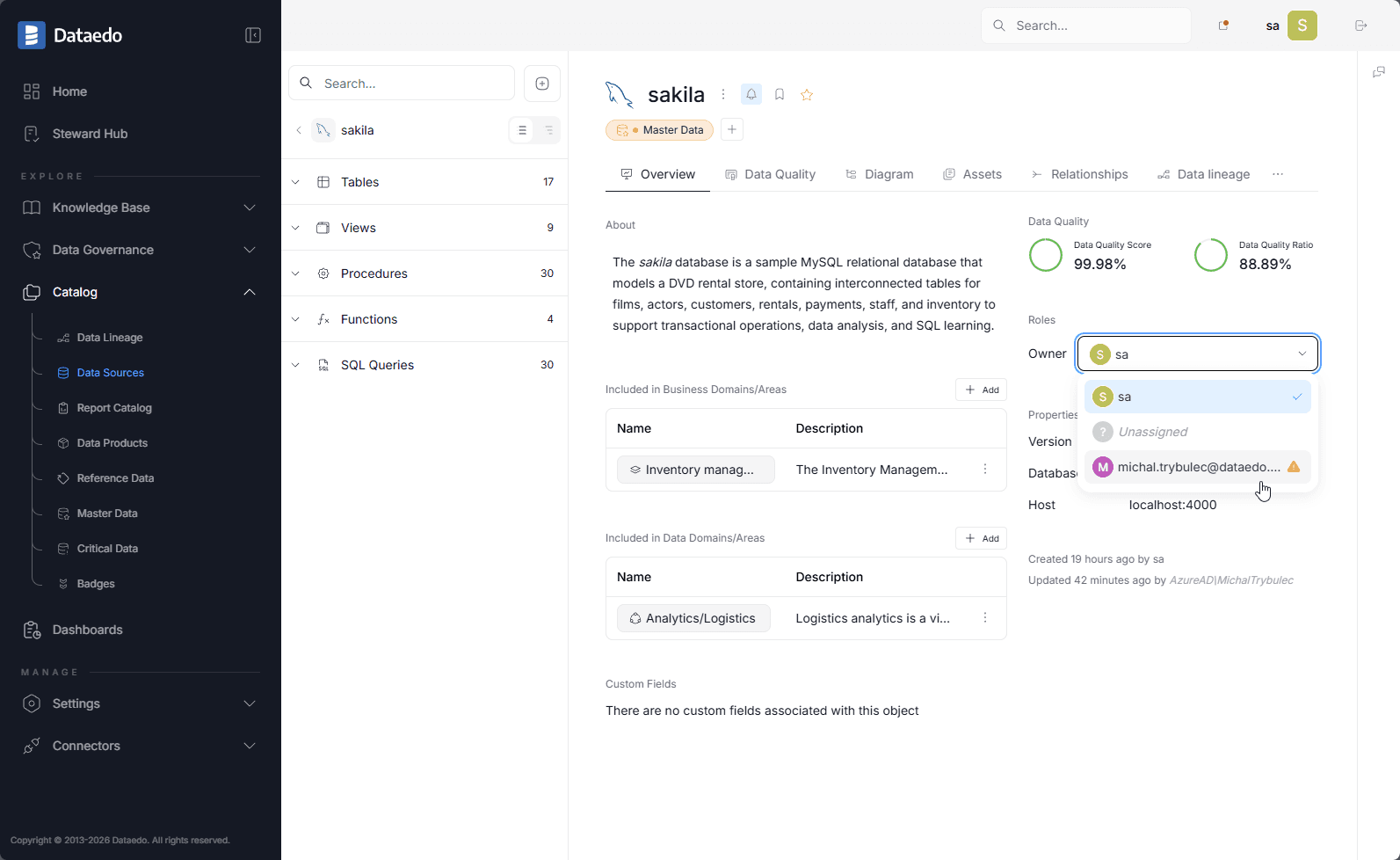 Owner and TechnicalOwner metadata maintained directly on a MySQL asset to support accountable approvals, issue routing, and change governance.
Best Practice 2: Standardize Business Definitions with a Glossary
MySQL can be technically consistent while business meaning remains inconsistent across teams.
Map shared terms (for example active_customer, paid_order, net_revenue) to concrete MySQL objects and downstream BI fields.
This reduces KPI drift and speeds up onboarding for analysts and engineers.
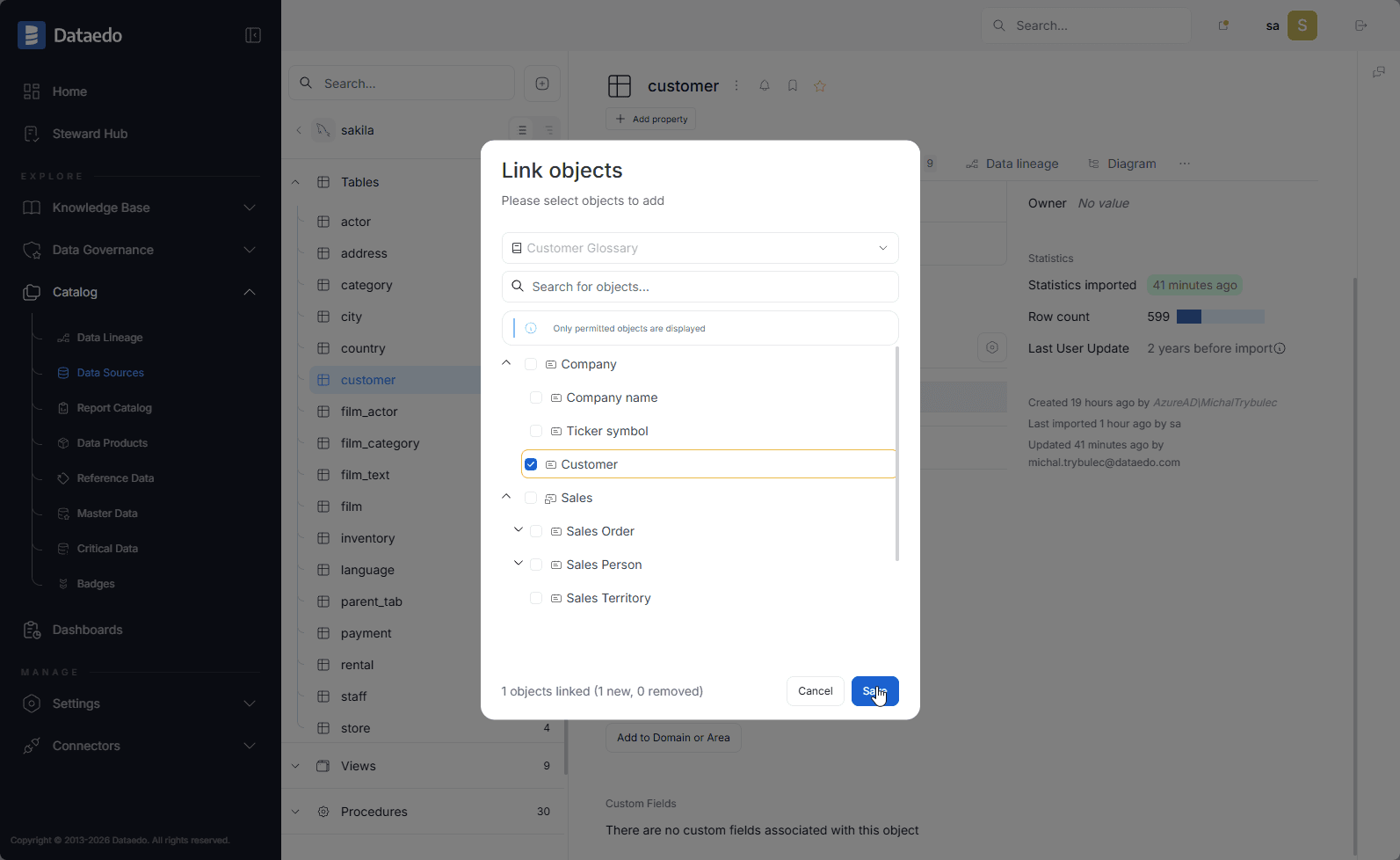 Business glossary term linked to MySQL tables/columns and related downstream assets, helping teams align KPI definitions across systems.
Best Practice 3: Operationalize Change Governance
MySQL environments often change quickly. Governance must be part of release workflow, not post-release cleanup.
Before promoting schema or transformation changes, review:
- environment/instance scope (which MySQL instances are affected),
- upstream ingestion/ETL dependencies and contracts,
- ownership and approver scope,
- glossary impact,
- lineage impact across upstream and downstream assets,
- quality risk for critical outputs.
Best Practice 4: Use Lineage for Impact Analysis Before Releases
Lineage should be used as a release control, not just documentation.
In many teams, the most important value comes from using MySQL lineage as part of a broader, end-to-end lineage view (for example ETL -> MySQL -> Power BI), not only as an internal MySQL dependency graph.
Use lineage together with ER diagrams, not instead of them:
- ER diagrams help teams understand MySQL structure and table relationships,
- lineage shows how data actually flows across transformations, ETL, and BI layers,
- together they improve both schema design discussions and release impact analysis.
At minimum, validate:
- upstream ETL/integration processes feeding MySQL,
- dependencies inside MySQL (tables, views, procedures, SQL logic),
- column-level impact on KPIs,
- affected BI datasets/reports (for example Power BI), dashboards, and owners.
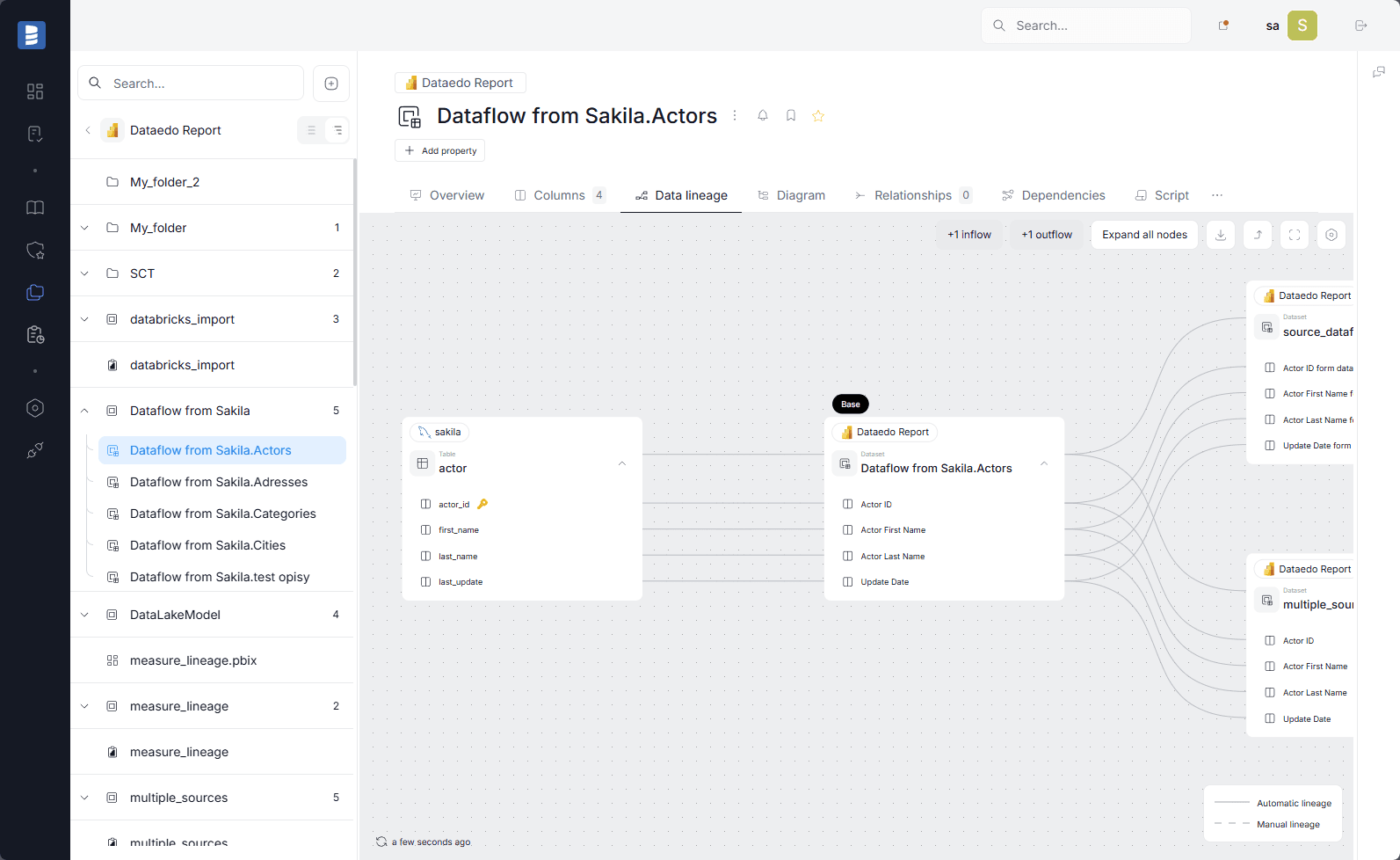 End-to-end lineage view showing MySQL in a broader flow (source/ETL to dataset/reporting), used for pre-release impact analysis.
Best Practice 5: Keep Object and Column Descriptions Current
Descriptions reduce operational ambiguity.
For critical MySQL objects, document:
- purpose and grain,
- transformation intent,
- accepted values and business rules,
- review ownership.
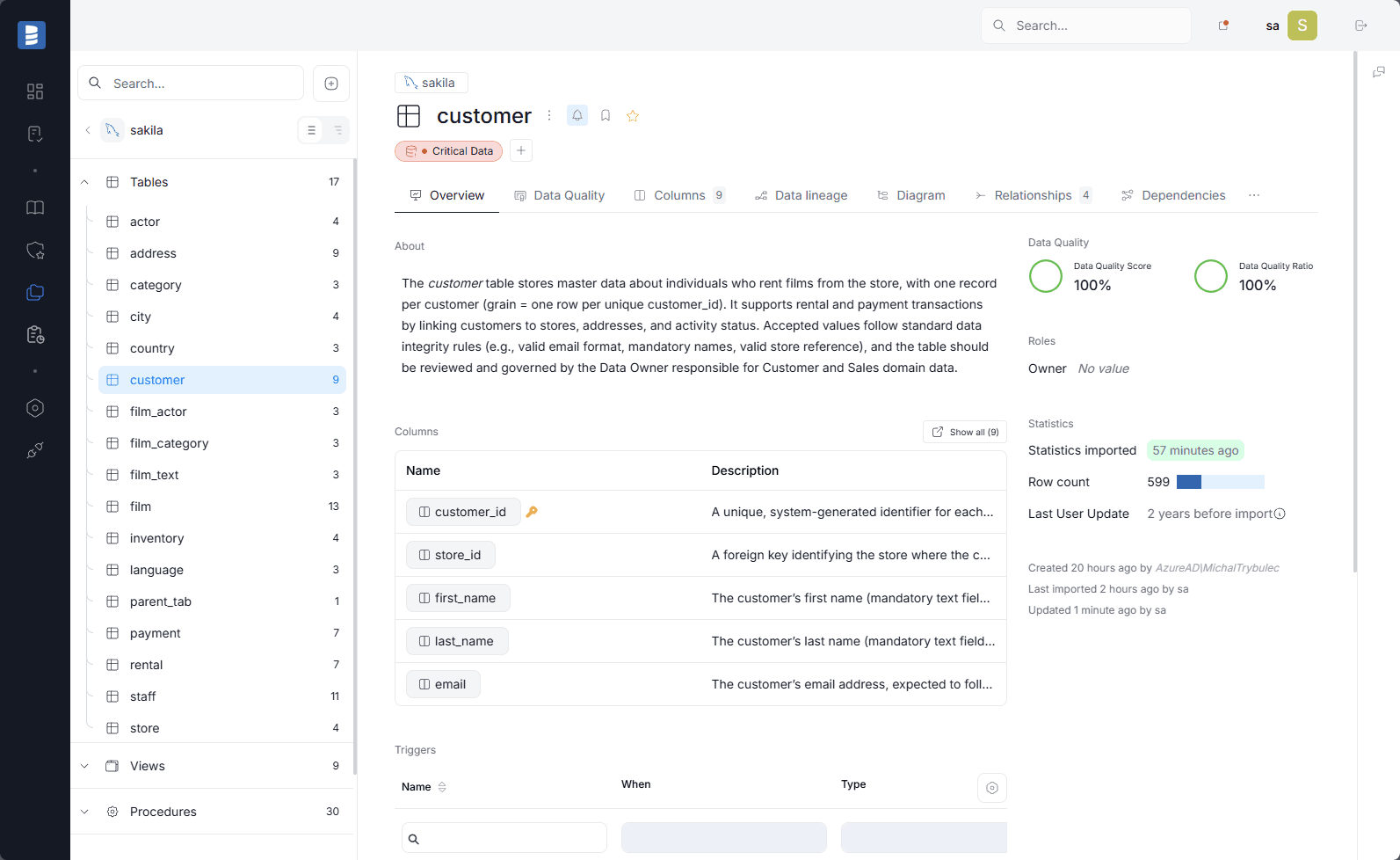 MySQL table overview with object description and column-level descriptions maintained in one place to support governance, onboarding, and safer changes.
Best Practice 6: Treat Data Quality as a Governance Signal
Lineage answers where data came from. Quality answers whether it is usable now.
Track quality metrics near metadata and lineage so teams can evaluate trust and risk in one place.
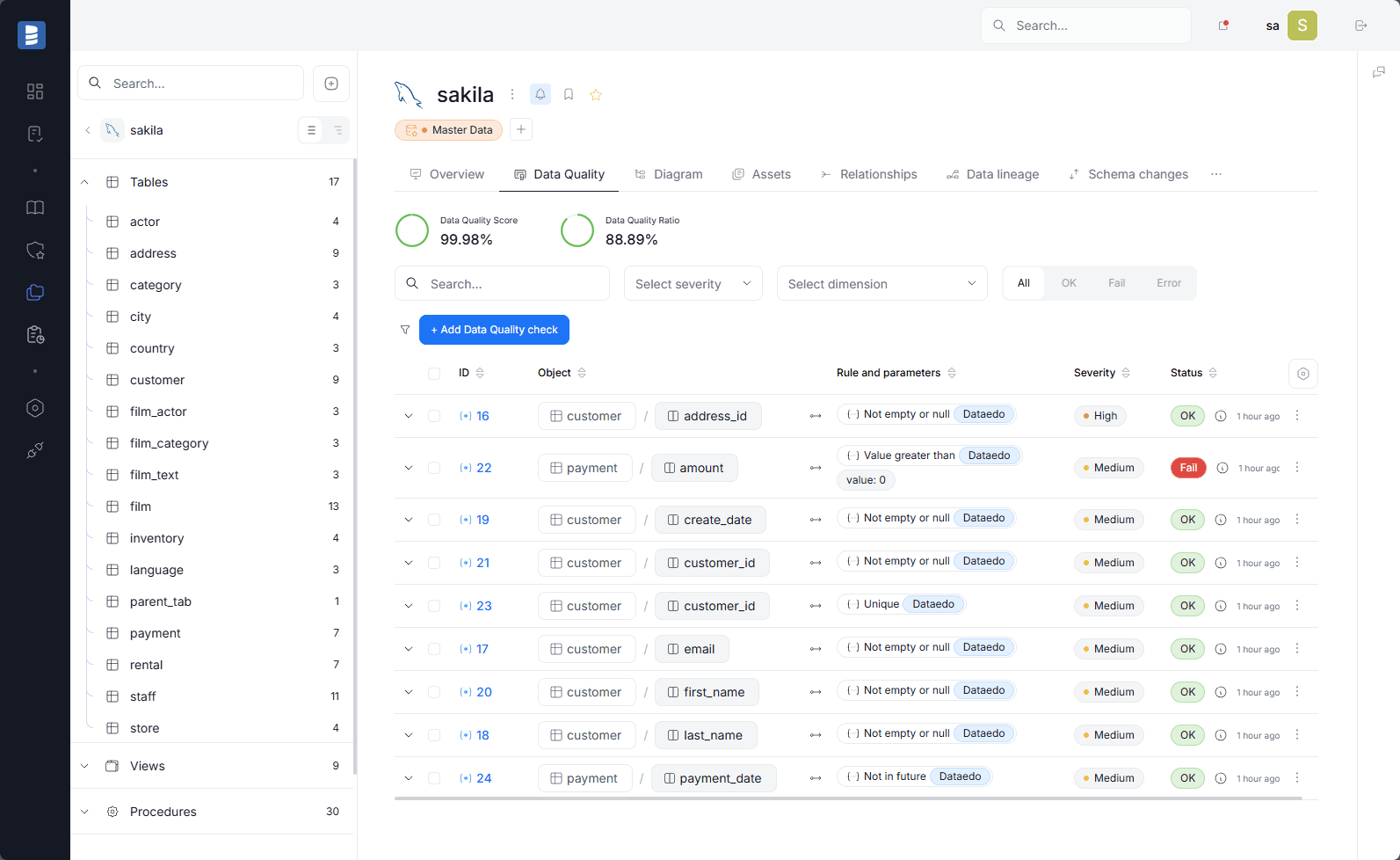 Data Quality indicators for MySQL assets (score, ratio, and rule activity) shown next to metadata and lineage to support governance decisions.
Common Mistakes to Avoid
- Treating governance as one-time documentation - MySQL ecosystems evolve continuously. Governance content must evolve with them.
- Assigning owners without decision authority - Ownership fields without approval rights do not improve change safety.
- Ignoring downstream impact - Without lineage-driven impact checks, releases break reports and trust.
- Treating MySQL as an isolated governance scope - If governance covers only MySQL objects but not upstream ETL and downstream BI usage, impact analysis remains incomplete.
- Separating quality from governance - Quality without ownership and lineage context is hard to operationalize.
- Optimizing for documentation volume - Usability matters more than document count. Keep metadata concise and actionable.
How Dataedo Helps with MySQL Governance
Dataedo helps teams combine governance controls in one workflow:
- MySQL metadata cataloging,
- support for MySQL deployments across cloud environments (for example AWS RDS, Microsoft Azure, and Google Cloud SQL),
- ER diagrams for MySQL structure and relationship visualization,
- glossary linking to real technical assets,
- end-to-end lineage and impact analysis,
- cross-system lineage visibility when ETL and BI sources are documented and linked,
- ownership and stewardship visibility,
- quality monitoring and governance context.
Frequently Asked Questions
Can MySQL governance work without dedicated tooling?
At very small scale, partially. At scale, centralized metadata and lineage are usually necessary.
Where should governance start first?
Start with ownership and glossary for critical KPIs, then add lineage and quality depth.
Should MySQL governance include ETL and BI assets?
Yes. For release safety and KPI trust, MySQL governance should include upstream data loading processes and downstream BI assets that consume MySQL data.
Can we apply the same governance approach across multiple MySQL instances?
Yes. This is one of the main reasons to use a centralized catalog and lineage approach, especially when MySQL runs across multiple environments or cloud services.
Are ER diagrams enough for MySQL governance?
No. ER diagrams are essential for understanding schema structure, but they do not replace lineage, ownership, glossary, and data quality controls needed for operational governance.
How often should metadata and governance context be refreshed?
At least as often as schema and transformation changes are released.
Does governance slow delivery down?
Poor governance design can. Operational governance usually speeds delivery by reducing rework and incidents.
Final Takeaway
MySQL enables fast delivery. Governance makes that speed safe and repeatable.
The strongest teams combine ownership, glossary, lineage, and quality controls into one operating model.
See how Dataedo helps teams scale MySQL governance with catalog, ER diagrams, glossary, cross-system lineage, quality signals, and impact analysis. Book a demo or start a free trial.