


 Michał Trybulec
Reliable dashboards built on MySQL require more than successful queries. Without consistent quality controls, teams eventually face broken KPIs, conflicting reports, and slow incident recovery.
In this guide, you’ll learn:
- which MySQL data quality controls deliver the most value,
- how to prioritize rules by business impact,
- how to connect quality with ownership and lineage,
- and how Dataedo helps operationalize quality workflows.
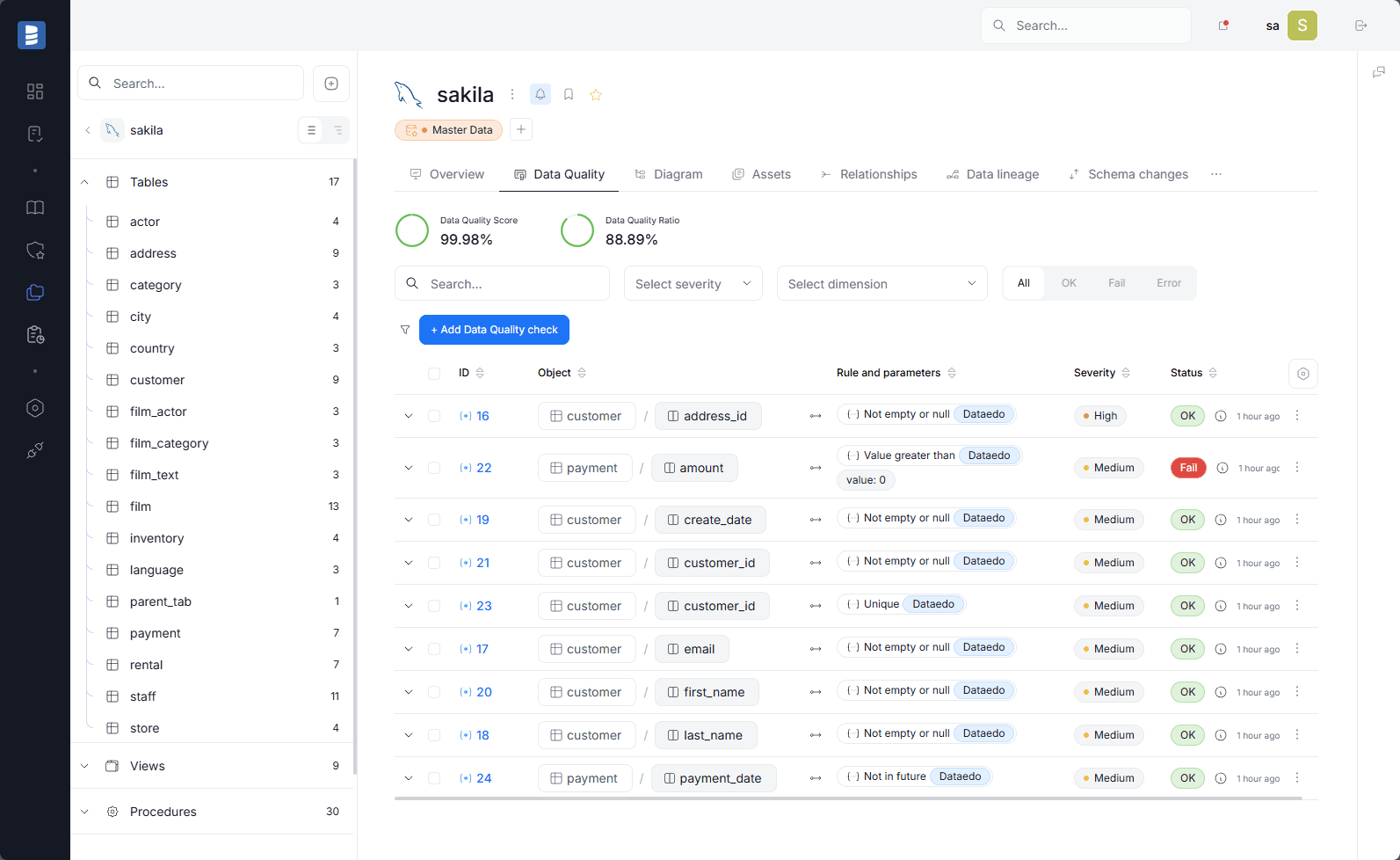 MySQL asset overview with Data Quality indicators (score and ratio) used to assess trust and prioritize remediation work.
What MySQL Data Quality Means in Practice
Quality should be evaluated against business usage, not abstract perfection. For MySQL analytics workloads, core quality dimensions usually include:
- completeness,
- uniqueness,
- validity,
- consistency,
- timeliness.
Why Quality Programs Fail in MySQL Environments
Frequent failure patterns:
- too many low-value rules and unclear priorities,
- no explicit owner for failed checks,
- missing link between quality incidents and downstream impact,
- quality checks treated as audits, not release controls.
Quality Rule Categories to Start With
1. Completeness Rules
Validate required fields and mandatory identifiers.
Examples:
- customer_id is never null,
- order_date exists for finalized transactions.
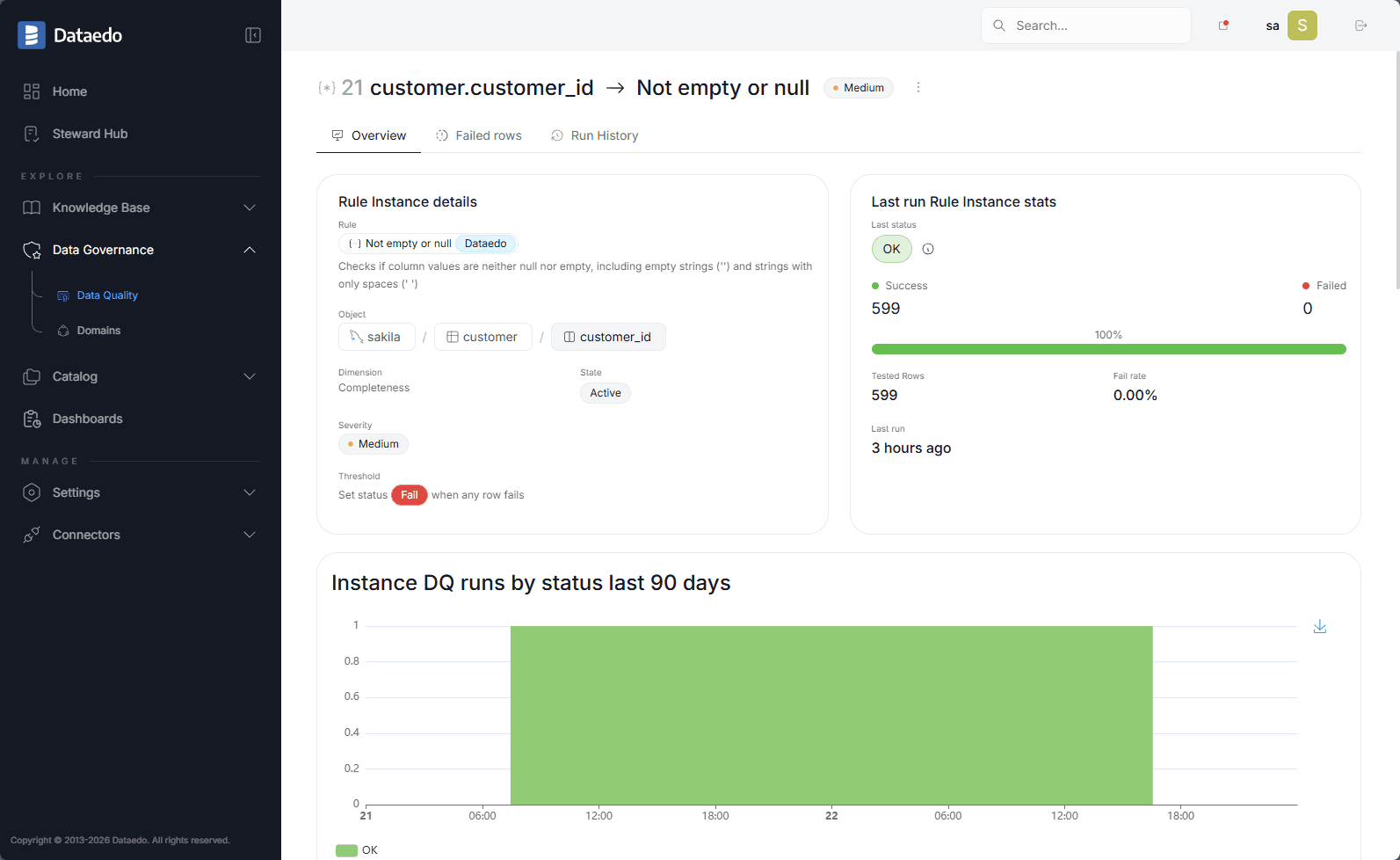 Completeness rule example showing failed records and threshold status, used to detect missing required values in MySQL datasets.
2. Uniqueness Rules
Protect business keys from duplicates.
Examples:
- unique order number per channel and date scope,
- unique active customer identifier.
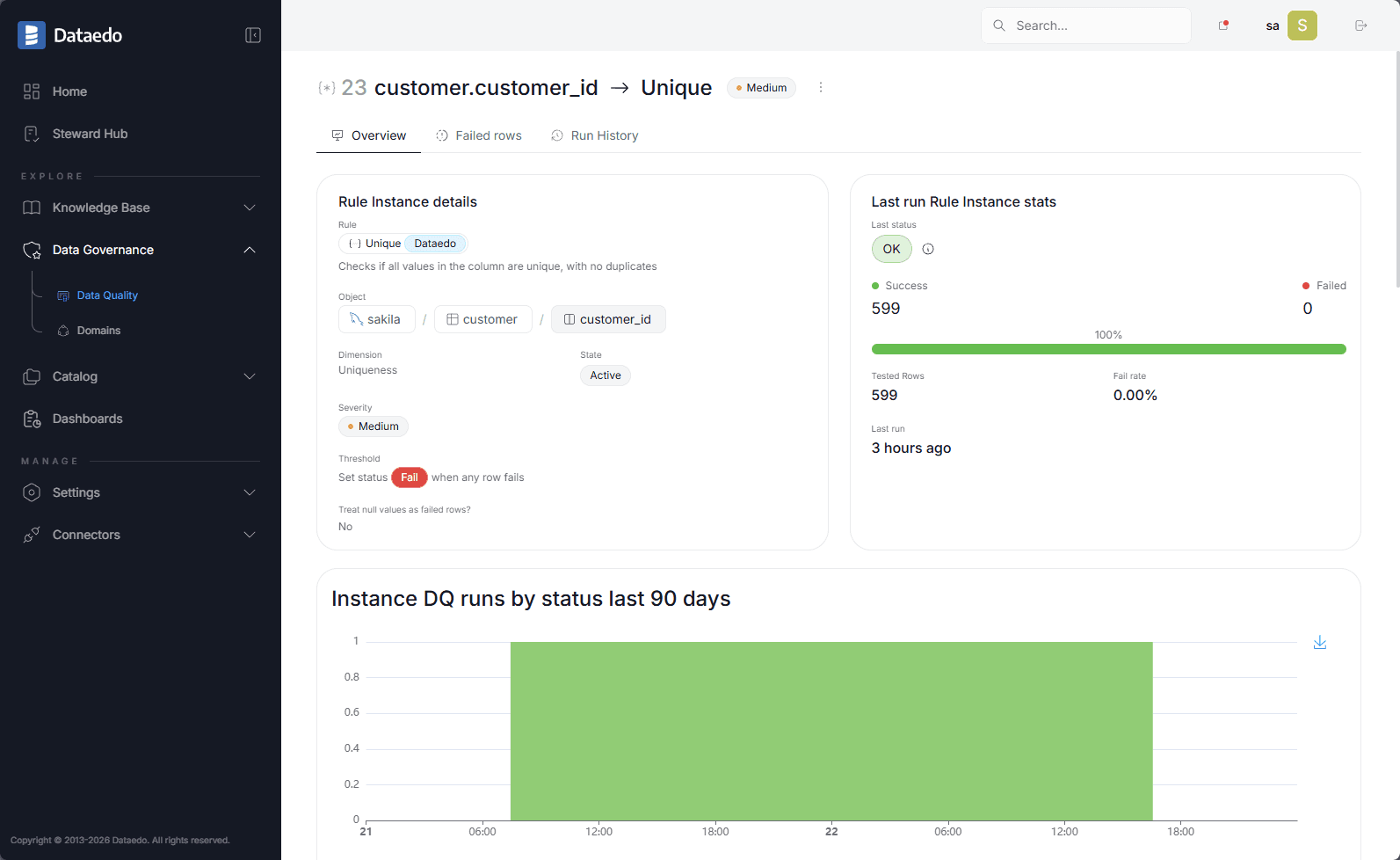 Uniqueness rule example highlighting duplicate key values and severity context for MySQL quality triage.
3. Validity and Domain Rules
Validate allowed ranges and business value sets.
Examples:
- non-negative amounts where required,
- status values from approved dictionary only.
4. Freshness and Timeliness Rules
Ensure data arrives on time for reporting SLAs.
Examples:
- daily load available before reporting window,
- max ingestion delay not exceeding agreed threshold.
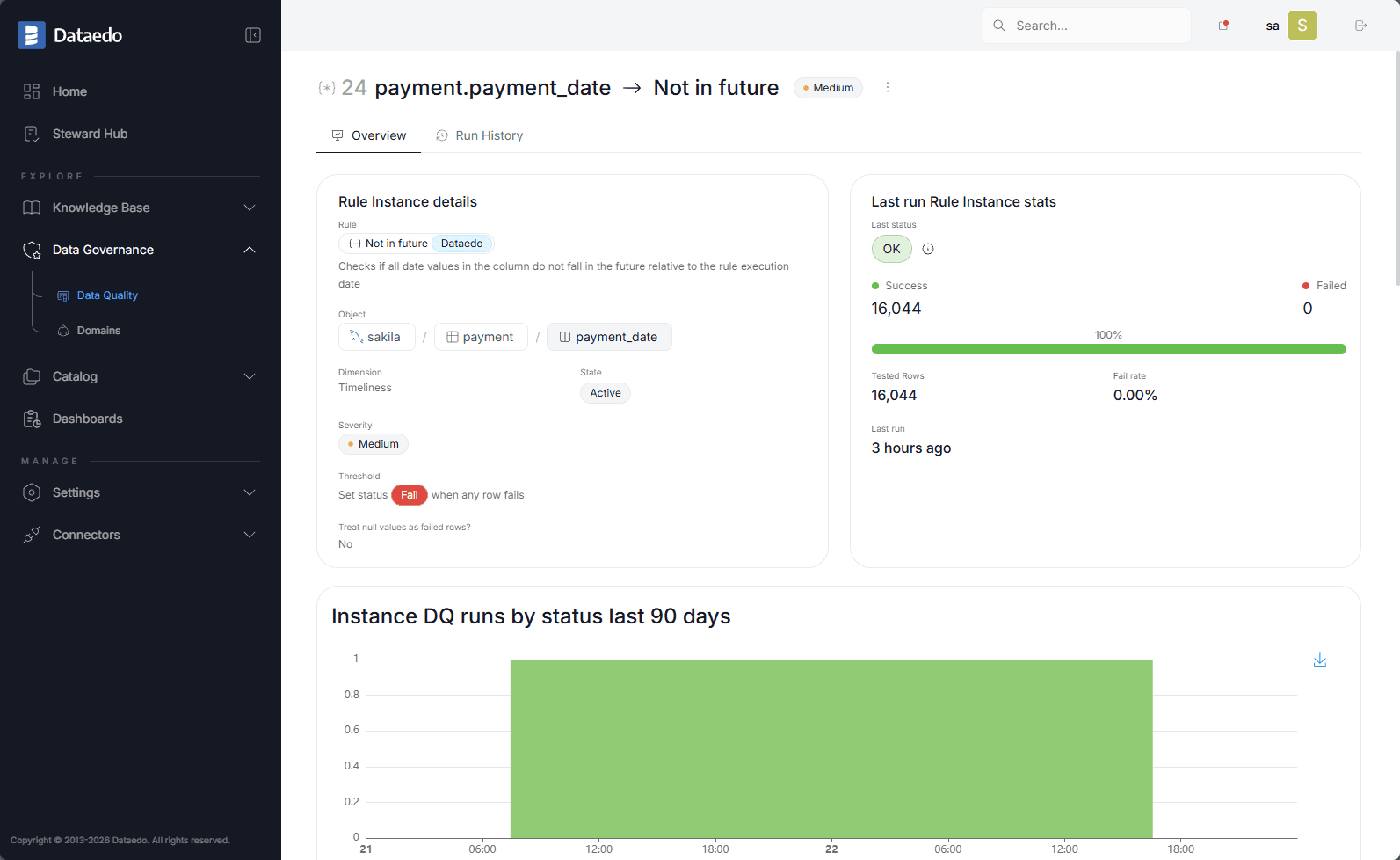 Freshness monitoring view for MySQL assets showing timeliness checks and delay indicators used for SLA-oriented reporting workflows.
Best Practice 1: Prioritize Rules by Business Impact
Start with highest-risk assets:
- KPI-driving facts,
- executive reporting dimensions,
- compliance-sensitive entities.
Use impact over volume as your prioritization logic.
Best Practice 2: Assign Ownership for Rule Outcomes
Failed rules without ownership become noise.
Define:
- business owner for acceptance criteria,
- technical steward for remediation workflow.
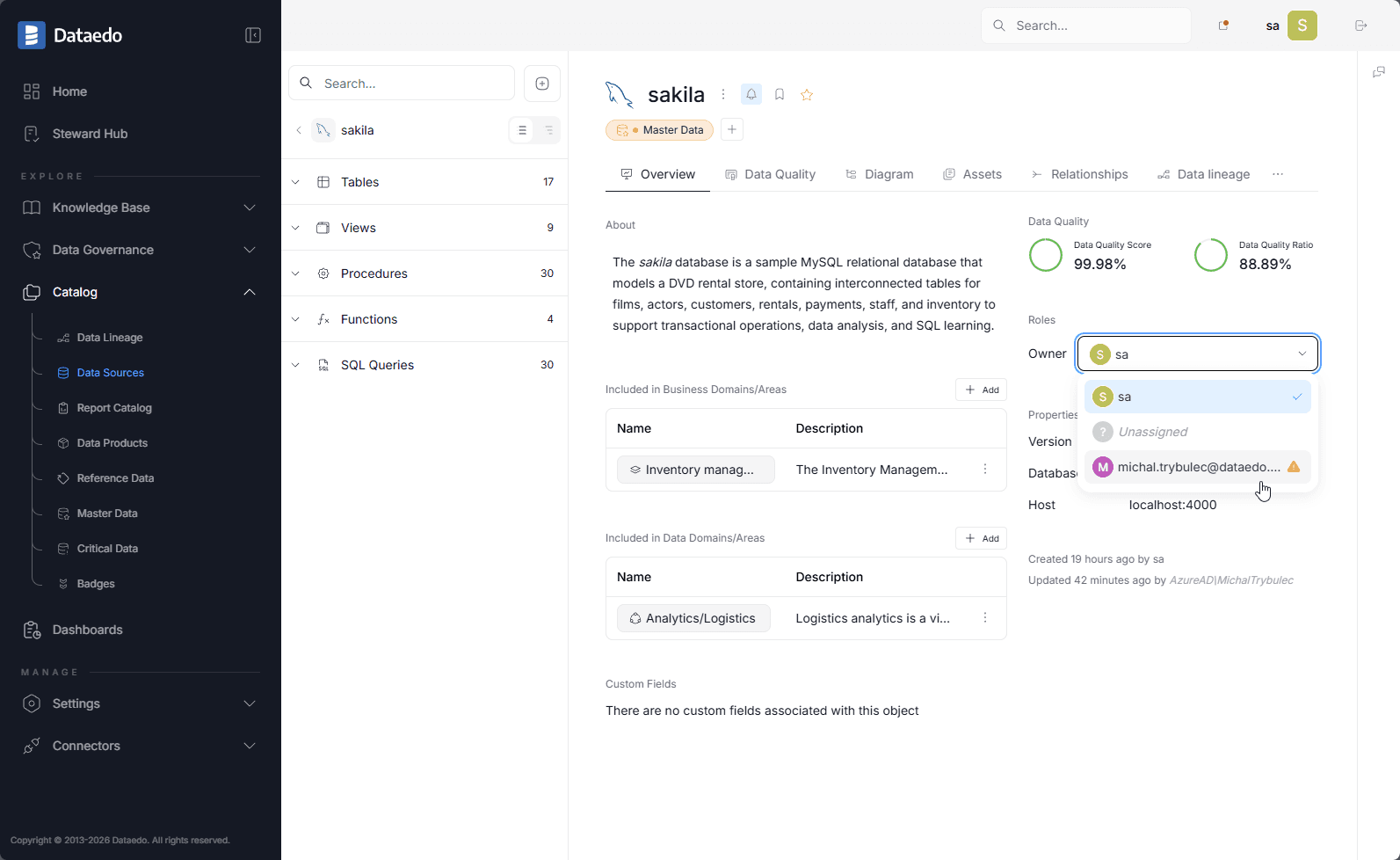 Ownership metadata on a MySQL asset used to route failed rule outcomes to the right business and technical stakeholders.
Best Practice 3: Link Quality to Object and Column Descriptions
Quality rules should reference documented business meaning.
For critical columns, maintain:
- definition and intent,
- accepted values,
- source-of-truth notes,
- review ownership.
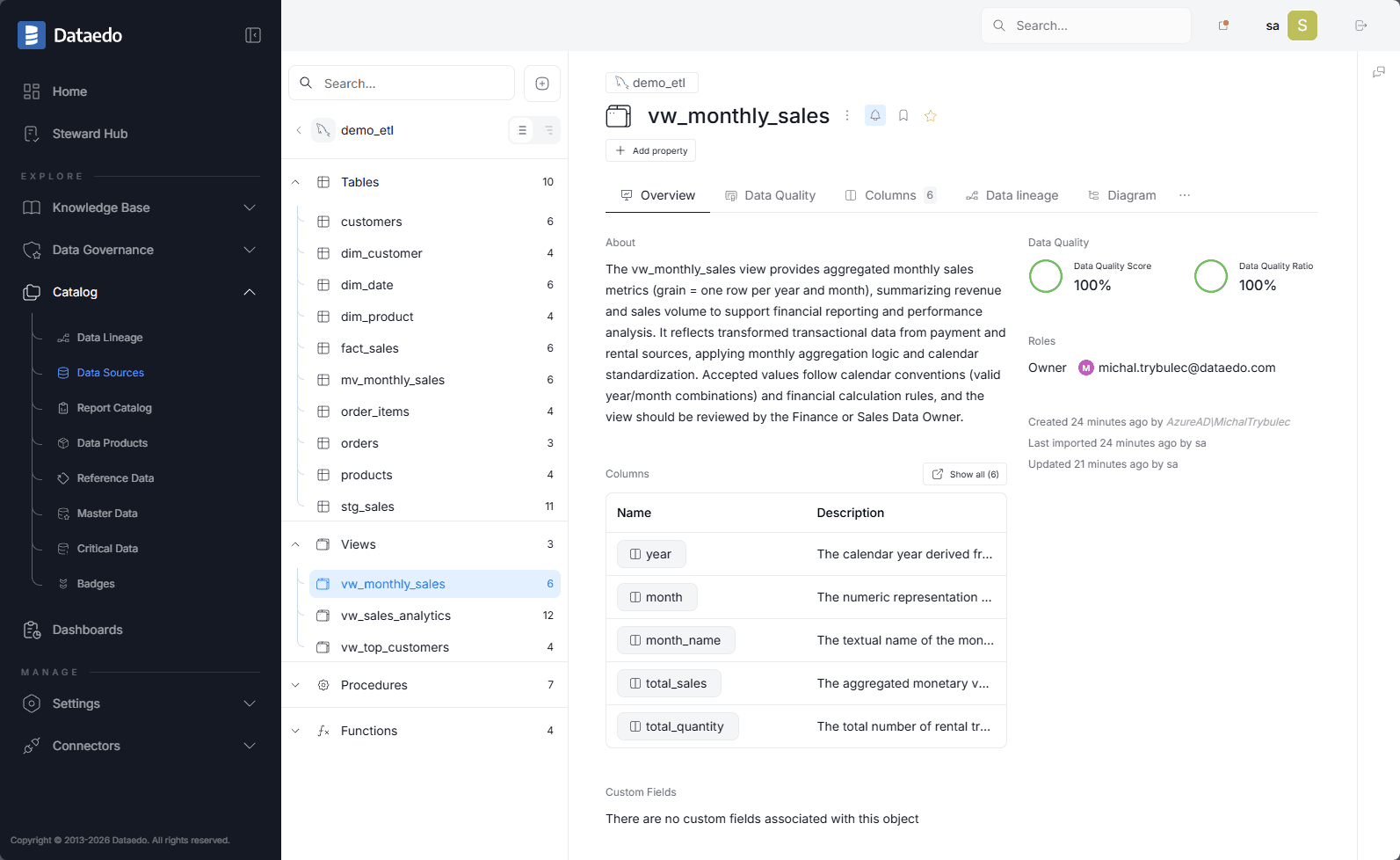 Object and column descriptions in Dataedo used to document rule intent, accepted values, and business meaning behind MySQL quality checks.
Best Practice 4: Use Lineage to Triage Quality Incidents
Not all quality defects have equal impact.
Use lineage to determine:
- which reports and KPIs are affected,
- which domains are impacted first,
- which fixes should be prioritized.
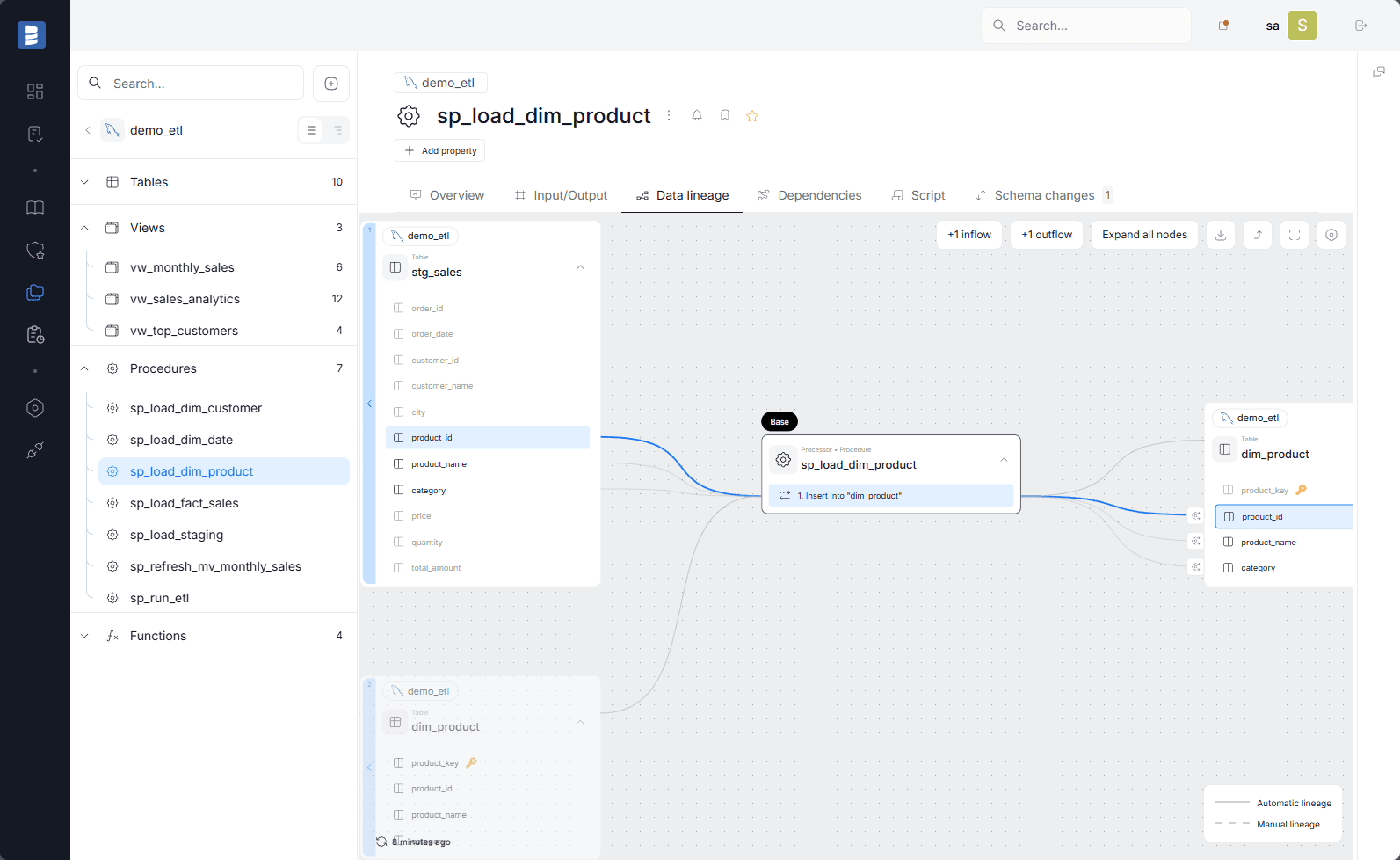 Column-level lineage used during incident triage to identify which downstream fields, reports, and KPIs are affected by a MySQL data quality issue.
Best Practice 5: Add Quality Gates to Release Workflow
Before deployment, validate:
- impacted rule outcomes,
- schema compatibility,
- downstream KPI behavior.
Quality gates reduce “successful deployment, broken analytics” outcomes.
Best Practice 6: Monitor Trends, Not Only Point Failures
Single failures matter, but trends matter more.
Track:
- pass/fail ratio over time,
- recurring failure classes,
- domain-level drift.
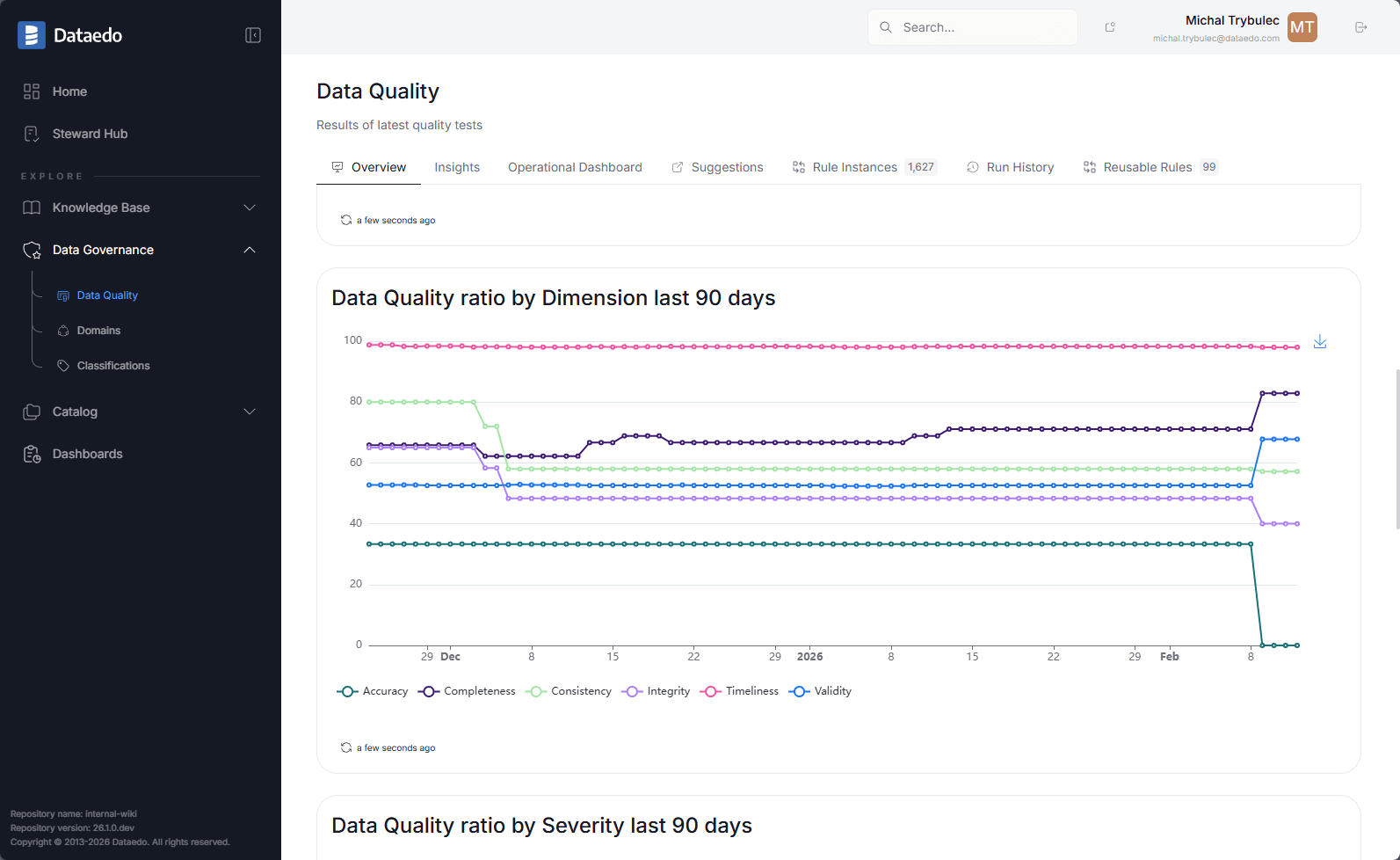 Quality trend analysis over time by dimension and severity, used to monitor recurring MySQL quality problems instead of isolated failures.
How Dataedo Helps Operationalize MySQL Data Quality
Dataedo connects quality controls with governance context:
- rule definition and execution tracking,
- quality metrics near metadata and lineage,
- ownership-aware remediation,
- impact-aware release decision support.
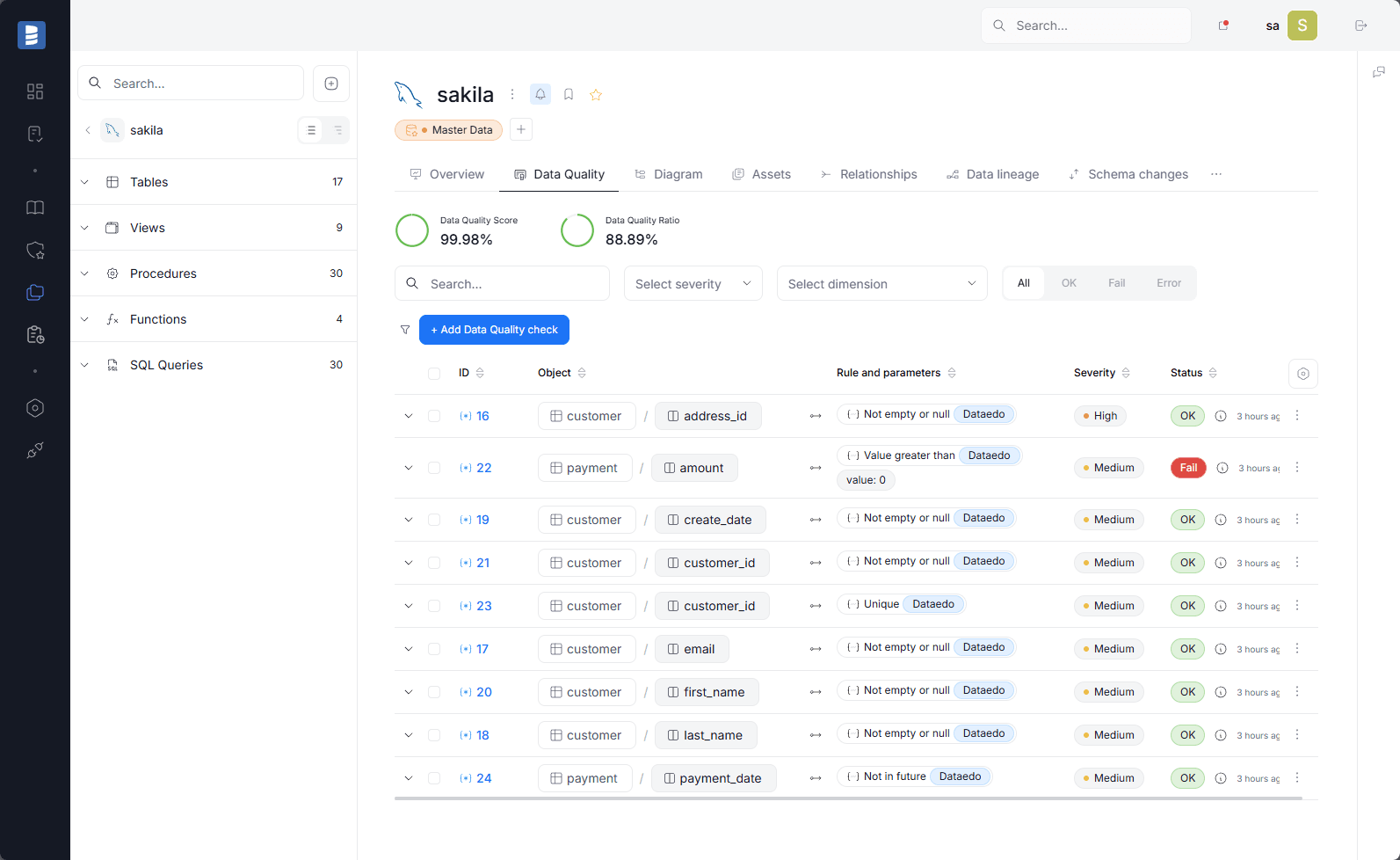 Data Quality rules dashboard showing rule status, severity, and execution scope for MySQL assets in an operational monitoring workflow.
Common Mistakes to Avoid
- Measuring quality without business context - Metrics without domain/KPI linkage rarely drive action.
- Treating all rules as equal - Severity and response time should reflect business impact.
- Running checks without clear remediation flow - No owner, no closure.
- Ignoring lineage during incident response - Without dependency visibility, triage is slower and less accurate.
- Optimizing for rule count - Focus on actionable, high-value controls.
Frequently Asked Questions
Where should we start with MySQL quality checks?
Start with high-impact tables and KPI-driving fields.
How often should checks run?
Usually both continuously and as part of release gates.
Can quality improve without lineage?
Partially. Lineage is needed for impact-aware prioritization.
What makes MySQL quality sustainable?
Ownership, clear severity model, and integration with release workflow.
Final Takeaway
MySQL data quality is not a one-time check. It is an ongoing governance process.
Teams that combine quality rules, ownership, lineage, and release gates build faster and more trusted analytics.
See how Dataedo helps teams operationalize MySQL data quality with governance context and impact-aware workflows. Book a demo or start a free trial.