


 Michał Trybulec
PostgreSQL is often treated as a reliable analytics source, but reliability is not automatic. Even well-designed PostgreSQL models can produce low-trust reporting when quality controls are inconsistent, undocumented, or disconnected from ownership and lineage.
In most teams, quality incidents are not caused by one major failure. They accumulate from small issues:
- missing validation rules on critical fields,
- weak release checks for schema changes,
- unclear accountability for data defects,
- and no shared visibility of quality status.
In this guide, you’ll learn:
- how to define practical PostgreSQL data quality controls,
- which rule categories matter most for analytics,
- how to operationalize quality in governance workflow,
- and how Dataedo helps teams connect quality to lineage and ownership.
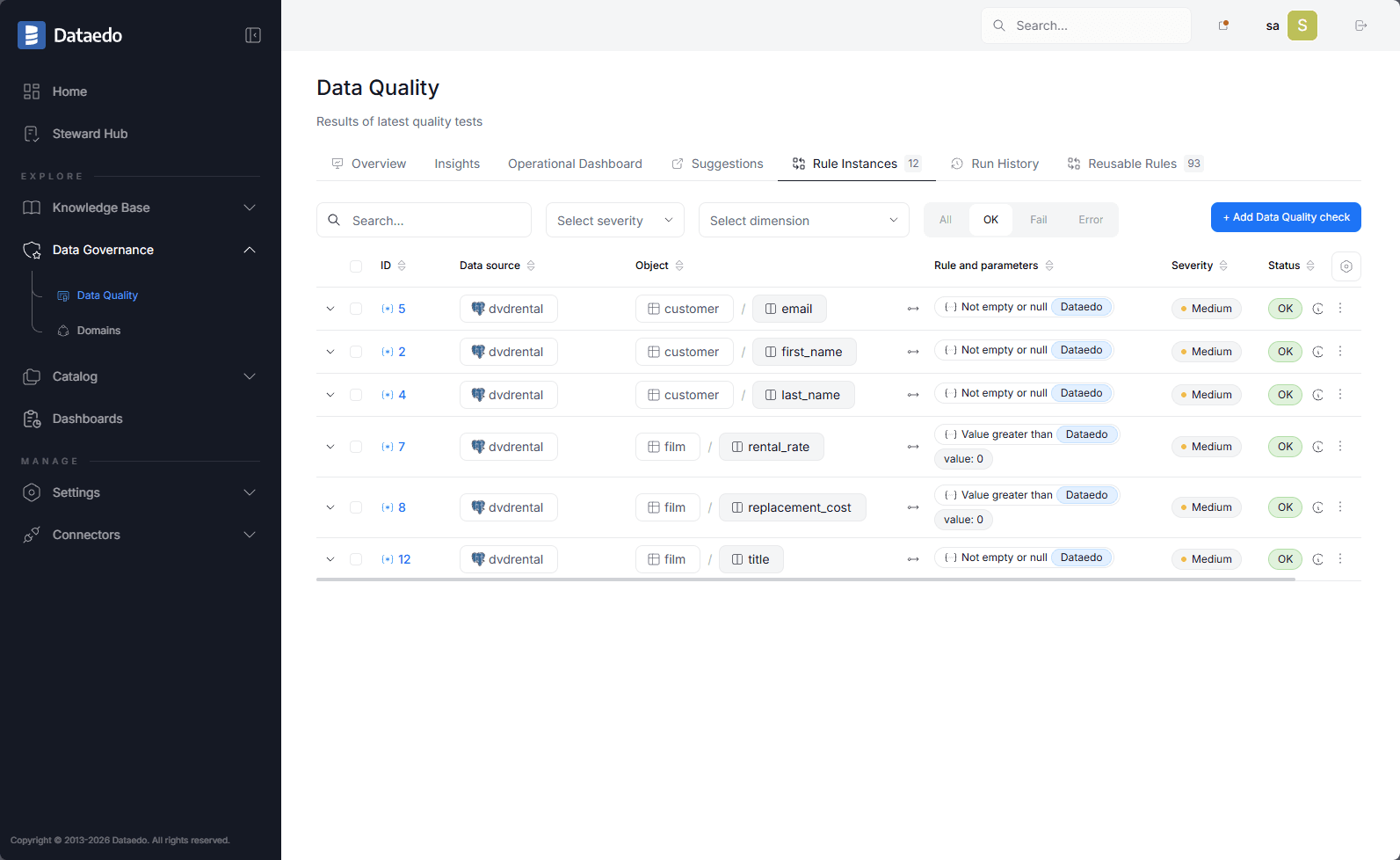 Data quality outcomes visible next to metadata and lineage context.
What PostgreSQL Data Quality Means in Practice
Data quality is not a generic score. It is fitness for a specific business use case.
For PostgreSQL analytics, teams should validate whether data is:
- complete for required fields,
- consistent across related objects,
- unique where business keys require it,
- accurate against expected business rules,
- timely for reporting SLAs.
Quality definitions should be explicit and versioned, not implied in ad hoc queries.
Why Data Quality Programs Fail in PostgreSQL Environments
Common failure patterns:
- rules exist but are not prioritized by business criticality,
- quality checks run but results are not operationalized,
- defects are found without clear owners,
- remediation is disconnected from release workflow.
This creates a recurring cycle: incident, patch, and repeat.
Quality Rule Categories Every PostgreSQL Team Should Start With
1. Completeness Rules
Validate mandatory fields, especially in keys and critical dimensions.
Examples:
- customer_id must not be null,
- order_date must be present for all completed orders.
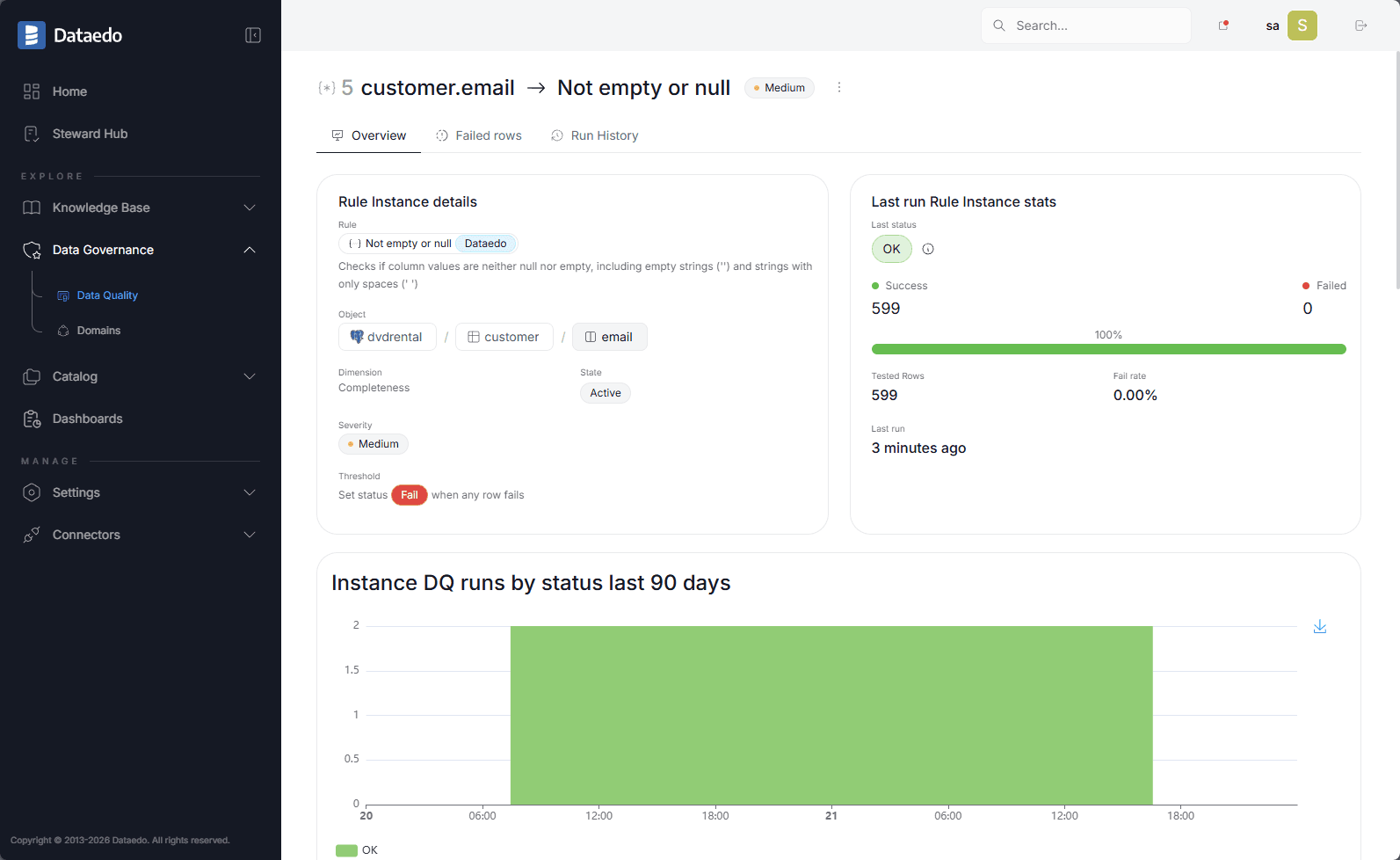 Completeness rule results highlighting null and missing-value violations on required fields.
2. Uniqueness Rules
Protect business identifiers from duplicates.
Examples:
- unique invoice number per business unit,
- unique user key in active customer domain.
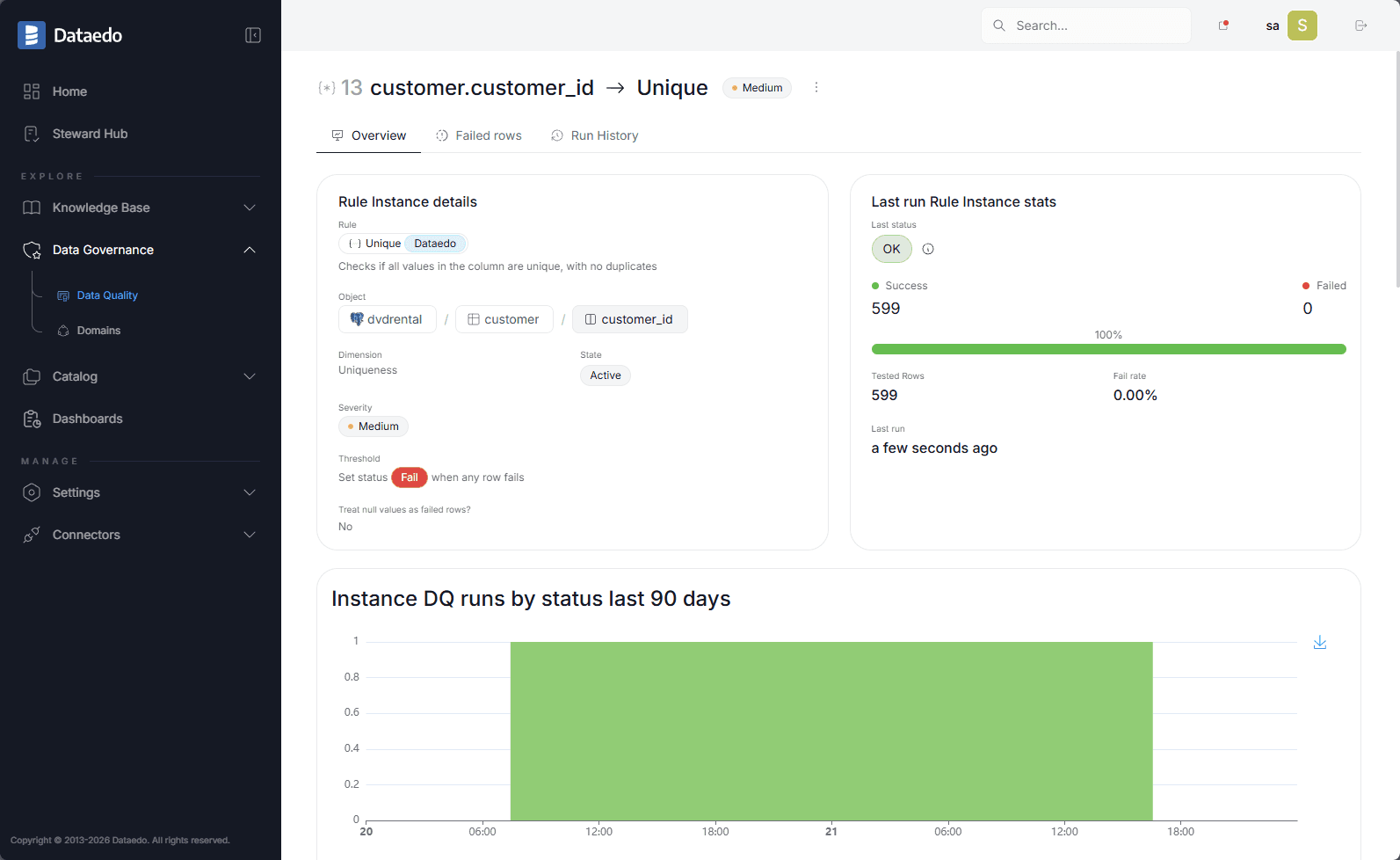 Uniqueness check identifying duplicate business keys that require remediation.
3. Validity and Domain Rules
Validate value ranges and controlled vocabularies.
Examples:
- status in allowed set,
- amount >= 0 for non-refund transactions.
4. Freshness and Timeliness Rules
Ensure data is current enough for its reporting purpose.
Examples:
- daily fact table updated before morning reporting window,
- ingestion delay threshold alerts for key domains.
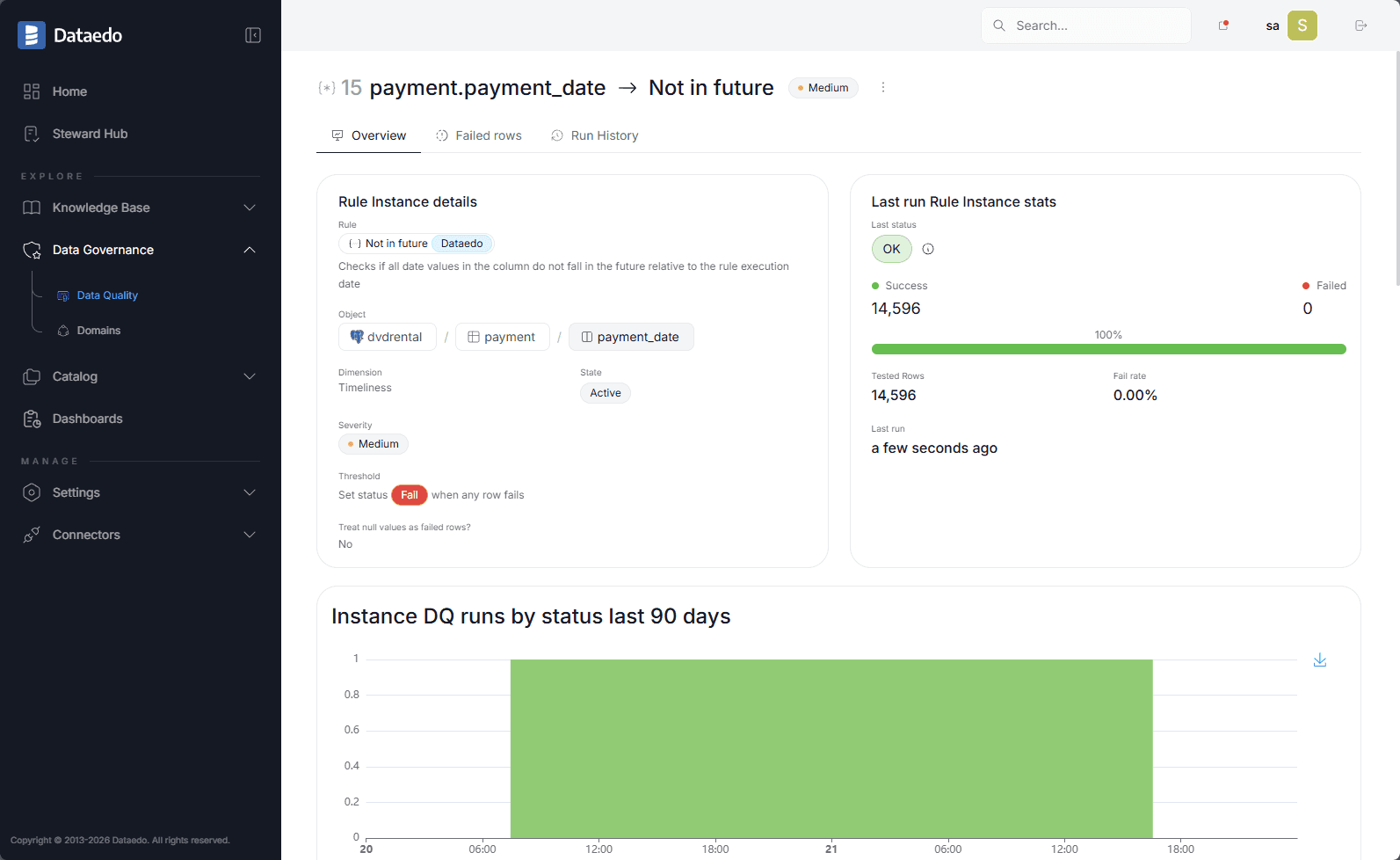 Freshness monitoring for scheduled loads and SLA compliance on critical datasets.
Best Practice 1: Tie Quality Rules to Business-Critical Assets
Do not try to validate everything equally. Start with:
- KPI-driving facts,
- executive reporting dimensions,
- compliance-relevant entities.
Prioritize by business impact, not by number of rules.
Best Practice 2: Assign Clear Ownership for Rule Outcomes
A failed quality rule without accountable ownership becomes noise.
At minimum define:
- business owner for acceptance criteria,
- technical steward for implementation and remediation workflow.
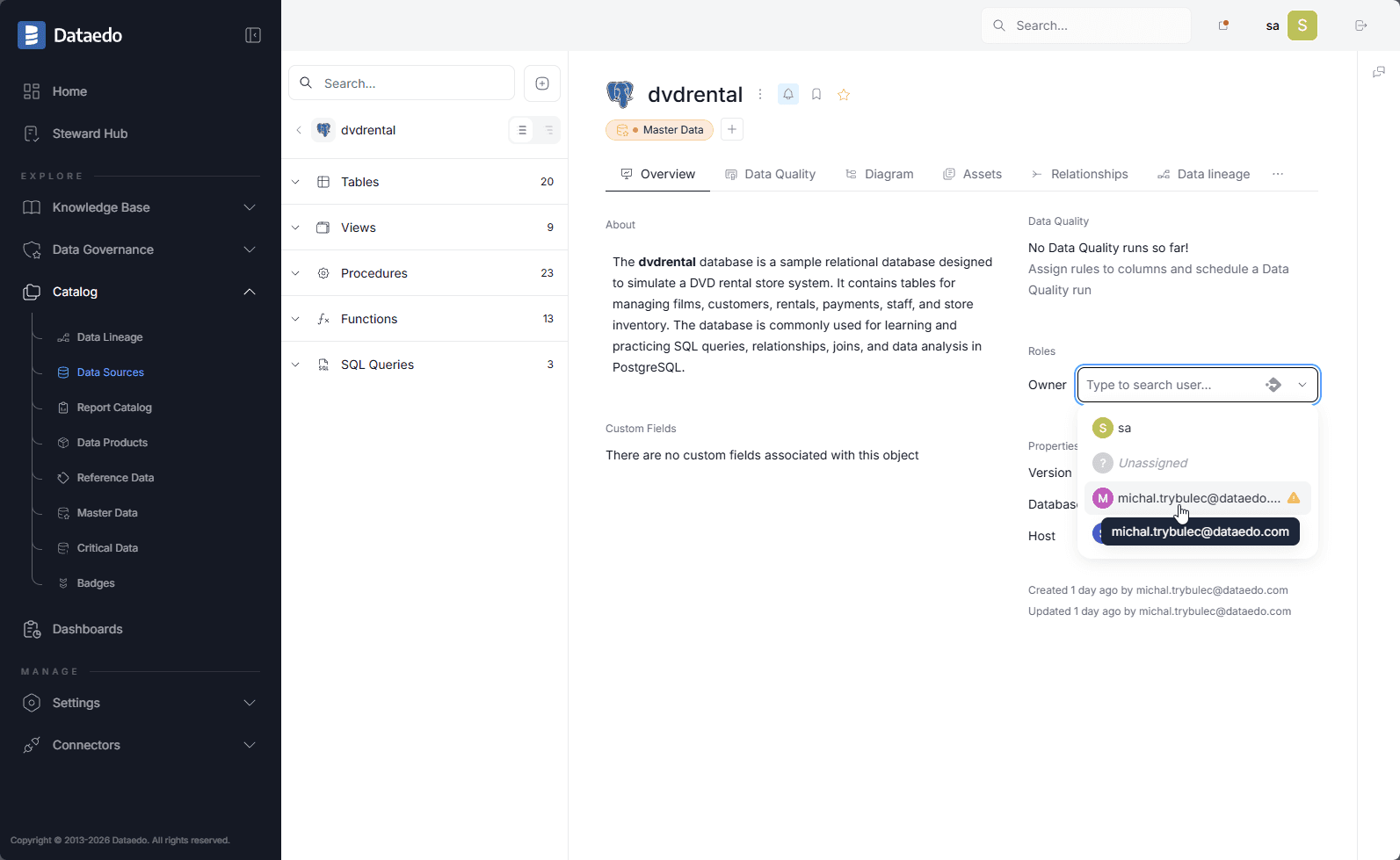 Ownership and stewardship fields attached to high-impact PostgreSQL assets.
Best Practice 3: Keep Object and Column Descriptions Aligned with Rules
Quality rules should reference documented meaning, not hidden assumptions.
For critical columns, descriptions should include:
- business definition,
- acceptable ranges or value sets,
- source-of-truth notes,
- rule ownership and review expectation.
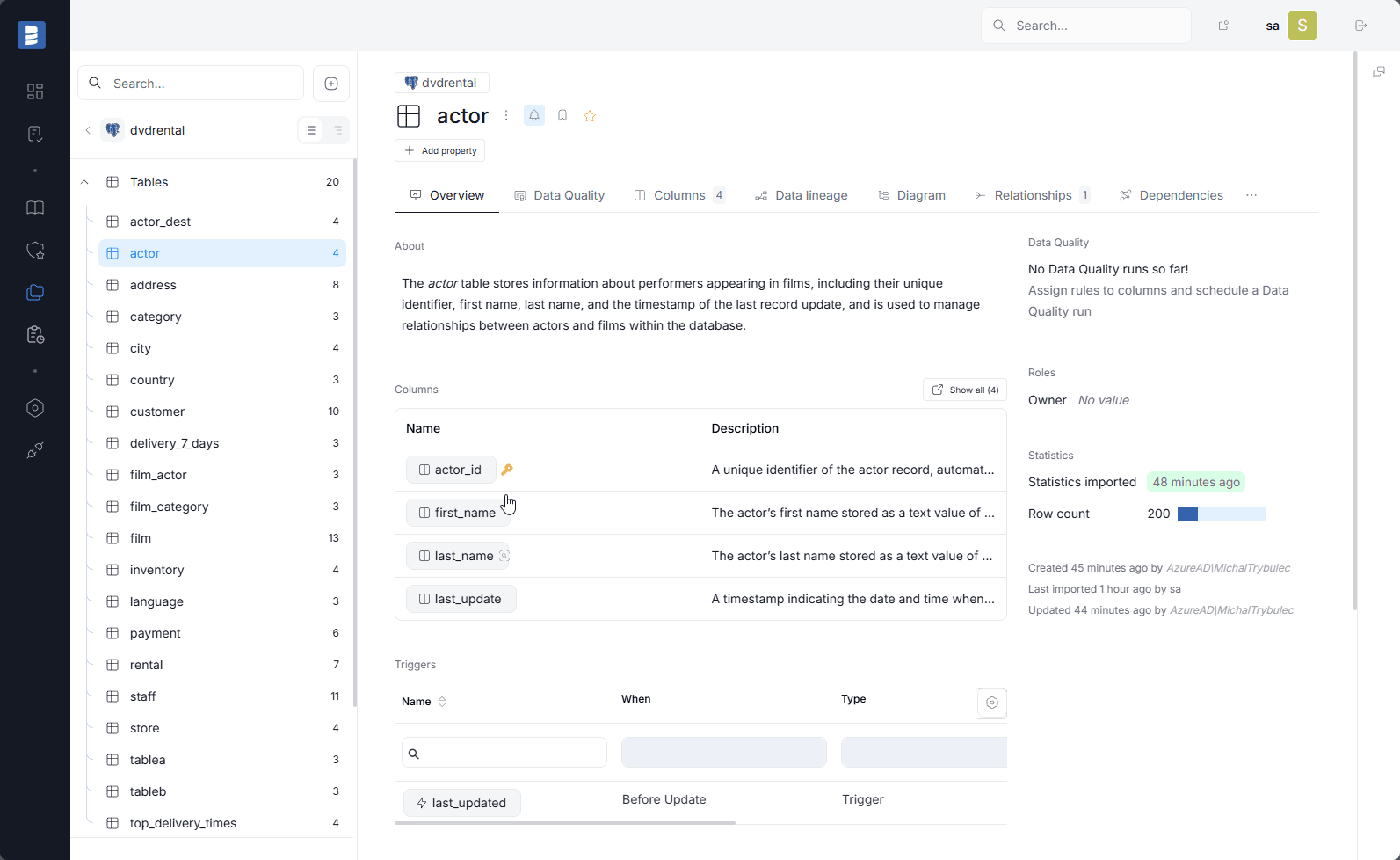 Object and column descriptions used as context for consistent quality rule design.
Best Practice 4: Use Lineage to Prioritize Defect Impact
Not every data defect has the same downstream risk.
Use lineage to determine:
- which dashboards and measures are affected,
- which business domains are impacted,
- where to focus validation effort first.
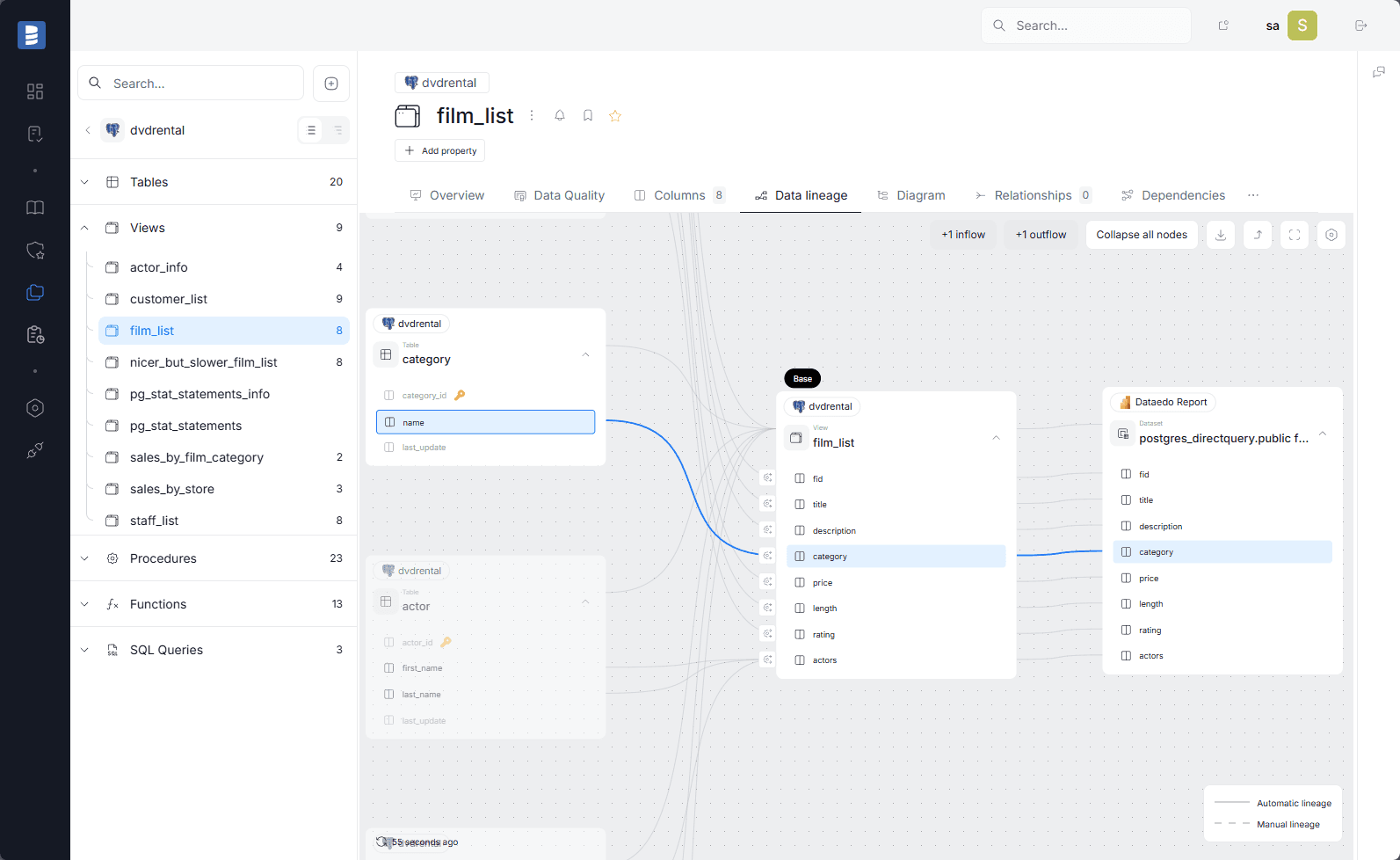 Column-level lineage used to assess defect propagation and remediation priority.
Best Practice 5: Put Quality Gates into Release Workflow
Before promoting PostgreSQL changes, include quality checks for impacted assets:
- schema compatibility checks,
- high-severity rule outcomes,
- downstream KPI validation for affected domains.
Quality gates reduce “successful deployment, broken analytics” scenarios.
Best Practice 6: Monitor Trends, Not Only Point Failures
One failed run is useful. Trend direction is operationally more useful.
Track:
- pass/fail ratios over time,
- recurring failure categories,
- domain-level quality drift.
This supports proactive correction before business trust erodes.
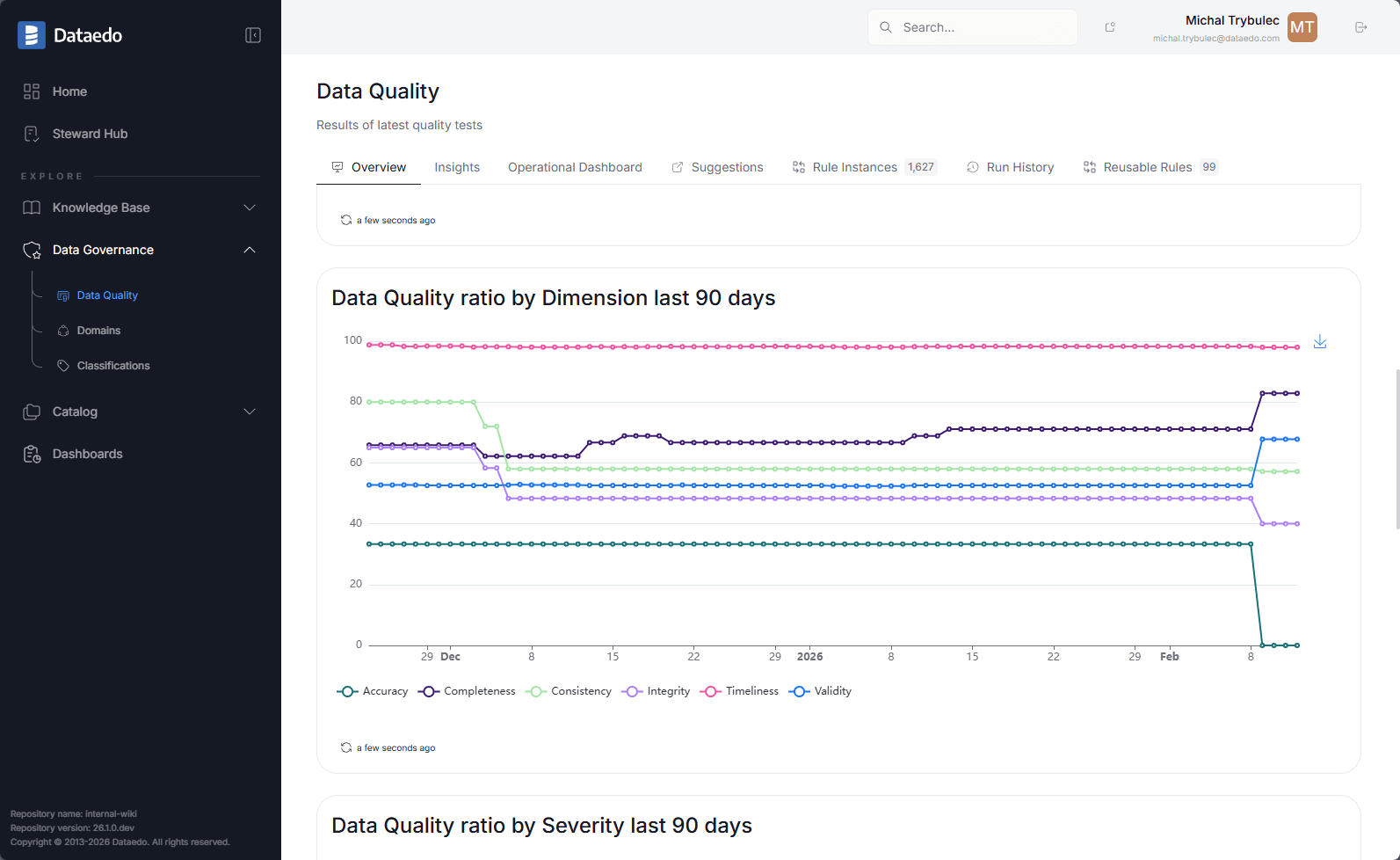 Quality trend analysis showing pass/fail ratios and domain-level drift over time.
Common Mistakes to Avoid
- Measuring quality without business context - Scores without KPI/domain linkage rarely change decisions.
- Treating all rules as equal priority - Critical asset rules should have higher severity and faster response paths.
- Running checks without clear remediation ownership - No owner means no closure.
- Isolating quality from lineage - Without dependency context, teams mis-prioritize fixes.
- Optimizing for number of rules instead of outcome - Better to run fewer high-value rules with clear actions than many rules no one uses.
How Dataedo Helps Operationalize PostgreSQL Data Quality
Dataedo helps teams connect quality controls to real delivery workflow:
- define and monitor quality checks in governance context,
- expose quality outcomes near metadata and lineage,
- link quality status to ownership and glossary definitions,
- use lineage for impact-aware remediation and release decisions.
This turns quality from periodic audit activity into an operational trust signal.
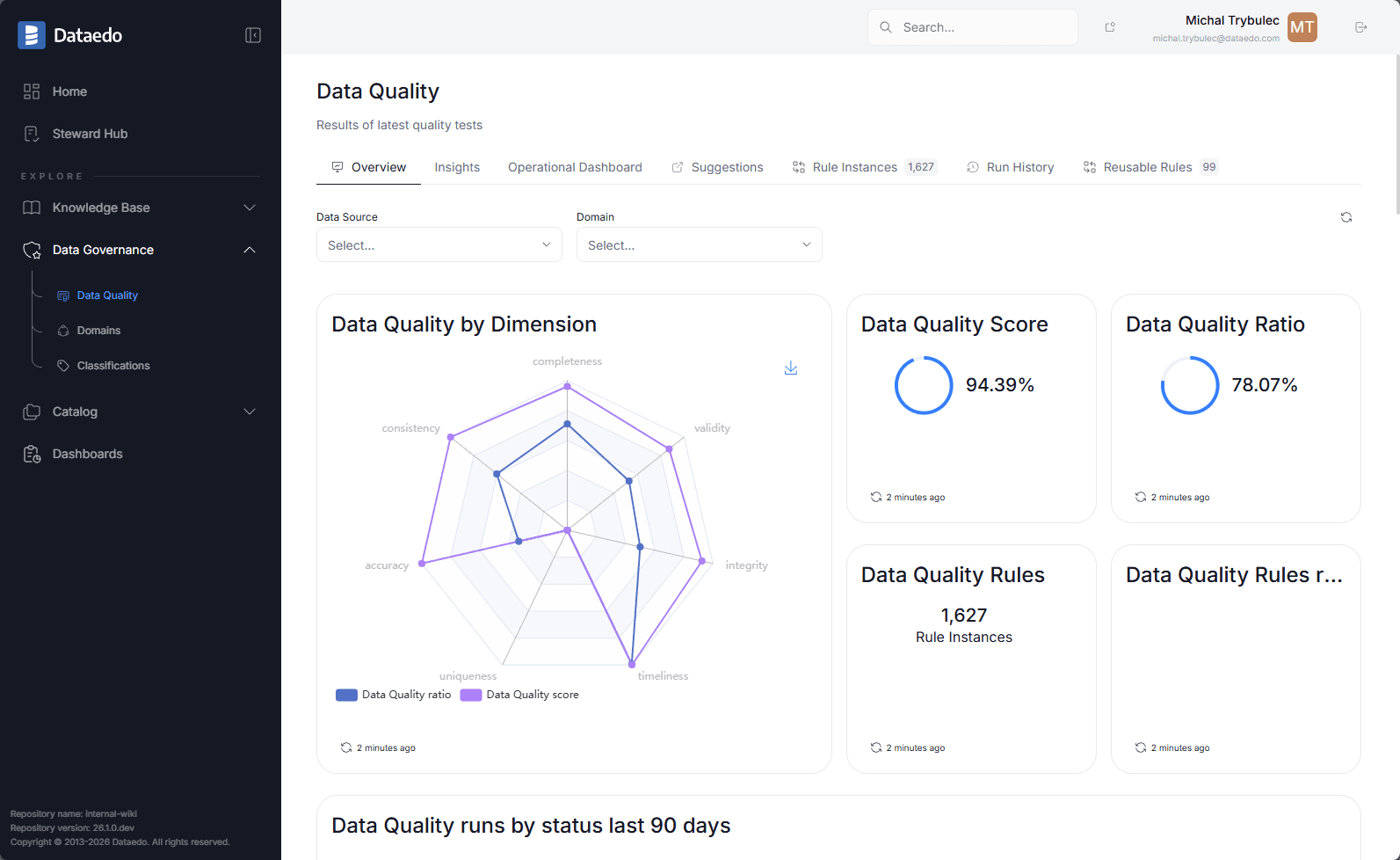 Quality dashboard with rule severity, execution status, and ownership context.
Frequently Asked Questions
Where should we start with PostgreSQL quality checks?
Start with high-impact facts, dimensions, and KPI-driving columns.
How many rules should we create first?
Start small and high-value. Expand after ownership and remediation flow is stable.
Should quality checks run daily or on release?
Usually both: continuous monitoring plus release-time gates for impacted assets.
Can we improve quality without lineage?
Partially. Lineage is needed for impact-based prioritization and faster root-cause isolation.
What makes quality sustainable long term?
Ownership, clear severity model, and integration with release workflow.
Final Takeaway
PostgreSQL data quality is not a one-time validation step. It is a repeatable governance process.
Teams that combine rule design, ownership, lineage, and release gates deliver faster with fewer analytics incidents.
See how Dataedo helps teams operationalize PostgreSQL data quality with governance context, lineage visibility, and impact-aware workflows. Book a demo or start a free trial.