


 Michał Trybulec
PostgreSQL is a trusted foundation for many analytics stacks, from operational reporting to domain-focused data products. Its flexibility is a strength, but at scale it creates a common governance problem: teams ship schema and logic changes faster than ownership, glossary context, and impact visibility can keep up.
When that happens, governance debt appears in daily delivery:
- KPI definitions diverge across teams,
- schema changes break downstream models,
- quality incidents take too long to isolate,
- and critical data has unclear ownership.
In this guide, you’ll learn:
- what effective PostgreSQL governance looks like in practice,
- eight best practices you can operationalize without slowing delivery,
- and how Dataedo helps make PostgreSQL governance repeatable.
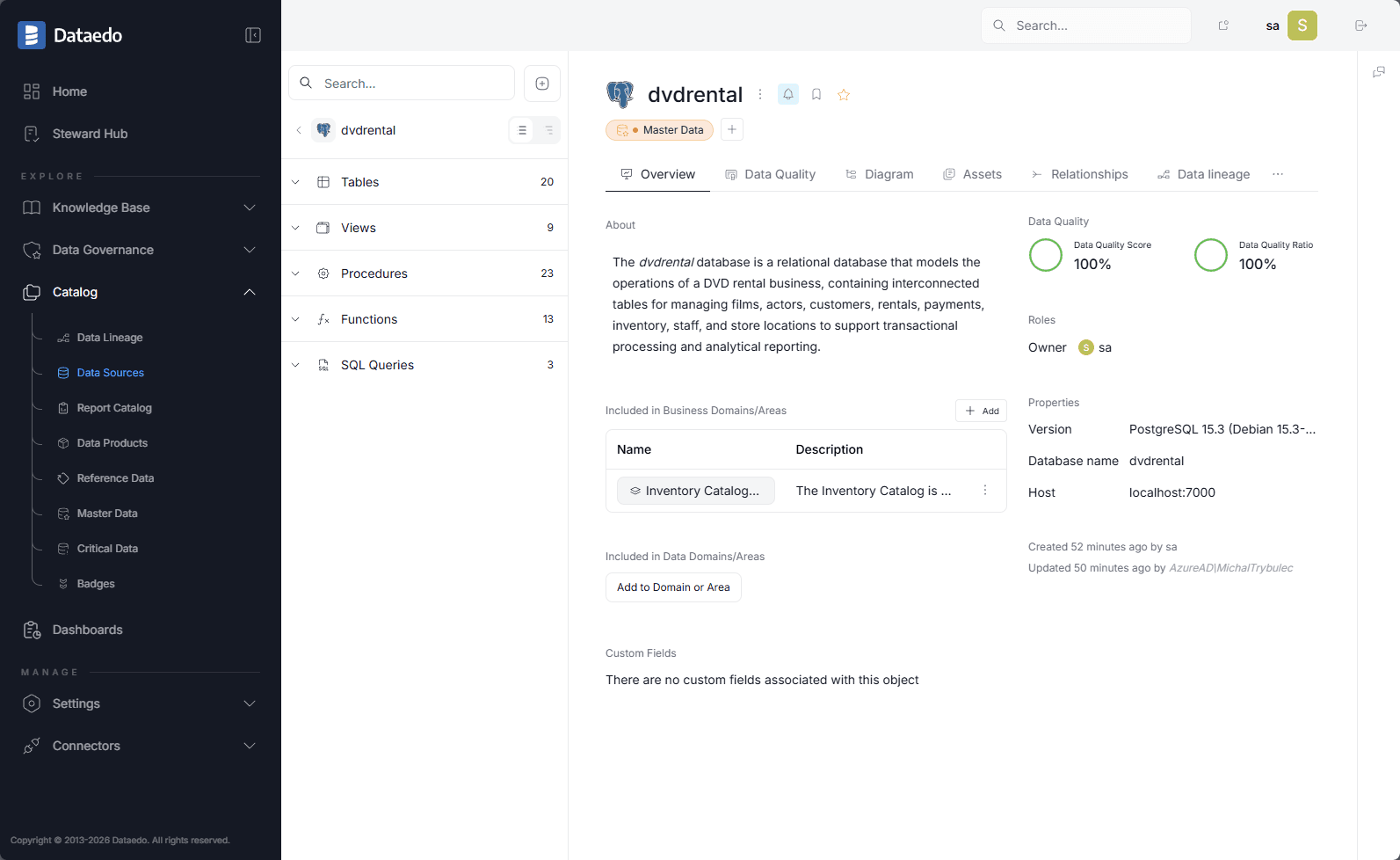 PostgreSQL object page with ownership, glossary links, quality status, and lineage context.
What Good PostgreSQL Governance Actually Means
Strong PostgreSQL governance is not a policy document. It is an operating model that connects technical metadata to business accountability.
Teams should be able to answer five questions quickly and consistently:
- What does this table, column, or view represent?
- Who owns it and who approves changes?
- Is the data reliable for this business use case?
- What depends on it downstream?
- What will break if we modify it?
If these answers require manual investigation every time, governance is incomplete even if documentation exists.
Why PostgreSQL Governance Breaks at Scale
Most governance failures start as small gaps:
- schema descriptions are missing or stale,
- ownership exists in Jira or Slack but not on data assets,
- business terms are defined but not mapped to technical fields,
- lineage is partial, so impact analysis remains guesswork.
Over time, teams spend more effort validating numbers than delivering new analytics.
Best Practice 1: Define Ownership at Object and Domain Level
Ownership should be explicit on critical PostgreSQL assets, not only at team level.
At minimum, define:
- Data Owner for business correctness and release decisions,
- Technical Owner/Steward for implementation and documentation quality.
Apply this to high-impact assets first:
- core fact tables,
- shared dimensions,
- business-critical views and materialized views.
Clear accountability reduces escalation loops during incidents and release windows.
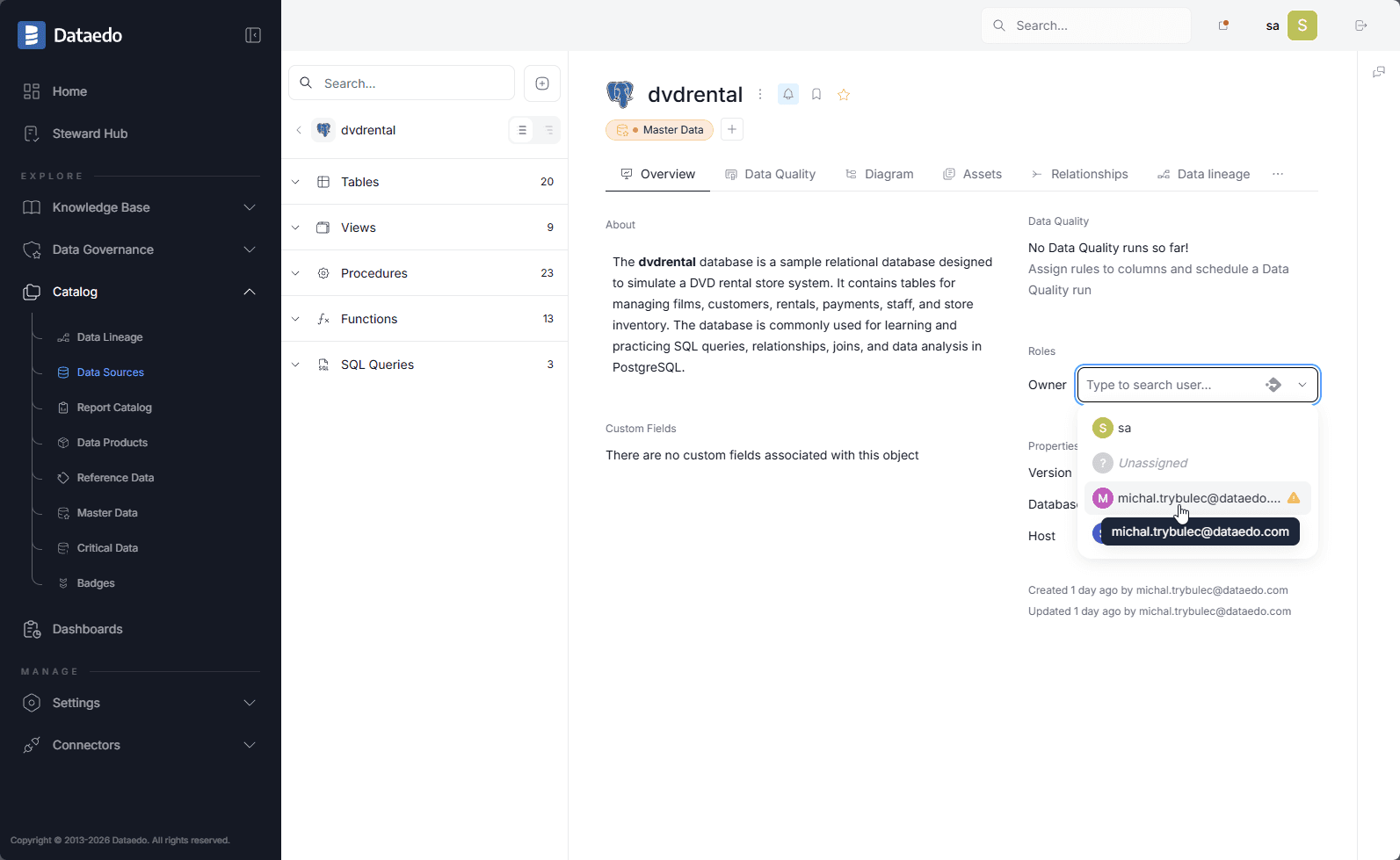 Owner and steward fields visible on a critical PostgreSQL asset in Dataedo.
Best Practice 2: Standardize Business Definitions with a Glossary
PostgreSQL can be technically consistent while business meaning remains inconsistent.
Terms such as active_customer, net_revenue, or qualified_lead should be governed as shared definitions and linked to real columns, views, and metrics.
A managed glossary helps:
- reduce KPI drift,
- speed up onboarding,
- improve trust in cross-team reporting.
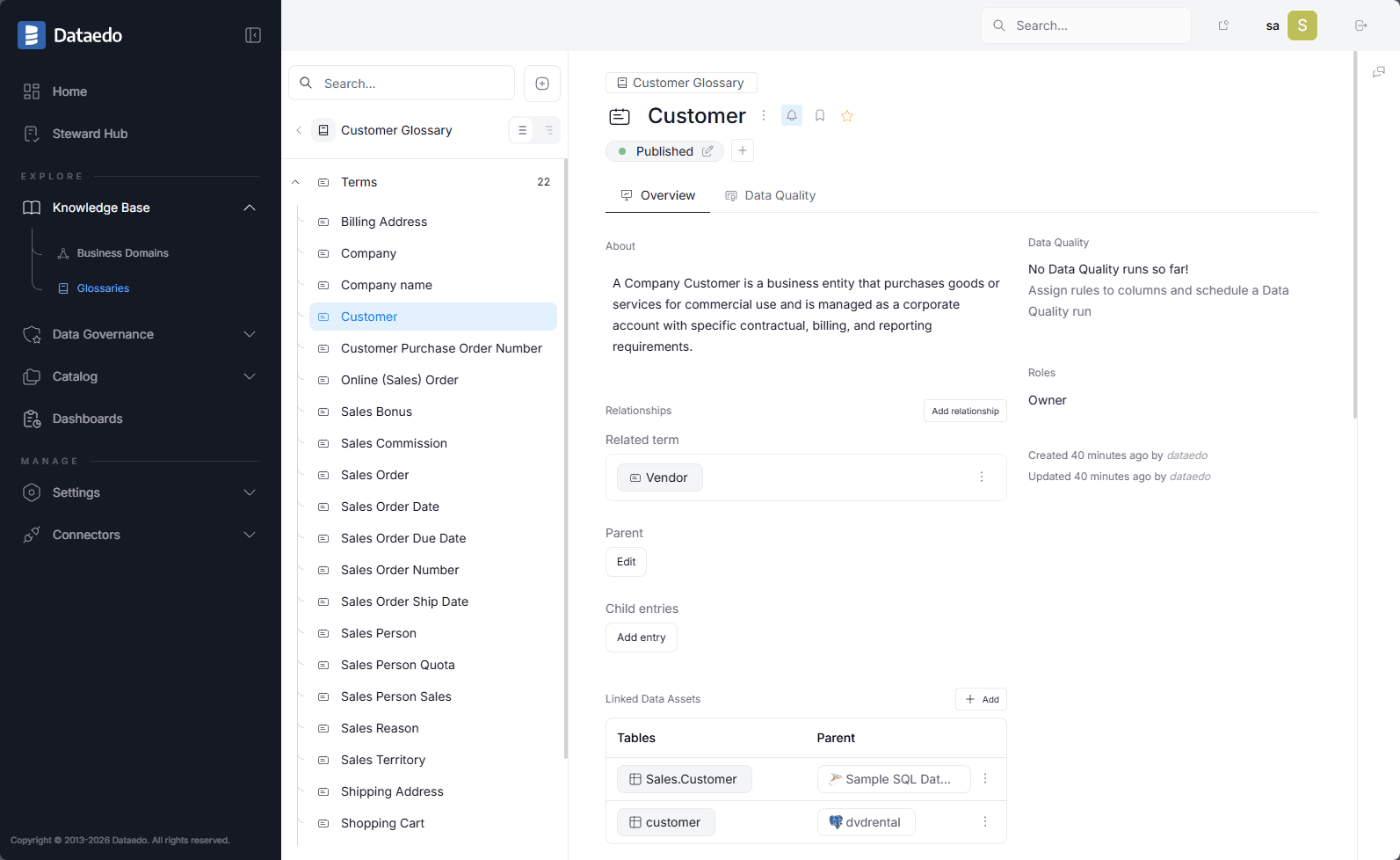 Glossary term linked to PostgreSQL columns and downstream analytical metrics.
Best Practice 3: Use End-to-End and Column-Level Lineage
Object-level lineage is useful for architecture visibility, but change decisions usually require column-level detail.
In PostgreSQL environments, a single column change can affect:
- dbt or ETL transformations,
- warehouse tables and marts,
- semantic models,
- dashboard measures.
Column-level lineage makes impact analysis practical before release and root-cause analysis faster after incidents.
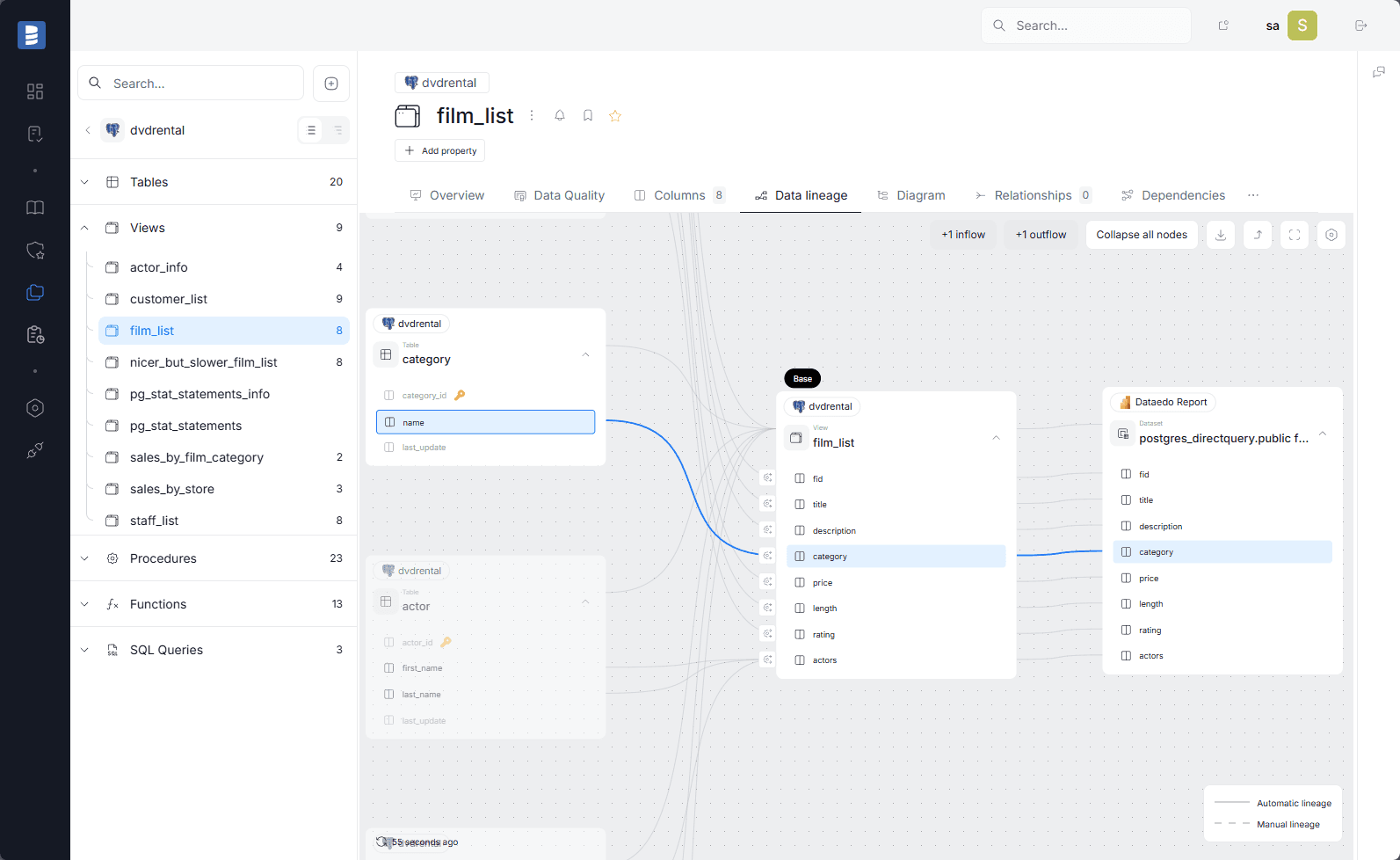 Column-level lineage from PostgreSQL source fields to downstream reporting assets.
Best Practice 4: Document Transformation Logic Where It Runs
Trust breaks most often in transformation layers, not only in raw sources.
Document purpose and scope on the actual PostgreSQL objects where logic executes:
- views,
- materialized views,
- functions and procedures,
- staging and curated schemas.
Good documentation should clarify:
- what this object does,
- which logic is intentionally included,
- what is explicitly downstream,
- which consumers are most sensitive to change.
Best Practice 5: Enrich Documentation with Object and Column Descriptions
Descriptions are the fastest way to turn technical metadata into usable knowledge for analysts, engineers, and business users.
At minimum, maintain descriptions for:
- schemas and tables (purpose, grain, update cadence),
- views and materialized views (business intent and transformation scope),
- columns (business meaning, calculation logic, units, sensitivity).
For high-impact columns, descriptions should also include:
- accepted values or business rules,
- source-of-truth notes,
- ownership and review expectations.
This removes ambiguity, improves onboarding, and reduces repeated Slack/Jira clarification loops.
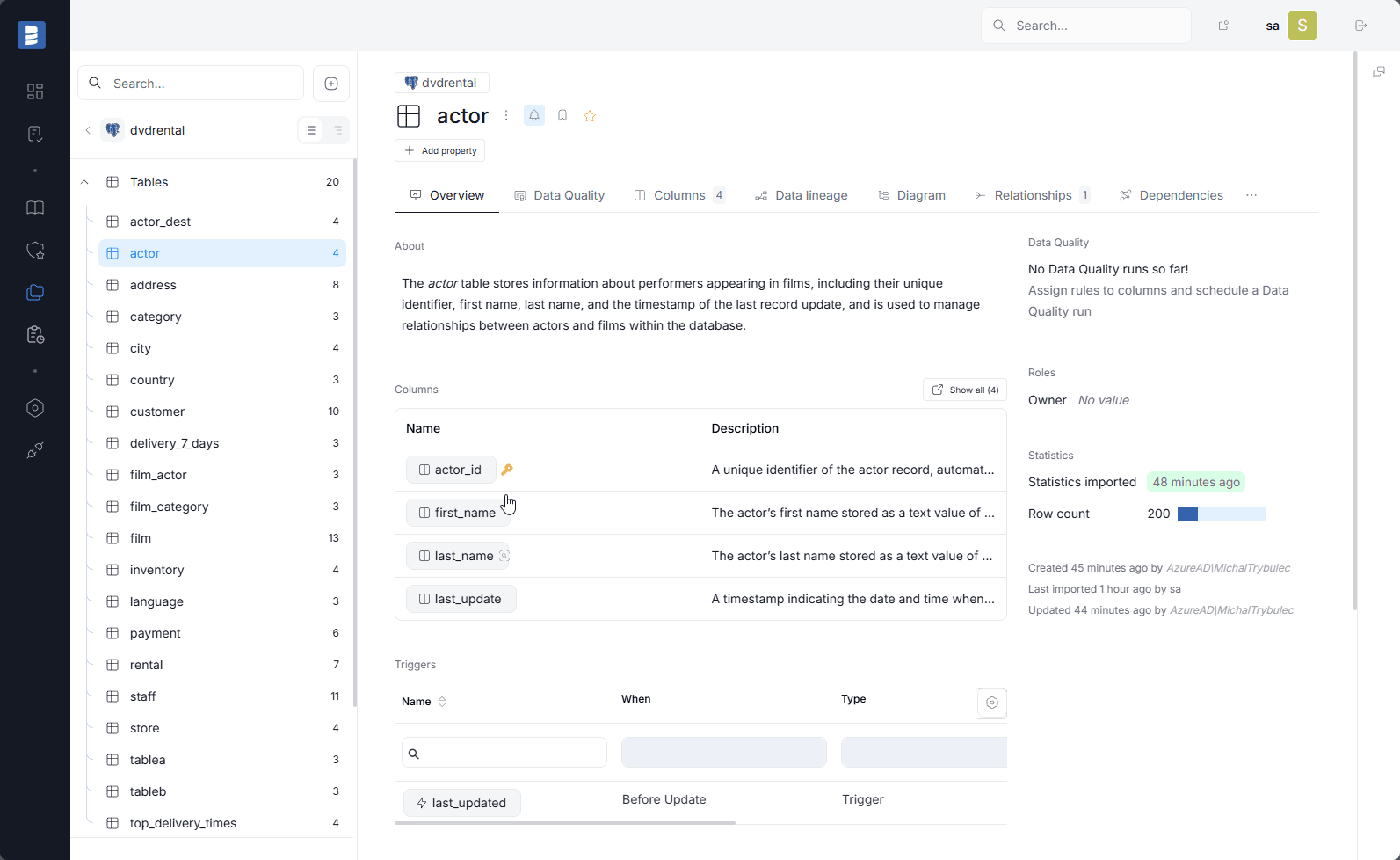 Example of enriched object and column descriptions used as governance context in Dataedo.
Best Practice 6: Put Governance into Release Workflow
Governance should be part of release gates, not post-release cleanup.
Before deploying PostgreSQL schema or logic changes, review:
- owner and approver scope,
- glossary impact on business definitions,
- lineage impact on downstream assets,
- schema and compatibility risk,
- data quality risk on critical outputs.
If teams discover dependency issues after deployment, governance is reactive and expensive.
Best Practice 7: Treat Data Quality as a Governance Signal
Lineage explains where data came from. Quality explains whether it is fit for use now.
In mature PostgreSQL setups, quality checks are:
- tied to business-critical rules,
- scheduled by severity,
- monitored over time,
- visible near metadata and lineage context.
Examples:
- null rate thresholds on mandatory keys,
- uniqueness checks for business identifiers,
- referential consistency checks across core domains.
Best Practice 8: Connect Security and Access Context to Metadata
Governed self-service requires both discoverability and control.
For PostgreSQL, metadata should include:
- sensitivity/classification context,
- ownership and stewardship,
- access boundaries (roles, RLS scopes where applicable),
- intended usage and audience.
This enables broader reuse without over-exposing restricted data.
Common Mistakes to Avoid
- Treating governance as one-time documentation - PostgreSQL environments evolve continuously. Governance content must evolve with each release cycle.
- Assigning owners without decision rights - Ownership fields alone are not enough. Owners need authority in change and publication workflow.
- Expecting lineage alone to guarantee trust - Without glossary, quality, and ownership context, lineage is necessary but not sufficient.
- Ignoring permissions and workflow design - If review responsibilities and publication stages are unclear, governance quality degrades quickly.
- Optimizing for volume instead of usability - Users need concise, actionable context, not maximum document count.
How Dataedo Helps with PostgreSQL Governance
- Centralize PostgreSQL Metadata with Governance Context - Combine technical metadata and business context in one catalog.
- Link Glossary Terms to Real Technical Assets - Connect approved business terms directly to PostgreSQL objects and downstream metrics.
- Analyze Dependencies with End-to-End Lineage - Use object-level and column-level lineage for safer impact analysis.
- Make Ownership and Stewardship Explicit - Show accountability directly where teams review and change assets.
- Operationalize Data Quality Monitoring - Track rule outcomes as ongoing trust signals, not one-time checks.
- Support Controlled Change with Workflow Signals - Use governance workflows and change context to reduce regression risk before release.
Frequently Asked Questions
Can PostgreSQL governance work without dedicated tooling?
At small scale, partially. As dependencies grow, teams usually need centralized metadata, ownership, lineage, and quality signals.
Is object-level lineage enough for release decisions?
For high-level architecture visibility, often yes. For production change safety, column-level lineage is usually required.
Where should a PostgreSQL governance program start?
Start with ownership and glossary alignment, then scale lineage and quality depth.
How often should PostgreSQL metadata be refreshed?
Match refresh cadence to your change cadence. High-change environments typically require frequent updates.
Does governance slow down delivery?
Poorly designed governance can. Operational governance integrated into release workflow usually improves delivery speed by reducing rework and incident risk.
Final Takeaway
PostgreSQL enables flexibility and speed. Governance makes that speed safe, trusted, and repeatable.
The strongest teams combine ownership, glossary, lineage, quality, and release controls into one working model.
See how Dataedo helps teams scale PostgreSQL governance with catalog, glossary, lineage, data quality, and impact analysis. Book a demo or start a free trial.