


 Michał Trybulec
SQL Server remains a core platform for transactional systems, reporting databases, and analytics-serving layers in many organizations. As usage scales across databases, instances, linked servers, ETL workflows, and BI tools, governance complexity rises quickly. The challenge is not just storing data. The challenge is keeping meaning, ownership, trust, and change impact under control.
In this guide, you’ll learn:
- what effective governance looks like in SQL Server environments,
- which governance controls have the biggest operational impact,
- and how Dataedo helps teams operationalize SQL Server governance.
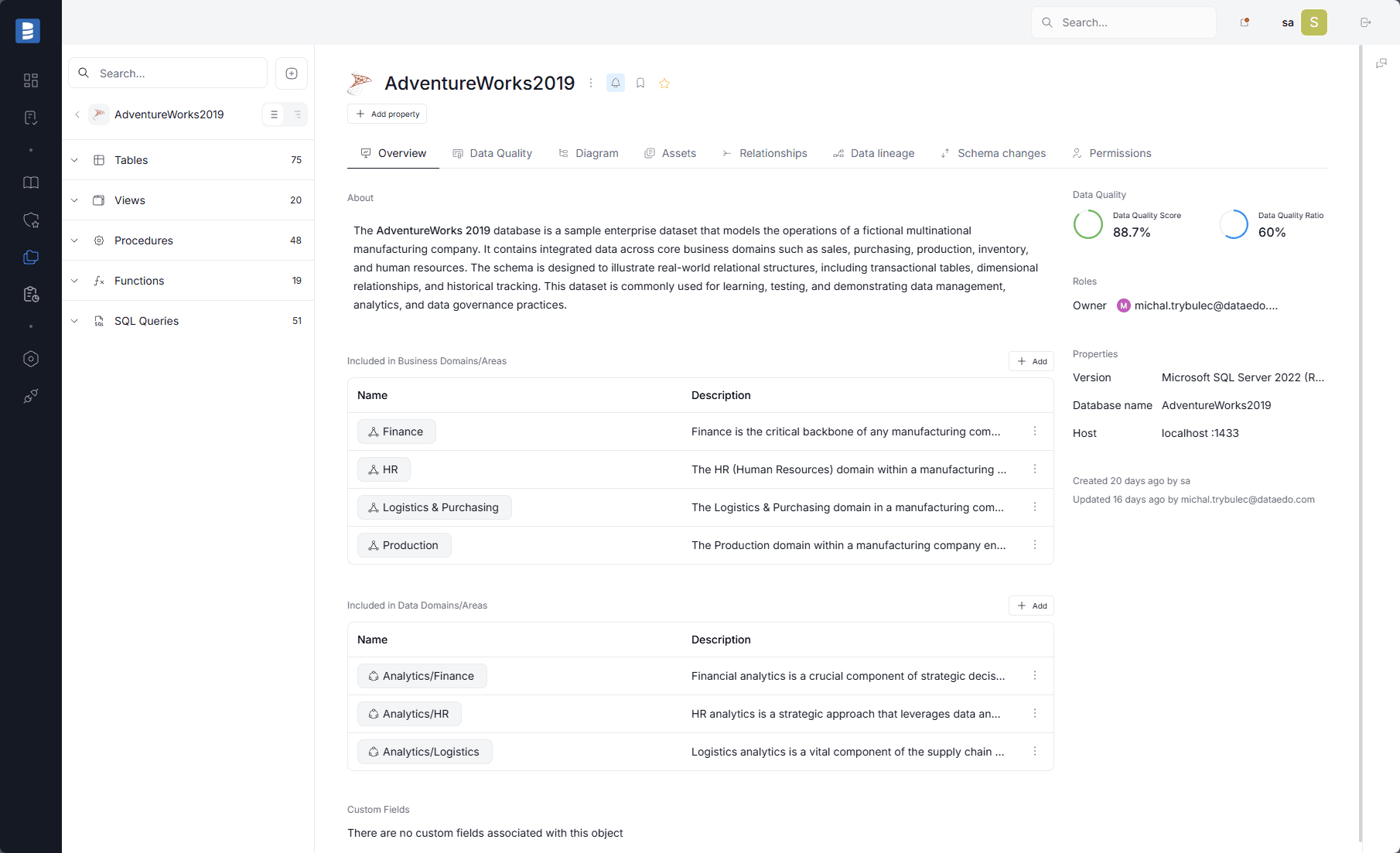 SQL Server asset page in Dataedo with descriptions, ownership, lineage, quality signals, and change context.
What Good SQL Server Governance Actually Means
Strong governance means teams can answer, quickly and consistently:
- What does this table, view, procedure, or function mean in business terms?
- Who owns it and who approves changes?
- Can we trust this data for the intended KPI or report?
- What feeds this data upstream and what depends on it downstream?
- What is the impact of a schema or logic change?
If answering those questions requires Slack threads, ticket archaeology, and manual SQL reverse-engineering, governance is too fragile.
Why SQL Server Governance Breaks at Scale
Typical failure patterns in SQL Server-heavy stacks:
- multiple databases/instances evolve without shared governance standards,
- business logic is spread across views, procedures, functions, and BI layers,
- linked server dependencies are not documented or mapped,
- ownership exists in org charts but not on assets,
- quality checks are disconnected from lineage and release workflow.
The result is familiar:
- KPI disputes,
- risky releases,
- repeated incidents,
- slower onboarding and troubleshooting.
Best Practice 1: Define Ownership at Domain and Asset Level
Ownership should be visible on the SQL Server assets that actually drive decisions:
- reporting tables and views,
- transformation procedures,
- functions reused in reporting logic,
- KPI-critical columns.
Use clear governance role:
- Owner (business correctness, approval authority, documentation accountability, and change coordination).
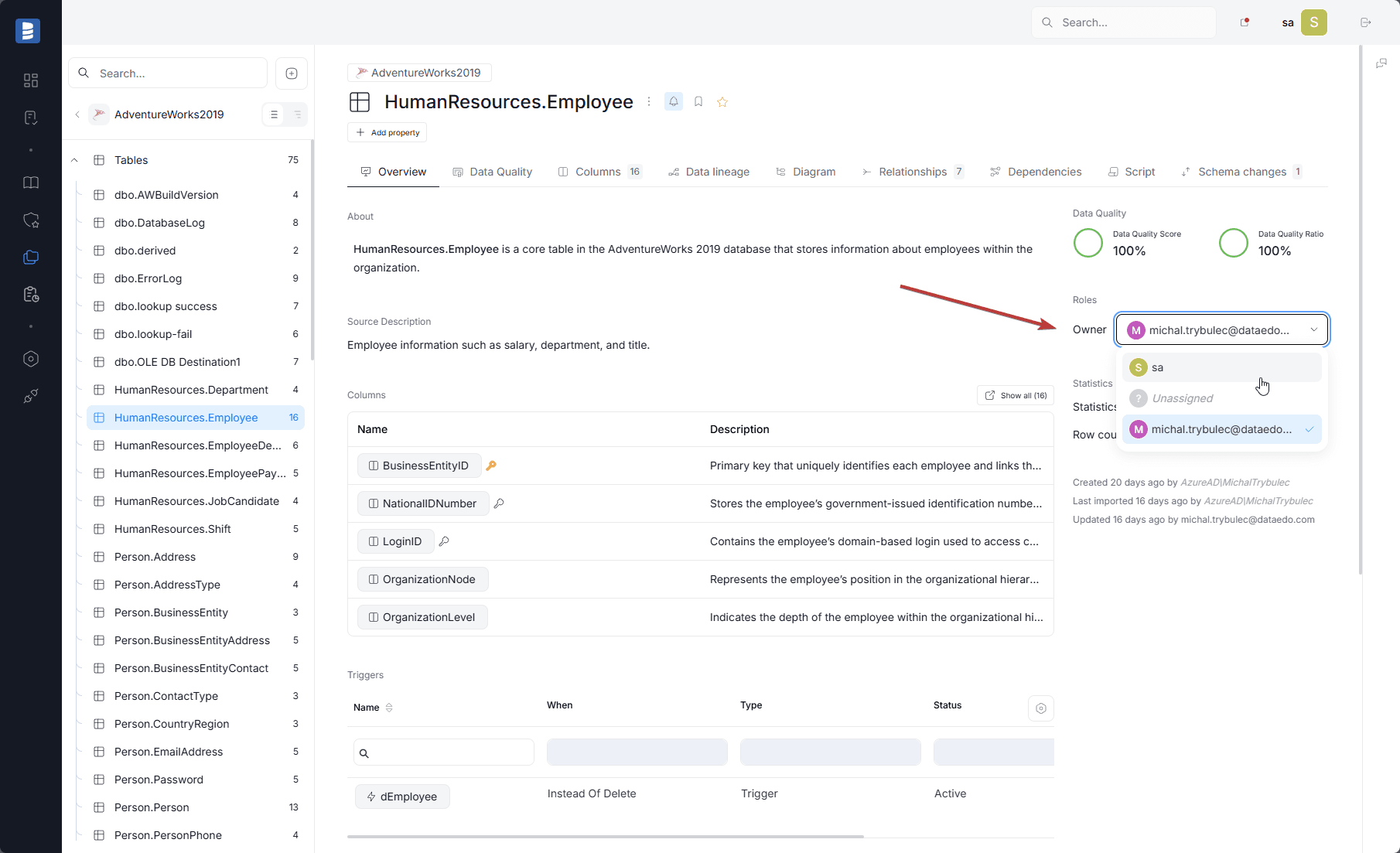 Owner metadata maintained directly on a SQL Server asset in Dataedo.
Best Practice 2: Standardize Business Definitions with a Glossary
SQL Server can be technically consistent while business meaning remains inconsistent across teams.
Map shared terms (for example active_customer, recognized_revenue, order_margin) to concrete SQL Server tables, views, columns, and downstream BI fields.
For example, in the AdventureWorks2019 database, active_customer can be interpreted in several valid but conflicting ways unless the term is governed explicitly. One team may treat every row in Sales.Customer as an active customer, while another may count only customers with at least one order in Sales.SalesOrderHeader, and a third may add a time window based on OrderDate. A glossary removes that ambiguity by defining the term once and linking it to the SQL Server assets that implement it.
This reduces KPI drift and makes cross-team reporting easier to trust.
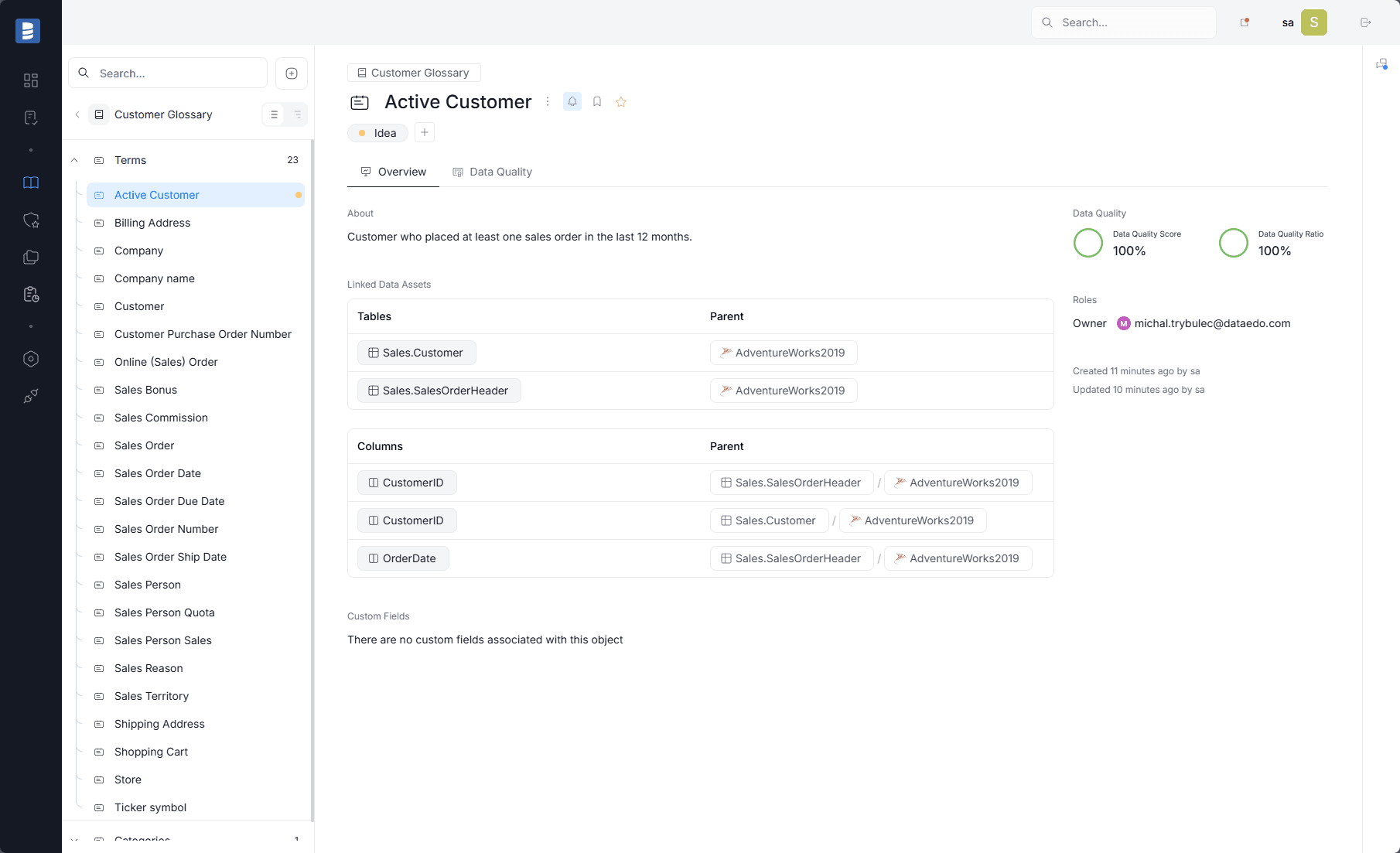 Glossary term linked to SQL Server fields and downstream analytical assets.
Best Practice 3: Document Objects and Columns (Not Only Tables)
A common governance mistake is documenting only tables while critical logic lives elsewhere.
In SQL Server environments, strong governance should include descriptions for:
- tables and columns,
- views and derived columns,
- procedures and functions,
- important parameters and returned result sets.
SQL Server teams also benefit from documenting logic near the point of use, especially where procedures/functions are part of operational reporting workflows.
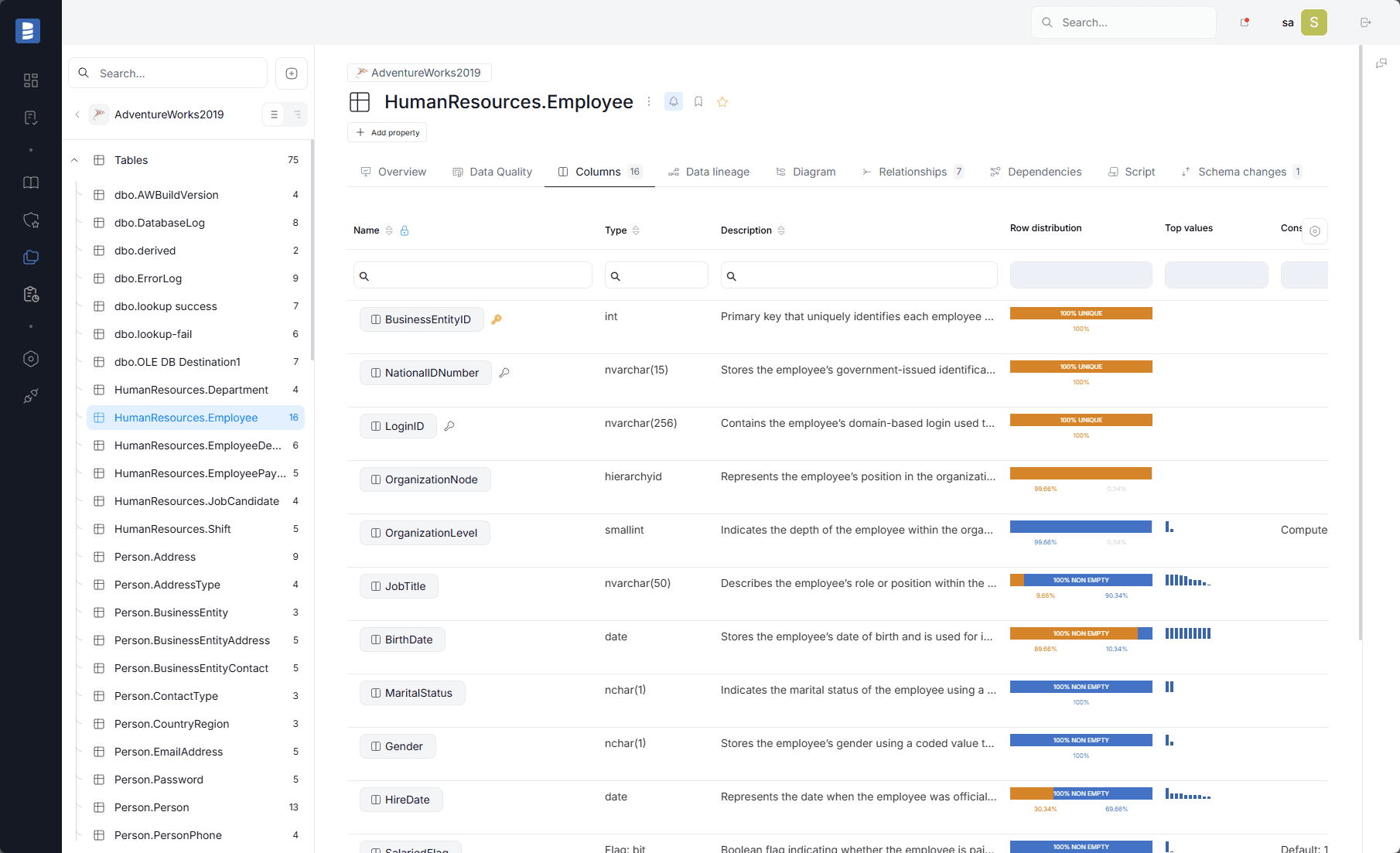 SQL Server object and column descriptions in Dataedo used to support onboarding, quality rule design, and safer changes.
Best Practice 4: Use Lineage for Impact Analysis Before Releases
Lineage should be used as a release control, not just a documentation diagram.
The strongest SQL Server teams use lineage as part of a broader end-to-end view (for example ETL -> SQL Server -> Power BI), while still validating dependencies inside SQL Server itself.
At minimum, review:
- upstream ETL/job/integration dependencies,
- SQL Server views, procedures, functions, synonyms, and SQL Query outputs involved,
- column-level impact on KPI logic,
- downstream BI datasets/reports and accountable owners.
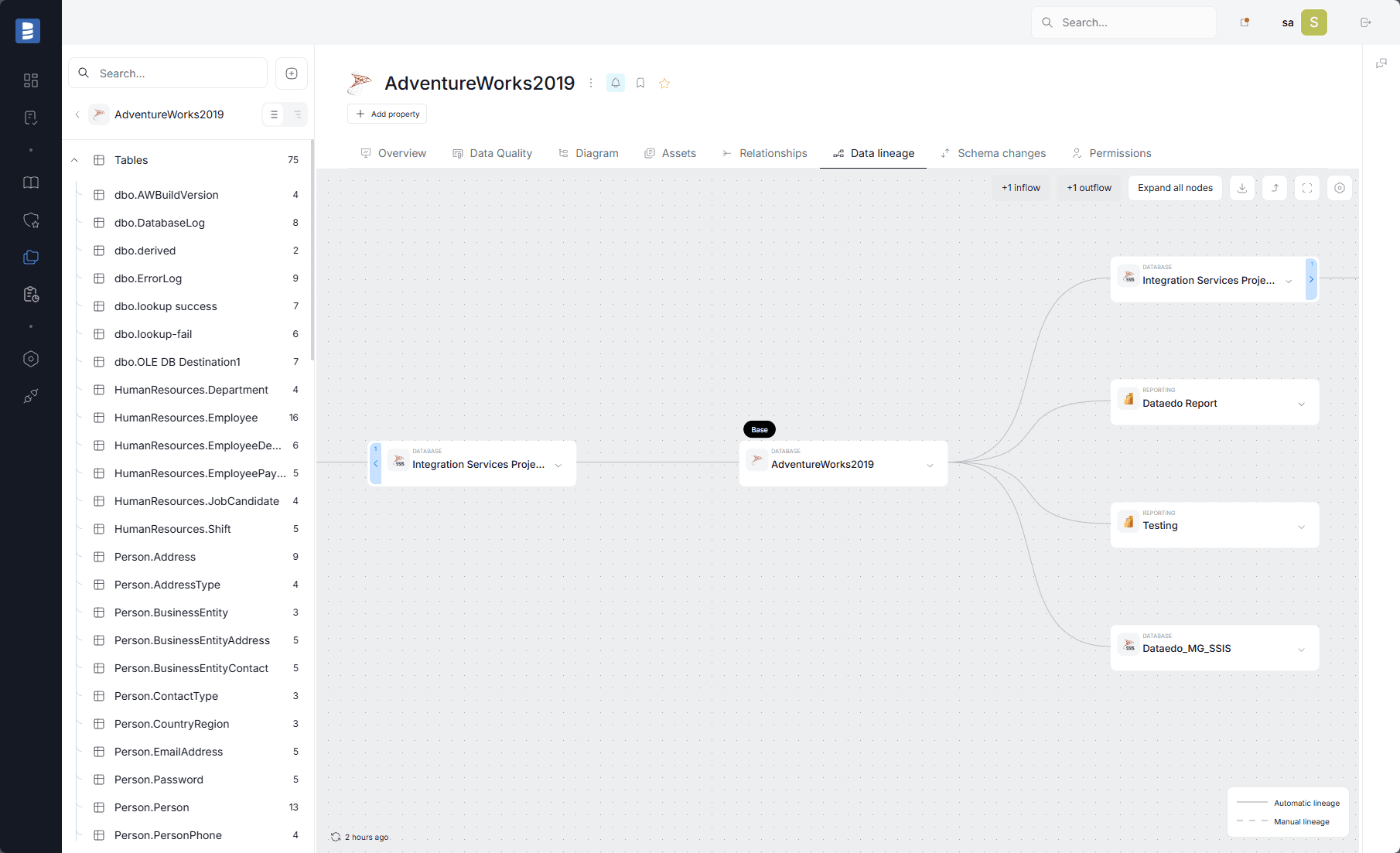 End-to-end lineage view showing SQL Server in a broader flow used for pre-release impact analysis.
That high-level perspective is useful for release planning, but SQL Server teams often need to go one level deeper. In Dataedo, you can move from the general dependency view into detailed column-level lineage to see exactly which source columns feed a downstream field, KPI, or report attribute.
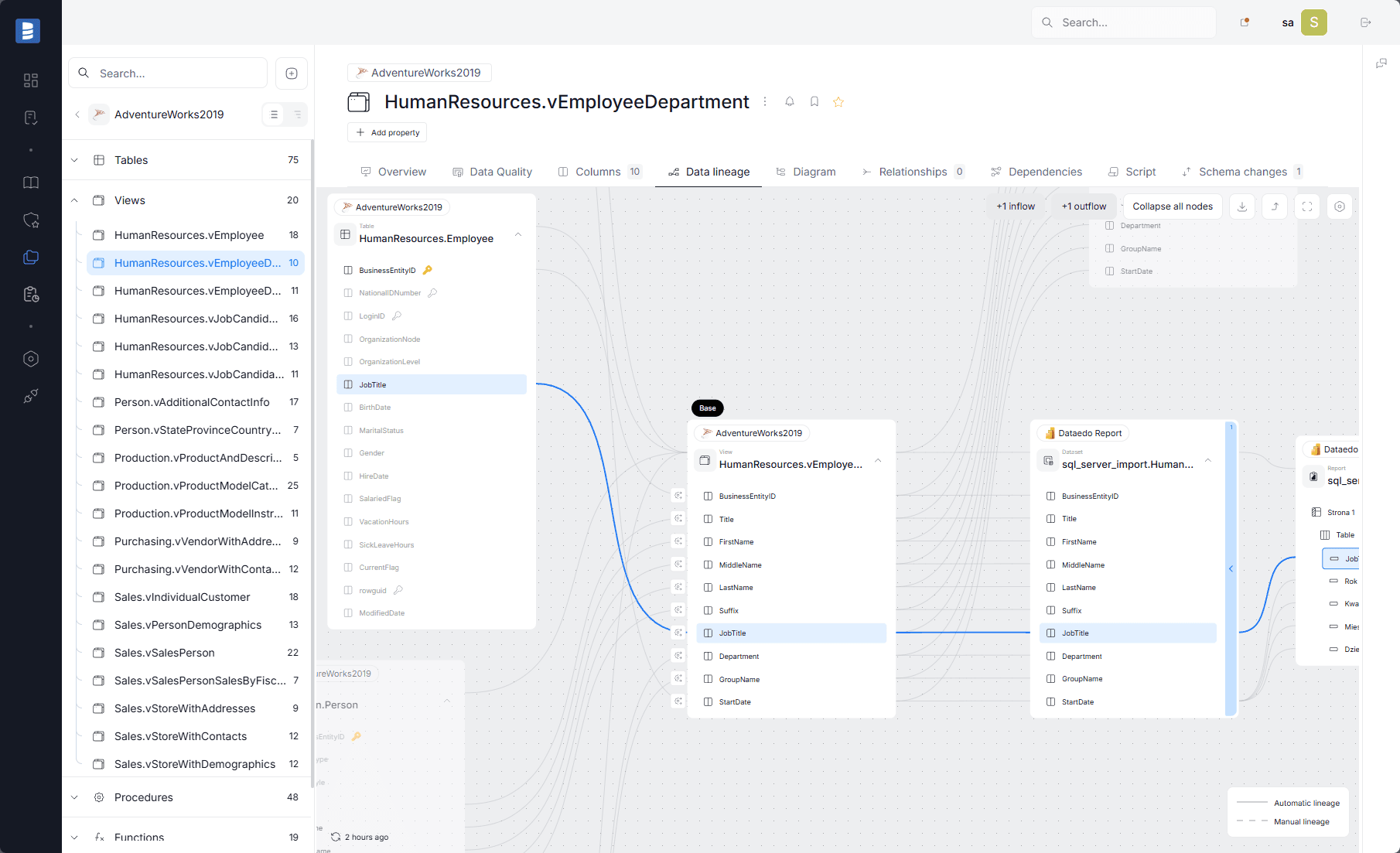 Column-level lineage view showing how specific SQL Server source columns propagate into downstream analytical fields.
Best Practice 5: Put Governance into Release Workflow
Governance is strongest when it is part of release readiness, not post-release cleanup.
Before promoting SQL Server schema or logic changes, review:
- owner and approver scope,
- glossary impact,
- lineage impact,
- schema change implications,
- quality risk and validation plan.
If teams only discover broken dependencies after deployment, governance is reactive and expensive.
Best Practice 6: Treat Data Quality as a Governance Signal
Lineage explains where data came from. Quality shows whether it is usable now.
Track quality signals near metadata, ownership, and lineage so teams can evaluate trust and release risk in one place.
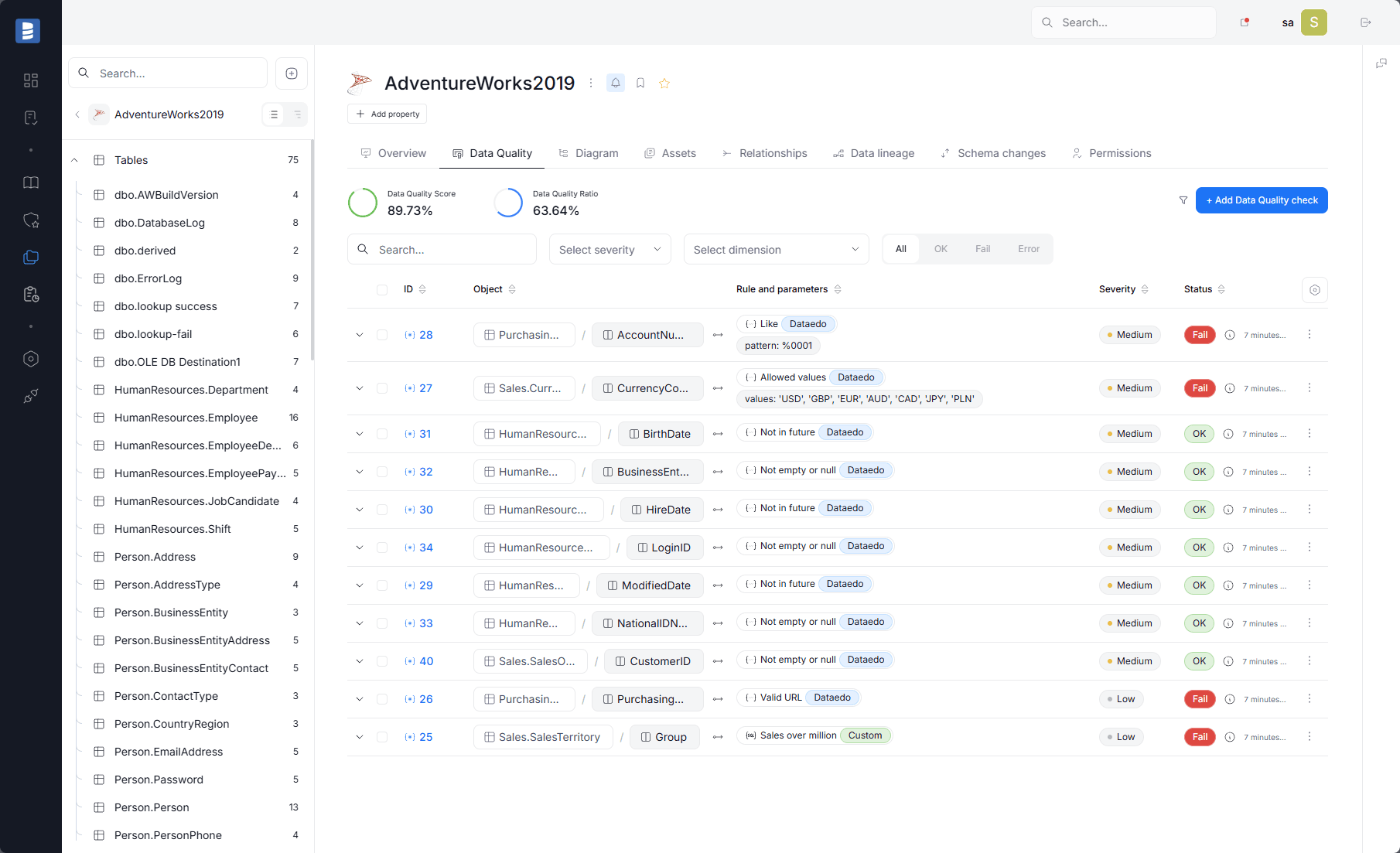 SQL Server Data Quality indicators shown with metadata and lineage context in Dataedo.
Best Practice 7: Govern Cross-Database and Linked Server Dependencies Explicitly
SQL Server governance often fails at environment boundaries.
Make it operational by:
- documenting linked servers and cross-database usage,
- maintaining Linked Source mappings where lineage depends on them,
- validating that referenced base objects are documented,
- reviewing dependency visibility after imports and changes.
This is especially important when synonyms or linked-server objects are used in reporting and ETL logic.
Common Mistakes to Avoid
- Treating governance as one-time documentation - SQL Server ecosystems evolve continuously. Governance metadata must evolve with releases.
- Assigning owners without decision authority - Ownership fields without approval rights do not improve change safety.
- Treating SQL Server as an isolated governance scope - If governance excludes upstream ETL and downstream BI dependencies, impact analysis stays incomplete.
- Ignoring procedures/functions in governance - Critical business logic often lives in routines, not only in tables and views.
- Separating quality from governance - Quality without ownership and lineage context is hard to operationalize.
How Dataedo Helps with SQL Server Governance
Dataedo helps teams combine governance controls in one workflow:
- SQL Server metadata cataloging across key object types,
- glossary linked to technical assets,
- lineage for views, procedures, functions, synonyms, and SQL Query outputs,
- ownership visibility,
- data quality monitoring context,
- schema and dependency visibility for impact-aware releases.
Frequently Asked Questions
Can SQL Server governance work without dedicated tooling?
At very small scale, partially. At scale, centralized metadata, lineage, and ownership context are usually necessary.
Should SQL Server governance include ETL and BI assets?
Yes. For release safety and KPI trust, SQL Server governance should include upstream loading processes and downstream BI assets that consume SQL Server data.
Are tables enough as the unit of governance?
No. Views, procedures, functions, and key columns often carry the business logic that changes KPI outcomes.
How often should governance metadata be refreshed?
At least in line with schema and transformation release cadence.
Does governance slow SQL Server delivery down?
Poorly designed governance can. Operational governance usually speeds delivery by reducing rework and incident recovery time.
Final Takeaway
SQL Server enables dependable data delivery, but governance is what makes that delivery trusted and repeatable.
The strongest teams combine ownership, glossary, lineage, quality, and release controls into one operating model.
See how Dataedo helps teams scale SQL Server governance with catalog, glossary, lineage, quality signals, and impact analysis. Book a demo or start a free trial.