 Support


Data governance rarely fails because a company forgot to write a policy. It usually fails because the policy does not help anyone decide what to do when a table changes, a KPI drifts, an audit question appears, or an owner needs to approve a release.
That is the gap data lineage closes. It does not replace stewardship, definitions, or control frameworks. What it does is make those things usable during real work. When the dependency path is visible, governance stops being a static set of standards and starts becoming part of change review, investigation, and accountability.
Governance Breaks At The Handoff
Most governance problems show up at handoff points. A developer changes a warehouse field but does not know which reports depend on it. A steward owns a KPI definition but cannot see the technical objects that implement it. An audit starts with a simple question about a value, and the team realizes the answer lives partly in documentation, partly in SQL, and partly in institutional memory.
Lineage matters because it connects those fragments. It shows how data moves from source to target and how transformations shape what appears downstream. That sounds technical, but the governance effect is operational: teams can answer not only “what is this asset?” but also “what does it touch, who should care, and what changes if we modify it?”
What Changes Once Lineage Is Visible
Governance becomes more useful when people can see the dependency path before they have to act on it.
The first effect is safer change review. A rename, refactor, or migration is no longer judged only by the person making it. The team can see which tables, reports, models, and fields depend on the object and review the blast radius before the change ships.
The second effect is clearer ownership. Ownership fields are much more useful when they sit beside the governed asset and its dependency path. Instead of maintaining a separate ownership register that has to be interpreted later, teams can see who should validate, approve, or explain a change in the same working context.
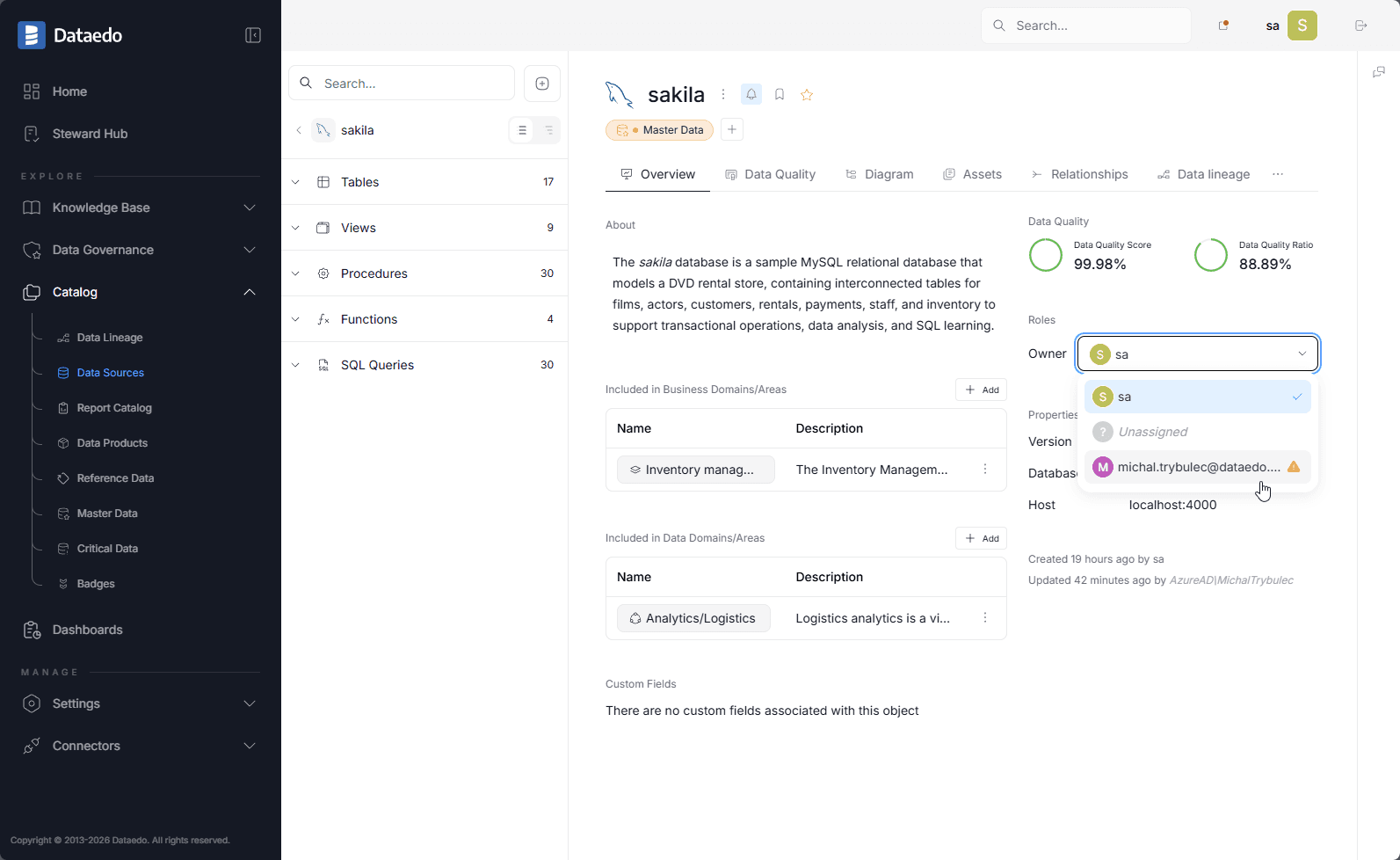 Ownership metadata becomes much more actionable when it sits next to the governed asset instead of in a separate register.
The third effect is that business meaning stops floating separately from technical flow. Most governance programs have some glossary work in place, but the gap between business language and implementation remains a constant problem. When lineage is linked to governed terms, people can see how a definition maps to real tables, fields, and transformations. That is what turns a glossary into a working governance layer instead of a reference document nobody consults during change review.
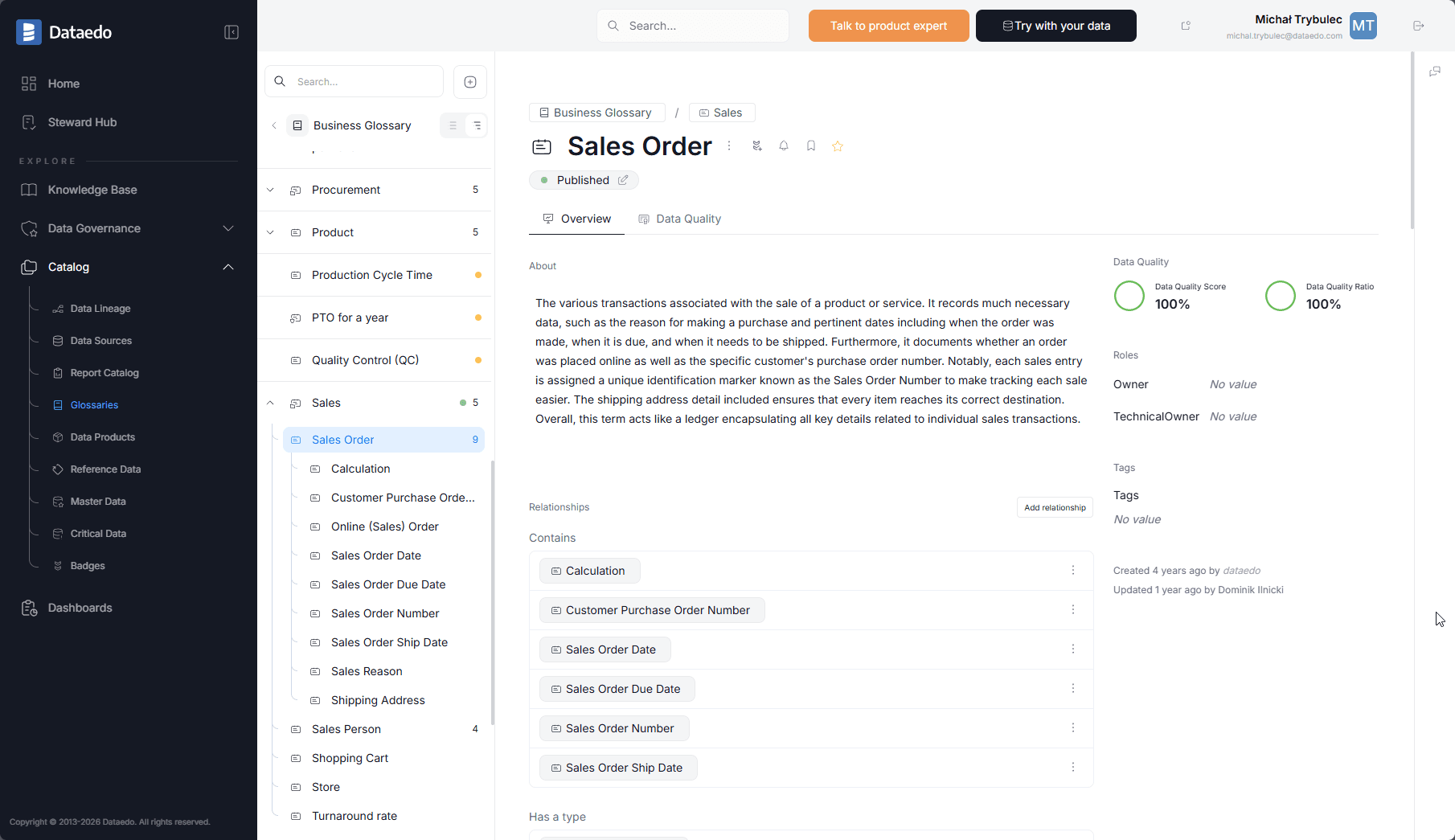 Glossary links help teams connect business terms to the technical objects that implement them.
The fourth effect is better audit and investigation flow. Instead of reconstructing a path from scratch, teams can follow the documented dependency chain and connect it to owners, governed terms, and the downstream outputs that may be affected. The fifth is collaboration. Governance becomes easier when engineering, analytics, and stewardship are working from the same view rather than translating the problem back and forth across separate tools and spreadsheets.
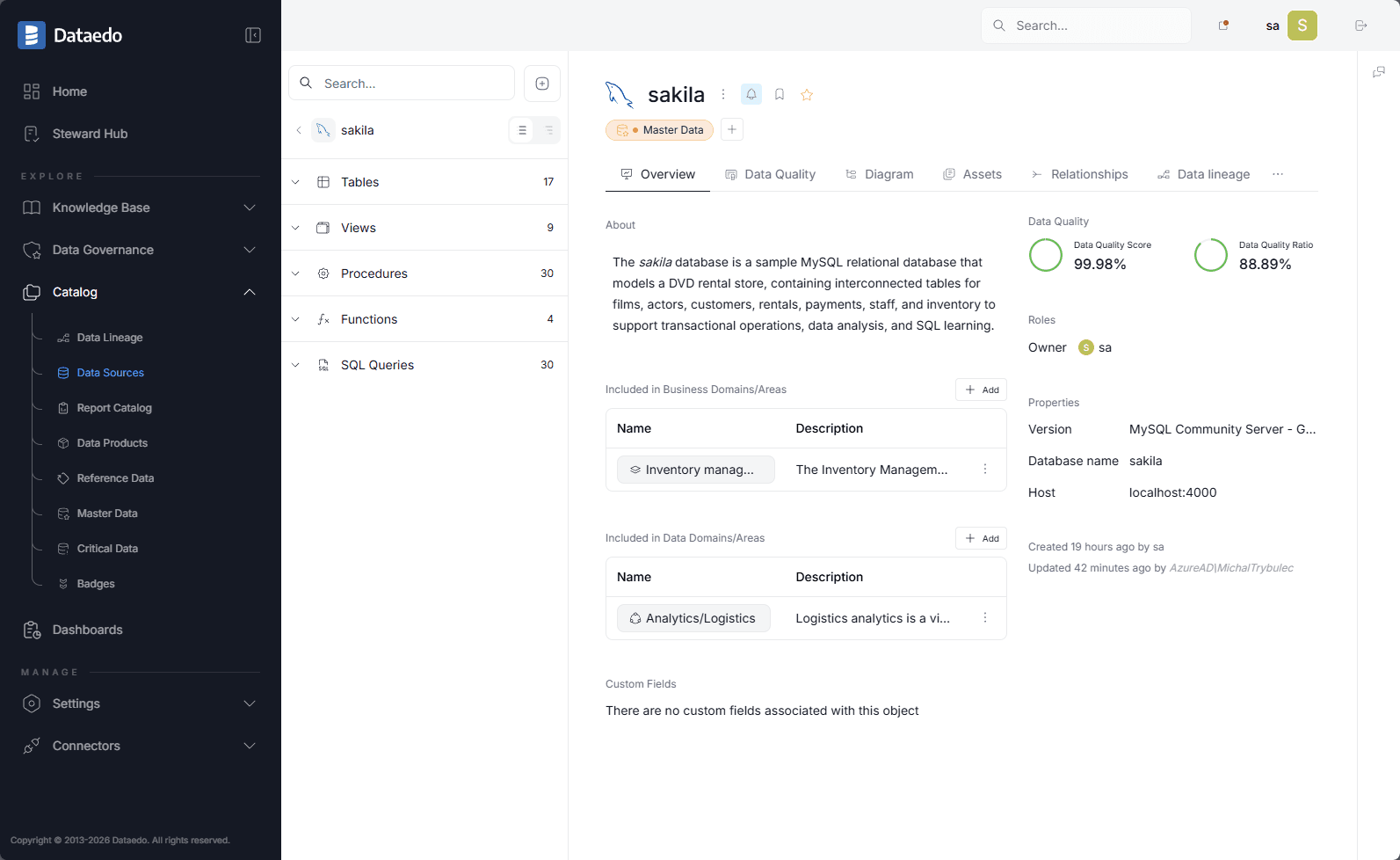 A governance overview is most useful when lineage, ownership, and discovery are visible in the same working context.
A Governance Workflow, Not Just A Diagram
The best way to see the governance value of lineage is to look at a simple review workflow.
Someone proposes a change. The team identifies the object and checks what depends on it. They review the owner or steward who should sign off. They verify whether the object is tied to a governed KPI or business term. If the asset is shared or sensitive, they widen the review and communicate with downstream consumers before release.
That is governance in action. The policy still matters, but lineage is what lets people apply it without guessing.
Where Quality Fits In
Lineage and data quality solve different problems, but they support the same governance decisions. Lineage tells you where data came from and where it goes. Data quality tells you whether the data looks reliable enough to trust. When they are connected, teams can answer a much more useful question than either one could answer alone: not only whether something is wrong, but who might be affected by it and how broadly it may spread.
| Topic | Data Quality | Data Lineage |
|---|---|---|
| Main purpose | Detect issues in the data | Trace dependencies and flow |
| Main question | Is the data reliable? | What does this data affect? |
| Best use | Monitoring, validation, exception handling | Change impact, troubleshooting, governance |
| Governance value | Signals when something looks wrong | Shows where the problem or change travels |
| User outcome | Trust the data more confidently | Govern the data with more context |
If quality tells you something is wrong, lineage helps you see where the problem may spread. If lineage tells you a change touches a critical KPI path, quality helps you decide how carefully that release should be validated.
What This Looks Like In Daily Work
Consider a warehouse column rename. Without lineage, the team may review only the table definition and the local code change. With lineage, they can see which reports, models, and business terms depend on that field before approving the change. That is not abstract governance. It is fewer surprises and better review discipline.
Or consider a governed KPI that changes after a model update. The glossary explains the meaning, the lineage shows the technical path, and the owner or steward can confirm whether the change was intended. None of those artifacts is enough by itself. Together, they create a governance trail that people can actually use.
The same pattern appears during data quality issues. Quality tells the team there is a problem, but lineage shows which downstream assets may now be at risk. That shortens the time between detection, escalation, and action.
How Dataedo Helps
Dataedo helps by keeping the metadata layers that governance depends on in one place. Teams can review the asset, the definition, the owner, the lineage, and the surrounding trust context without stitching that picture together manually across separate tools. That is especially useful when governance needs to move from a policy layer into day-to-day execution.
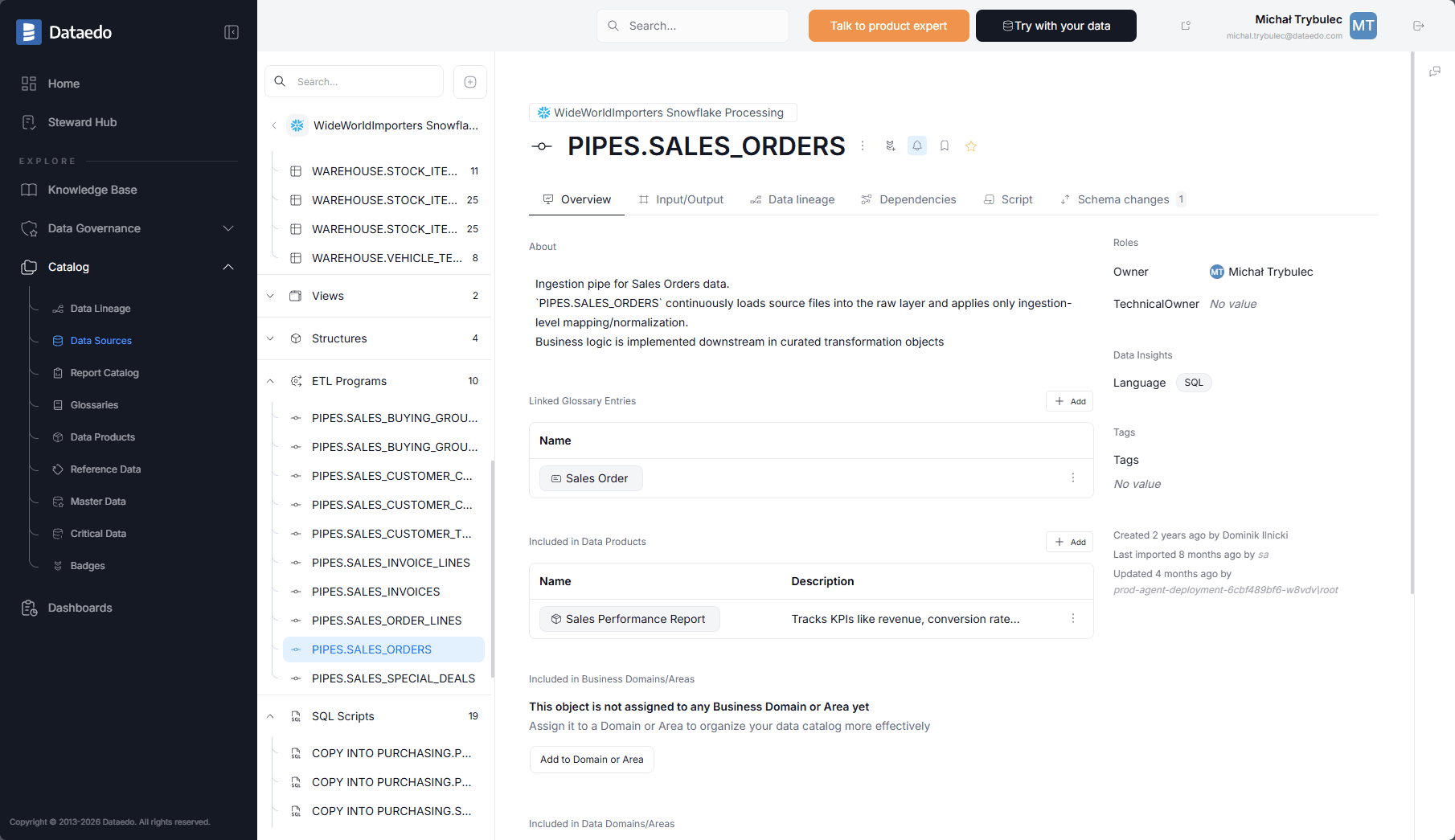 Transformation logic documentation makes governance more operational because teams can review how the governed asset is actually produced.
That is the real governance value of lineage. It does not simply document the flow. It gives teams the context they need to govern the flow while work is happening.
Lineage matters most when the data is shared, business-critical, or changed often. The more downstream consumers an asset has, the more governance value that visibility provides, because the cost of not seeing the dependency path rises quickly.
FAQ
Is data lineage the same as data governance?
No. Governance is the broader operating model. Lineage is one of the key metadata layers that makes governance practical.
Do you need a glossary if you already have lineage?
Yes. Lineage shows flow. A glossary gives business meaning. Most governance programs need both.
Can lineage help with audits?
Yes. It helps teams trace dependencies, explain changes, and reconstruct how data moved through the stack.
Does lineage replace ownership?
No. Lineage becomes more useful when ownership and stewardship are documented alongside it.
Final Takeaway
Data lineage improves data governance by making dependencies visible.
It helps teams review changes, connect business meaning to technical assets, trace problems faster, and make ownership more actionable.
When lineage is combined with a catalog, glossary, ownership, and data quality context, governance becomes something teams can actually use.
See how Dataedo helps teams connect lineage, catalog, glossary, ownership, and quality so governance decisions have more context. Book a demo or try for free now.


